How Is a Tirzepatide Maintenance Dose Chosen?
The right ongoing dose depends on why you take tirzepatide, how well it’s working, and what you can comfortably tolerate.
A tirzepatide maintenance dose isn’t chosen by reaching the highest number on the pen. For Zepbound, the labeled ongoing options depend on whether treatment is for weight management or obstructive sleep apnea; response and tolerability guide the choice. Mounjaro’s dosing is guided by the need for additional blood-glucose control. Your prescriber can reassess the plan as your results, side effects, or pregnancy plans change.23
Start with the product and treatment goal
If you’re nearing the end of dose escalation, it’s reasonable to ask whether the next dose is one you’ll stay on. The first distinction is which tirzepatide product you take and what it’s treating.
For Zepbound, the recommended once-weekly maintenance doses for weight reduction and long-term weight maintenance are 5 mg, 10 mg, or 15 mg. For obstructive sleep apnea (OSA), the recommended maintenance doses are 10 mg or 15 mg. The maximum recommended Zepbound dose is 15 mg once weekly for either indication. Its 2.5 mg starting dose is for treatment initiation, not maintenance.2
Mounjaro has different dosing language. Its prescribing information directs increases when additional blood-glucose control is needed and allows time on the current dose before another increase. The maximum adult dose is 15 mg once weekly. Don’t assume that Zepbound’s maintenance-dose list is a separate dosing rule for Mounjaro just because both contain tirzepatide.23
Balance the result against the cost of getting it
For Zepbound, the prescribing information explicitly says to consider treatment response and tolerability when selecting a maintenance dose. If someone doesn’t tolerate a maintenance dose, it says to consider a lower maintenance dose. That makes the decision more useful than a simple question of whether a higher dose might produce more weight loss: the ongoing dose also has to be workable.2
For example, you might be pleased with your progress but find that nausea after a dose increase makes ordinary meals difficult. That’s a different conversation from one in which side effects are manageable but your treatment goal isn’t being met. Gastrointestinal symptoms are a recognized issue during dose escalation, which is why both products use gradual increases.23 If vomiting leaves you with signs of dehydration, such as very little urine or dark urine, contact your care team promptly rather than waiting for a routine dose review.1
Research can show what happened on average, but it can’t pick your dose for you. In a randomized weight-loss trial of adults with overweight or obesity without type 2 diabetes, average weight reduction at 72 weeks was greater in the higher-dose tirzepatide groups than in the 5 mg group. Those group averages don’t tell you whether an increase is worth its side effects in your situation.45 A large retrospective study of adults using a UK digital prescribing service also found meaningful weight-loss outcomes among people who hadn’t escalated beyond intermediate doses. Because it observed real-world treatment rather than assigning doses at random, it doesn’t establish the best maintenance dose for an individual.5
Reassess without treating every plateau as failure
A slower change on the scale is a reason to look at the broader picture, not an automatic instruction to increase. A dose review can consider your progress toward the original goal, whether you’re able to continue treatment, and whether side effects or interruptions have changed the balance. Real-world research identifies tolerability and treatment interruptions among the factors that can affect results outside clinical trials.24
One useful way to frame the conversation is: What benefit am I getting at this dose, and what would we hope to gain by changing it? If the answer is unclear, staying with an effective, tolerable maintenance option may be a different choice from escalating simply because another dose exists. If the current dose isn’t meeting the treatment goal, your prescriber can weigh that against how you’ve responded to increases so far.23
Bring pregnancy plans into the decision early
There isn’t a separate labeled maintenance-dose list for women. Pregnancy plans and contraception can, however, change the treatment plan, rather than point to a different women’s dose.23
Zepbound’s prescribing information says weight loss is not recommended during pregnancy and directs patients to discontinue it when pregnancy is recognized. Human pregnancy data for tirzepatide are insufficient to determine its risks, so if you’re planning a pregnancy, discuss how treatment fits that plan before another dose change. For Mounjaro, the decision also has to account for diabetes control: its prescribing information notes risks from poorly controlled diabetes in pregnancy and says use during pregnancy should be considered only when the potential benefit justifies the potential fetal risk.23
If you use an oral hormonal contraceptive, mention it when starting tirzepatide or considering an increase. Both products can delay stomach emptying and may reduce the contraceptive’s effectiveness. Their prescribing information advises switching to a non-oral method or adding a barrier method for four weeks after starting treatment and four weeks after each dose increase. Hormonal contraceptives that aren’t taken by mouth should not be affected in the same way.23
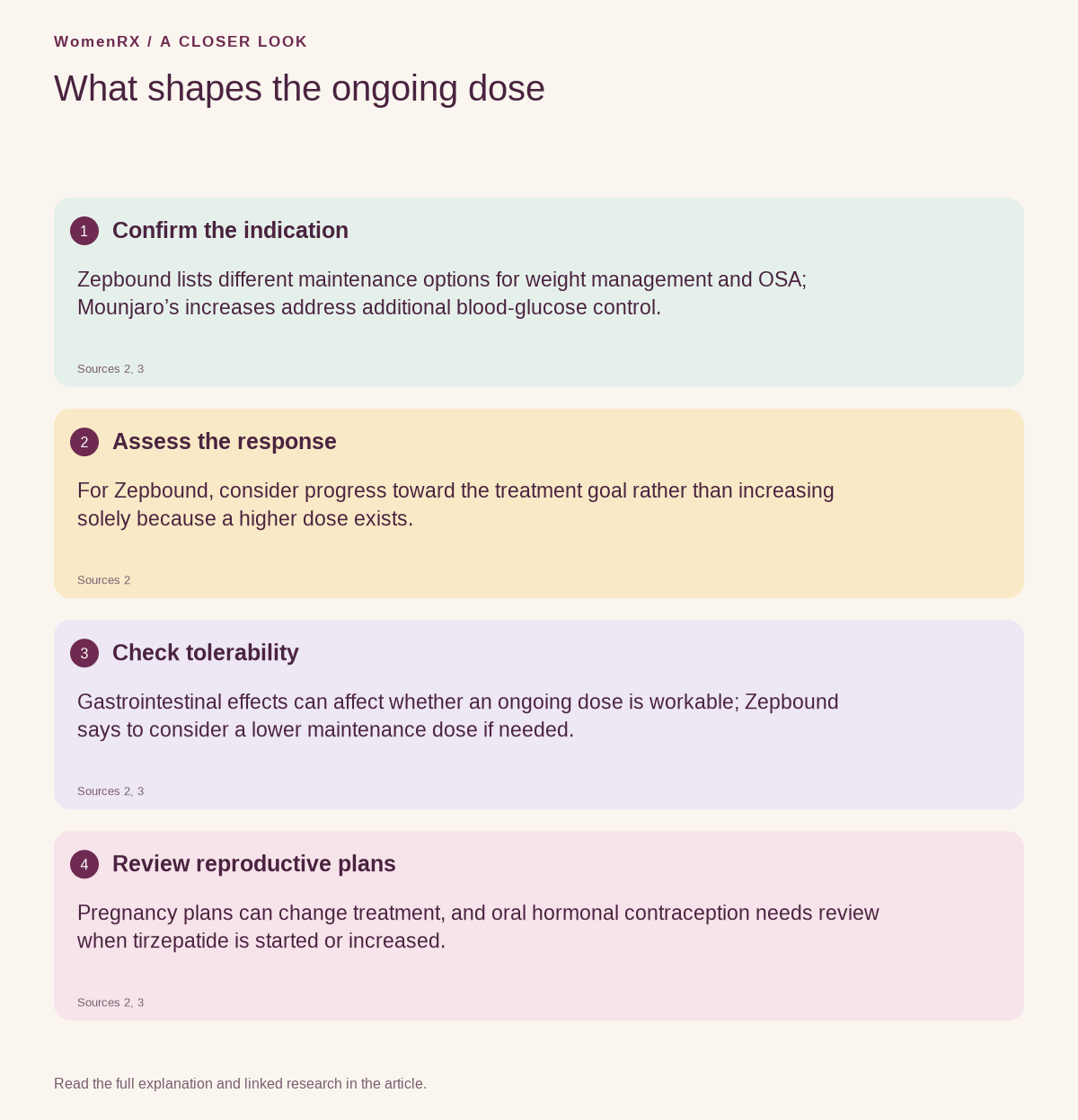
What shapes the ongoing dose
Confirm the indication: Zepbound lists different maintenance options for weight management and OSA; Mounjaro’s increases address additional blood-glucose control.23
Assess the response: For Zepbound, consider progress toward the treatment goal rather than increasing solely because a higher dose exists.2
Check tolerability: Gastrointestinal effects can affect whether an ongoing dose is workable; Zepbound says to consider a lower maintenance dose if needed.23
Review reproductive plans: Pregnancy plans can change treatment, and oral hormonal contraception needs review when tirzepatide is started or increased.23
Read the figure as text
A dose review moves from the treatment goal to how the current dose is working, then checks whether anything changes the plan.- Confirm the indication: Zepbound lists different maintenance options for weight management and OSA; Mounjaro’s increases address additional blood-glucose control.23
- Assess the response: For Zepbound, consider progress toward the treatment goal rather than increasing solely because a higher dose exists.2
- Check tolerability: Gastrointestinal effects can affect whether an ongoing dose is workable; Zepbound says to consider a lower maintenance dose if needed.23
- Review reproductive plans: Pregnancy plans can change treatment, and oral hormonal contraception needs review when tirzepatide is started or increased.23
More questions, answered
Are 7.5 mg and 12.5 mg Zepbound maintenance doses?
They can be steps during dose escalation, but Zepbound lists 5 mg, 10 mg, and 15 mg as its recommended once-weekly maintenance doses for weight reduction and long-term maintenance. For OSA, it lists 10 mg and 15 mg.2
Do I need the highest dose to maintain weight loss?
Not necessarily. Zepbound directs prescribers to consider both response and tolerability when choosing a maintenance dose, and to consider a lower maintenance dose if one isn’t tolerated. The highest labeled dose isn’t automatically the most suitable ongoing choice for you.2
Sources you can check
- Nausea | Vomiting | MedlinePlusAccessed 2026-09-25Return to first citation
- ZEPBOUND (TIRZEPATIDE) INJECTION, SOLUTION ZEPBOUND (TIRZEPATIDE) INJECTION, SOLUTION ZEPBOUND KWIKPEN (TIRZEPATIDE) INJECTION, SOLUTION [ELI LILLY AND COMPANY] | US prescribing information and patient instructionsAccessed 2026-09-25Return to first citation
- MOUNJARO (TIRZEPATIDE) INJECTION, SOLUTION MOUNJARO KWIKPEN (TIRZEPATIDE) INJECTION, SOLUTION [ELI LILLY AND COMPANY] | US prescribing information and patient instructionsAccessed 2026-09-25Return to first citation
- Real-World Evidence for Existing Anti-Obesity Therapies-The Realities of Treatment Adherence, Tolerability, Access and Patient Satisfaction.Kassem S. · Diabetes, obesity & metabolism · 2026Return to first citation
- Real-World Effectiveness and Treatment Patterns of Tirzepatide in a Large UK Digital Health Cohort.Rosenior-Patten O, Lees Z, Rowe R, Hussain S, Ahmad E, Brooke E, Dix S, Maybury C. · Diabetes, obesity & metabolism · 2026Return to first citation