How Prescribers Choose a Semaglutide Maintenance Dose
For Wegovy, the labeled options are the starting point; your response, side effects, and plans for continued treatment shape the decision.
For adult weight reduction, Wegovy injection has two labeled weekly maintenance doses: 1.7 mg and the recommended 2.4 mg. Wegovy tablets have a recommended maintenance dose of 25 mg daily. Those are product-specific starting points for a prescriber’s decision, not a dose to choose yourself. Treatment response, tolerability, and plans such as pregnancy can change what happens next. 1
Start with the product you’re taking
“Maintenance” can sound like a single destination: reach a certain number, then stay there. For Wegovy, the label gives a starting point, but the decision to continue a dose also depends on how treatment is going for you.
For adults using Wegovy injection for weight reduction, the labeled maintenance options are 1.7 mg or 2.4 mg once weekly, with 2.4 mg recommended. The prescribing information says to consider both treatment response and tolerability when selecting between them. It also describes a conditional increase to a maximum of 7.2 mg weekly for someone who has tolerated 2.4 mg for at least four weeks and for whom additional weight reduction is clinically indicated. That isn’t a universal maintenance target. 1
For adults using Wegovy tablets for weight reduction, the recommended maintenance dose is 25 mg once daily. If that dose isn’t tolerated, the label says a prescriber may consider switching to Wegovy injection at 1.7 mg once weekly. The tablet and injection numbers aren’t interchangeable. Ozempic tablets have different maintenance instructions tied to blood-sugar control, so an Ozempic tablet dose isn’t a Wegovy weight-reduction dose. 1 2
A labeled maintenance dose is an option in the dosing instructions for a particular product and use. It tells a prescriber which options apply, not which one will work best for you. 1 2
What goes into the decision
Your response over time. Rather than focusing on a single weigh-in, you can consider how your overall pattern of weight change relates to the goals behind treatment. A plateau alone doesn’t establish that a dose should go up or down. In a 60-week randomized trial of 120 adults with overweight or obesity, semaglutide reduced measured energy intake compared with placebo at weeks 20, 40, and 60, even though some subjective appetite differences seen earlier weren’t present later. The finding helps explain why treatment effects can’t be judged by appetite alone, but it doesn’t tell an individual what dose to take. 4
Side effects and day-to-day tolerability. The question isn’t simply whether you can reach a target dose. It’s whether the regimen’s benefits remain worthwhile alongside its side effects. A systematic review of four randomized trials in adults with overweight or obesity without type 2 diabetes found gastrointestinal side effects, including nausea, vomiting, diarrhea, and constipation, were more frequent with semaglutide than placebo; stopping treatment because of side effects was also more frequent. 3
Wegovy’s injection instructions allow a prescriber to consider delaying an increase if a dose isn’t tolerated during escalation. For maintenance treatment in adults using the injection for weight reduction, the label specifically calls for weighing response and tolerability when selecting a dose. Both are reasons to review the plan with your prescriber rather than change the dose on your own. 1
The plan beyond the next refill. Weight management often involves decisions over time, not just reaching a number and ending treatment. In an extension of a semaglutide trial, adults with overweight or obesity who stopped weekly semaglutide 2.4 mg after 68 weeks regained some of the weight they had lost during the following year. Structured lifestyle support also ended when treatment stopped, so the extension can’t predict what would happen if you stopped medication under a different plan. It does make a conversation about continuation or stopping more useful than assuming the weight change will automatically last. 5
Pregnancy planning changes that conversation. Wegovy’s prescribing information says to discontinue Wegovy at least two months before a planned pregnancy because semaglutide remains in the body for a long time. This is a reason to revisit the treatment plan with your prescriber, not a reason to choose a particular maintenance dose. 1
Breastfeeding also calls for a product-specific review: Wegovy’s medication guide says breastfeeding isn’t recommended during tablet treatment. For the injection, it says it isn’t known whether semaglutide passes into breast milk and advises discussing how to feed your baby while using Wegovy. Those are different considerations, not a single rule for every semaglutide product. 1
Make the next conversation specific
Instead of asking only, “What’s my maintenance dose?”, try questions that connect the decision to your situation:
- Which Wegovy formulation am I taking, and which labeled maintenance options apply to it?
- What signs of benefit are we looking at besides the scale?
- How are my side effects affecting the balance of benefits and drawbacks?
- If I’m planning a pregnancy or breastfeeding, how does that change the treatment plan?
- If we continue, adjust, or stop, what should I expect and when should we review the plan again?
A useful plan should make clear what the dose is meant to accomplish, how tolerability factors in, and what would prompt another review. The number alone can’t answer those questions.
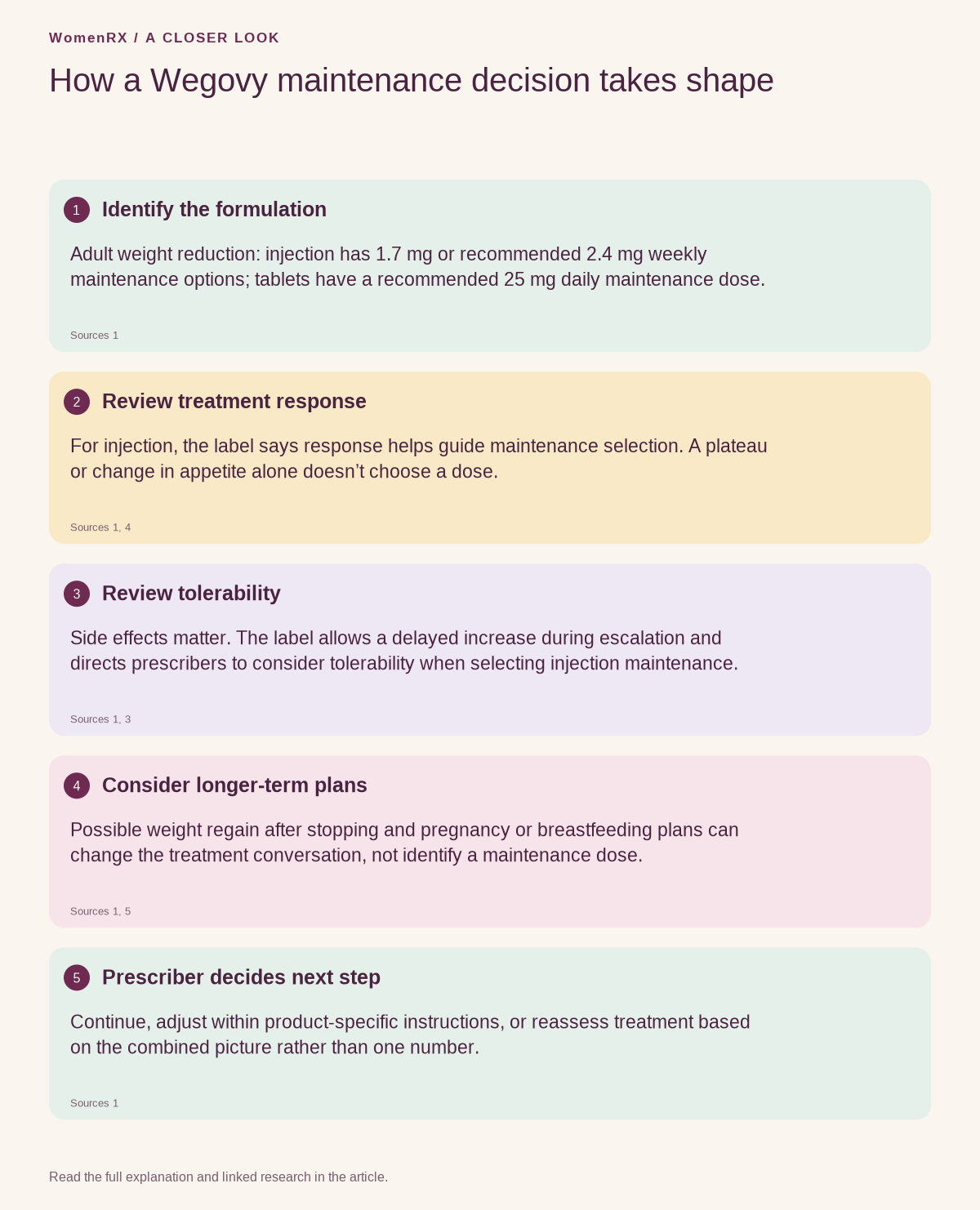
How a Wegovy maintenance decision takes shape
Identify the formulation: Adult weight reduction: injection has 1.7 mg or recommended 2.4 mg weekly maintenance options; tablets have a recommended 25 mg daily maintenance dose.1
Review treatment response: For injection, the label says response helps guide maintenance selection. A plateau or change in appetite alone doesn’t choose a dose.14
Review tolerability: Side effects matter. The label allows a delayed increase during escalation and directs prescribers to consider tolerability when selecting injection maintenance.13
Consider longer-term plans: Possible weight regain after stopping and pregnancy or breastfeeding plans can change the treatment conversation, not identify a maintenance dose.15
Prescriber decides next step: Continue, adjust within product-specific instructions, or reassess treatment based on the combined picture rather than one number.1
Read the figure as text
The exact formulation sets the labeled dosing baseline. A prescriber then weighs response, tolerability, and reasons to revisit treatment; this is not a dose-selection tool.- Identify the formulation: Adult weight reduction: injection has 1.7 mg or recommended 2.4 mg weekly maintenance options; tablets have a recommended 25 mg daily maintenance dose.1
- Review treatment response: For injection, the label says response helps guide maintenance selection. A plateau or change in appetite alone doesn’t choose a dose.14
- Review tolerability: Side effects matter. The label allows a delayed increase during escalation and directs prescribers to consider tolerability when selecting injection maintenance.13
- Consider longer-term plans: Possible weight regain after stopping and pregnancy or breastfeeding plans can change the treatment conversation, not identify a maintenance dose.15
- Prescriber decides next step: Continue, adjust within product-specific instructions, or reassess treatment based on the combined picture rather than one number.1
More questions, answered
Does a weight-loss plateau mean my dose should change?
Not by itself. One study found semaglutide continued to reduce measured energy intake over 60 weeks, while some early differences in how participants described appetite had faded. That study doesn’t determine an individual dose, so a plateau is better discussed alongside your overall response and side effects. 4
Will I regain weight if I stop semaglutide?
Regain is possible, but the amount isn’t predictable for you. In a trial extension, participants regained some weight during the year after semaglutide and structured lifestyle support ended. Discuss what support comes next before making a change. 5
Sources you can check
- WEGOVY (SEMAGLUTIDE) INJECTION, SOLUTION WEGOVY (SEMAGLUTIDE) TABLET [NOVO NORDISK PHARMACEUTICAL INDUSTRIES, LP] | US prescribing information and patient instructionsAccessed 2026-09-25Return to first citation
- OZEMPIC (ORAL SEMAGLUTIDE) TABLET RYBELSUS (ORAL SEMAGLUTIDE) TABLET [NOVO NORDISK PHARMACEUTICAL INDUSTRIES, LP] | US prescribing information and patient instructionsAccessed 2026-09-25Return to first citation
- Effectiveness & safety of semaglutide in weight reduction in obese nondiabetic patients: A systematic review and meta-analysis.Naz F, Qaiser F, Mumtaz A, Din SU, Mustafa A, Ullah A, Perveen A, Malik J. · Medicine · 2026Return to first citation
- Short- and long-term effects of semaglutide 2.4 mg on energy intake, appetite, and food reward: a 60-week, double-blind randomized controlled trial.Tronieri JS, Allison KC, DeRouen K, Amaro A, Collins KG, Roy A, Watts S, Ananna T, Wadden TA. · The American journal of clinical nutrition · 2026Return to first citation
- Weight regain and cardiometabolic effects after withdrawal of semaglutide: The STEP 1 trial extension.Wilding JPH, Batterham RL, Davies M, Van Gaal LF, Kandler K, Konakli K, Lingvay I, McGowan BM, Oral TK, Rosenstock J, Wadden TA, Wharton S, Yokote K, Kushner RF, STEP 1 Study Group... · Diabetes, obesity & metabolism · 2022Return to first citation