Who Needs Vitamin B12, and How Is a Dose Chosen?
Your B12 dose depends on whether you’re covering everyday intake, planning around a plant-based diet or pregnancy, or treating a confirmed deficiency.
There isn’t one B12 dose for everyone. For US adults, the recommended daily intake is 2.4 mcg, rising to 2.6 mcg during pregnancy and 2.8 mcg while breastfeeding. A supplement’s dose is not the same as the amount your body absorbs. For diagnosed deficiency, clinicians may use much higher doses, such as 1,000-2,000 mcg orally in studies, depending on the cause and treatment plan. 1
Start with the reason you’re considering B12
Vitamin B12 helps your body make red blood cells and maintain a healthy nervous system. The right amount depends on what you need it for: meeting routine dietary needs, filling a gap in a plant-based diet, or treating a deficiency caused by low intake or poor absorption. Those are different situations, so a product’s large number on the label doesn’t automatically make it the right choice. 1 2
Daily intake is a target, not a pill dose
In the United States, the recommended dietary allowance (RDA) is 2.4 micrograms (mcg) a day for adults, 2.6 mcg during pregnancy, and 2.8 mcg while breastfeeding. These figures describe daily intake from food and supplements combined. They aren’t instructions to buy a supplement with exactly that amount. 1
B12 is naturally found in animal foods such as fish, meat, eggs, and dairy. Some breakfast cereals and nutritional yeasts are fortified, but plant foods don’t naturally provide B12. If you eat vegan, or rarely eat animal foods, check whether fortified foods are a dependable part of your usual diet. If not, a supplement is one way to cover the gap. 1
Supplement labels can be confusing: a multivitamin commonly contains 5-25 mcg, while a B12-only product commonly contains 500-1,000 mcg. Those are typical product ranges, not recommended doses for every person. Absorption changes with the amount: the body absorbs a smaller proportion from large doses, so the label amount isn’t the amount absorbed. A clinician or dietitian can help you choose an approach that fits your diet and circumstances. 1
A 2024 scoping review reported that 50-100 mcg daily is advised for vegetarians, but also found a lack of randomized trials comparing B12 forms or doses and no consensus across dietary guides. Treat that range as a review-level suggestion, not a universal US recommendation. 3
Pregnancy and breastfeeding call for a closer look at diet
The US intake targets rise modestly during pregnancy and breastfeeding. That doesn’t mean every pregnant or breastfeeding woman needs a separate B12 pill: the useful question is whether her food and any existing supplements reliably cover B12. This is especially worth reviewing if she eats vegan or has difficulty absorbing the vitamin. B12 deficiency during pregnancy or breastfeeding can affect the baby as well as the mother. 1
If you’re already taking a prenatal or multivitamin, check its B12 amount and consider it alongside fortified foods and your usual diet. Avoid stacking products just because each one lists B12; the amount and reason for taking it matter.
Deficiency treatment is a different decision
A diagnosed deficiency may need more than ordinary dietary coverage. Causes include not getting enough B12, trouble absorbing it from food, some gastrointestinal surgeries or conditions, and pernicious anemia, in which the body lacks a factor needed to absorb B12. Long-term metformin use is also associated with B12 deficiency. 1 4
For context, three small randomized trials included in a Cochrane review compared oral doses of 1,000-2,000 mcg with injections in 153 people with deficiency. The low-quality evidence suggested that high-dose oral B12 could normalize blood B12 levels about as well as injections. This is a treatment example, not a self-treatment plan: the trials were small, and a blood-level result doesn’t establish that one approach is right for every cause or person. 1
Injections may be used when a person has pernicious anemia or another condition causing serious absorption problems. The choice of form and dose depends on the cause, test findings, symptoms, and response to treatment. Don’t use a routine dietary target to treat a diagnosed deficiency, or assume a high-dose product is a substitute for investigating why B12 is low. 1
What to bring into the dose discussion
A useful starting point is to tell your clinician what you eat, which supplements you already take, and whether you have a condition or take a medicine that could affect absorption. Metformin and proton pump inhibitors are among the medicines associated with deficiency in the NIH reference; long-term metformin use is a recognized risk factor. 1 4
Fatigue can have many causes, and B12 supplements improve it only when low B12 is the reason. Numbness or tingling can occur with B12 deficiency even without anemia, so don’t rely on a normal blood count alone to rule it out. If symptoms or risk factors raise concern, testing and the reason behind a low result can help distinguish dietary prevention from treatment. 1 2
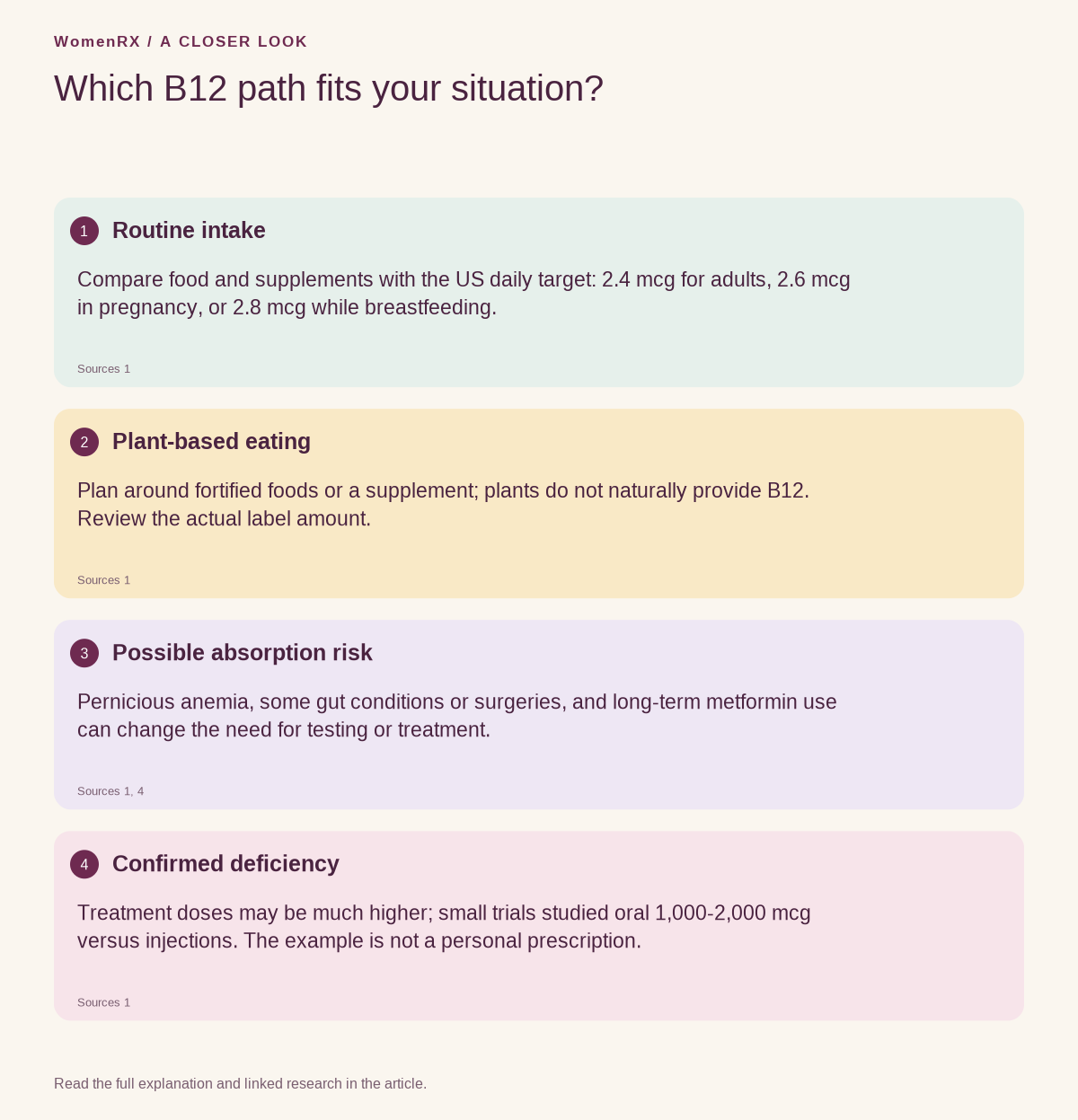
Which B12 path fits your situation?
Routine intake: Compare food and supplements with the US daily target: 2.4 mcg for adults, 2.6 mcg in pregnancy, or 2.8 mcg while breastfeeding.1
Plant-based eating: Plan around fortified foods or a supplement; plants do not naturally provide B12. Review the actual label amount.1
Possible absorption risk: Pernicious anemia, some gut conditions or surgeries, and long-term metformin use can change the need for testing or treatment.14
Confirmed deficiency: Treatment doses may be much higher; small trials studied oral 1,000-2,000 mcg versus injections. The example is not a personal prescription.1
Read the figure as text
Separate routine intake planning from risk-based testing and treatment for a diagnosed deficiency.- Routine intake: Compare food and supplements with the US daily target: 2.4 mcg for adults, 2.6 mcg in pregnancy, or 2.8 mcg while breastfeeding.1
- Plant-based eating: Plan around fortified foods or a supplement; plants do not naturally provide B12. Review the actual label amount.1
- Possible absorption risk: Pernicious anemia, some gut conditions or surgeries, and long-term metformin use can change the need for testing or treatment.14
- Confirmed deficiency: Treatment doses may be much higher; small trials studied oral 1,000-2,000 mcg versus injections. The example is not a personal prescription.1
More questions, answered
Is methylcobalamin better than cyanocobalamin?
The NIH fact sheet reports no evidence that B12 supplement forms differ in absorption. The reason for taking B12 and the amount needed matter more than choosing a form based on claims that one is generally superior. 1
Will B12 help if I’m tired?
Only if low B12 is causing the tiredness. Fatigue has many possible causes, so taking more B12 won’t necessarily help when your B12 status is already adequate. 2
Sources you can check
- Vitamin B12 - Health Professional Fact SheetAccessed 2026-09-25Return to first citation
- Common questions about cyanocobalamin - NHSAccessed 2026-09-25Return to first citation
- Exploring Vitamin B12 Supplementation in the Vegan Population: A Scoping Review of the Evidence.Fernandes S, Oliveira L, Pereira A, Costa MDC, Raposo A, Saraiva A, Magalhães B. · Nutrients · 2024Return to first citation
- Vitamin B12 deficiency in long-term metformin use and clinician awareness: a scoping review.Parsonage I, Wainwright D, Barratt J. · BMJ open · 2026Return to first citation