What Vitamin B12 Helps With, and What It Doesn’t
B12 can relieve problems caused by deficiency, but more B12 isn’t a proven energy or memory boost when you already have enough.
Vitamin B12 helps your body make red blood cells and keep your nervous system healthy. Replacing it can ease fatigue and other symptoms when a deficiency is the cause. If you already have enough B12, taking more isn’t a proven energy boost. Research also doesn’t support assuming that B12 supplements will improve thinking or memory, particularly in older adults with only mildly low levels. 2 3 5
First, ask what B12 would be correcting
B12 helps your body make red blood cells that carry oxygen and supports a healthy nervous system. A deficiency can cause fatigue, shortness of breath, and neurological changes. Replacing B12 can help when low B12 is responsible for those symptoms. 1 2 3
That’s different from taking extra B12 in hopes of feeling sharper or more energetic. For example, tiredness might prompt you to consider a supplement, but tiredness alone can’t tell you whether B12 is the problem. The distinction between correcting a deficiency and adding more when you already have enough is what makes the benefit claim meaningful. 1 3
Energy depends on the cause of your fatigue
B12 supplements can improve tiredness caused by low B12. They aren’t a dependable pick-me-up when low B12 isn’t the cause. 3
Your reason for being low matters, too. You may get too little B12 from your diet, or you may have trouble absorbing it despite eating enough. Pernicious anemia, gastrointestinal surgery, and prolonged use of medicines such as metformin or proton pump inhibitors are among the possible reasons for deficiency. Eating few or no animal products is another reason to pay attention to B12 intake. 1 2
If a B12 blood result is unclear, a methylmalonic acid test can sometimes help confirm deficiency. It needs interpretation in context because kidney problems can raise methylmalonic acid independently of B12 status. 1
Nerve symptoms and memory are not the same claim
B12 deficiency can affect the nervous system, so identifying and treating an overt deficiency has a clear purpose. A 2025 review of randomized trials reported improvement in neurological symptoms among people with overt deficiency. But among older adults with subclinical, or mildly low, B12, it found no significant improvement in cognitive or neurological outcomes. The trials differed in who they enrolled and what they measured, which limits how broadly to apply either finding. 1 5
A better-looking blood marker also isn’t necessarily a better memory. In that review, reductions in homocysteine did not consistently correspond to clinical improvement. The research supports treating a real deficiency, not using B12 as a general brain booster. 5
Pregnancy, breastfeeding, and fertility raise separate questions
During pregnancy or breastfeeding, the useful goal is to meet your nutritional needs, particularly if your diet or a problem with absorption puts you at risk of low B12. That’s not the same as evidence that extra B12 improves outcomes for everyone in these stages. 1 4
For breastfeeding women, a Cochrane review examined supplements containing multiple micronutrients. Its two small included studies did not provide quantitative data to assess maternal and infant health outcomes. The review therefore can’t tell us whether B12 alone improves those outcomes. 4
Fertility claims need similar care. A single-center retrospective study found that, within a lower range of B12 blood levels, higher levels were associated with a higher clinical pregnancy rate among women using a particular IVF protocol. Because the researchers observed blood levels rather than assigning women to take B12, the study cannot show that a supplement improved pregnancy chances. It also does not establish a B12 target for people trying to conceive generally. 6
Match the next step to your situation
If you have fatigue alongside symptoms such as tingling or balance changes, or you have a reason you might not get or absorb enough B12, it’s worth discussing whether testing is appropriate. If deficiency is confirmed, finding its cause helps determine how to correct it: a dietary shortfall and an absorption problem aren’t necessarily handled the same way. 1
If your B12 status is adequate and you’re considering a supplement mainly for energy or memory, the case is much weaker. The question worth settling first is whether low B12 is actually contributing to what you’re feeling. 3 5
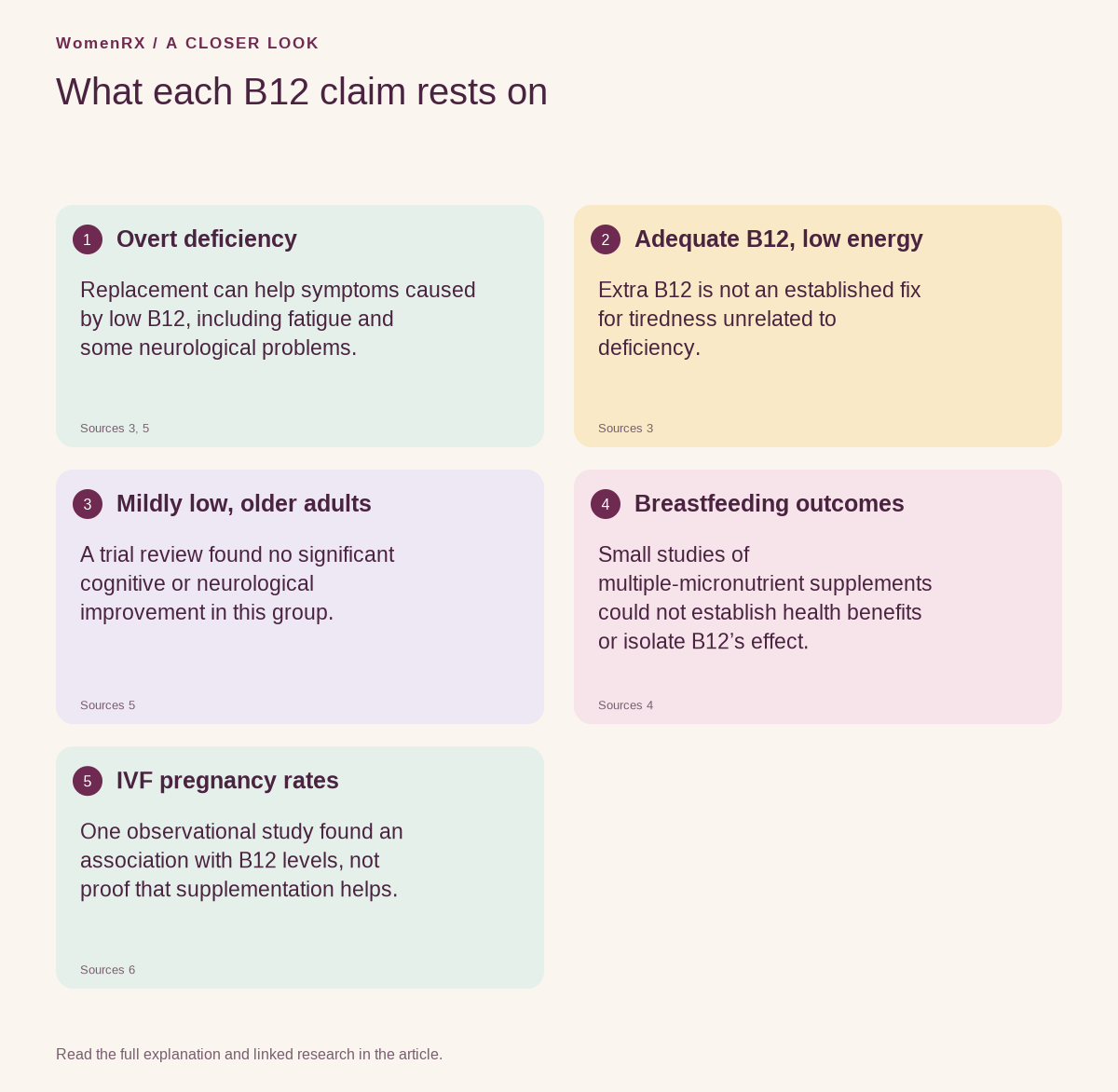
What each B12 claim rests on
Overt deficiency: Replacement can help symptoms caused by low B12, including fatigue and some neurological problems.35
Adequate B12, low energy: Extra B12 is not an established fix for tiredness unrelated to deficiency.3
Mildly low, older adults: A trial review found no significant cognitive or neurological improvement in this group.5
Breastfeeding outcomes: Small studies of multiple-micronutrient supplements could not establish health benefits or isolate B12’s effect.4
IVF pregnancy rates: One observational study found an association with B12 levels, not proof that supplementation helps.6
Read the figure as text
The answer changes with B12 status, the outcome you hope to improve, and the population studied.- Overt deficiency: Replacement can help symptoms caused by low B12, including fatigue and some neurological problems.35
- Adequate B12, low energy: Extra B12 is not an established fix for tiredness unrelated to deficiency.3
- Mildly low, older adults: A trial review found no significant cognitive or neurological improvement in this group.5
- Breastfeeding outcomes: Small studies of multiple-micronutrient supplements could not establish health benefits or isolate B12’s effect.4
- IVF pregnancy rates: One observational study found an association with B12 levels, not proof that supplementation helps.6
More questions, answered
Is a B12 shot better than a pill?
Not automatically. A review of trials reported similar neurological treatment outcomes with oral and injected B12 in people with overt deficiency, but the underlying studies varied. Injections are also used for certain causes of severe deficiency or malabsorption. The cause of low B12 matters more than assuming one form is best for everyone. 1 5
Sources you can check
- Vitamin B12 - Health Professional Fact SheetAccessed 2026-09-25Return to first citation
- About cyanocobalamin - NHSAccessed 2026-09-25Return to first citation
- Common questions about cyanocobalamin - NHSAccessed 2026-09-25Return to first citation
- Supplementation with multiple micronutrients for breastfeeding women for improving outcomes for the mother and baby.Abe SK, Balogun OO, Ota E, Takahashi K, Mori R. · The Cochrane database of systematic reviews · 2016Return to first citation
- The Neurological Sequelae of Vitamin B12 Deficiency: A Systematic Review and Randomized Controlled Trial.Hamza Ali AA, Mohamed FHA, Hago S, Elsadig Elgali IF, Sherfeldin Mohammed HE, Mirghani RG. · Cureus · 2025Return to first citation
- Does vitamin B12 influence clinical pregnancy outcome in the follicular-phase GnRH agonist protocol?Wang X, Fu K, Zhang Y, Jiang S, Zhang C. · BMC pregnancy and childbirth · 2025Return to first citation