Pelvic Organ Prolapse: What Assessment and Treatment Involve
A vaginal bulge deserves attention, but an exam finding alone doesn’t decide whether you need treatment.
An assessment usually starts with your symptoms and a pelvic examination. A clinician may describe how far the prolapse extends, but that stage doesn’t capture how much it affects your daily life. If it isn’t bothering you, observation may be reasonable; other options include pelvic floor muscle training, a pessary, or surgery, chosen around your symptoms and priorities. 1 2 4
Start with what you notice
Pelvic organ prolapse happens when the bladder, uterus, or bowel bulges into the vagina. Some people have no symptoms. Others notice a vaginal lump or bulge, or vaginal discomfort, particularly while standing. Bladder changes can include feeling that you haven’t emptied fully, going more often, or leaking a little urine with coughing, sneezing, or exercise. 1 2
Bowel or urinary symptoms don’t automatically tell you which organ has prolapsed. A prospective study found that some symptoms were associated with particular examination findings, while urgency, frequency, and constipation did not show the same anatomical association. In other words, a symptom can be real and worth discussing even when it doesn’t map neatly to the visible prolapse. 2
Age and menopause can be part of the context: prolapse is common in women over 50 and becomes more common with age, particularly after menopause. If pregnancy and birth history feels relevant to your concerns, include it in the conversation too. Those details are context, not a substitute for assessing what you’re experiencing now. 1
What an assessment can tell you
A clinician will ask what you’ve noticed and examine you. You can ask what the examination involves before it begins, and whether a chaperone can be present. The examination may be described using a stage from 1 to 4, with 4 indicating more advanced prolapse. 1
That stage describes anatomy, not how disruptive the symptoms feel. Research has found that symptom impact doesn’t always track with prolapse location or severity. It helps to describe what’s changed for you, such as a bulge or vaginal discomfort while standing, difficulty emptying your bladder, or a bulge that affects activities. These reports belong alongside the examination findings when you discuss next steps. 2 4
A useful way to begin is to say what you most want help with: the bulge, vaginal discomfort, bladder or bowel changes, or the effect on daily activities. Mention what you hope to keep doing and whether you may want children in the future. Health and personal goals can affect which options make sense. 1 3
Compare options by what matters to you
Observation may be an option when prolapse causes no symptoms or doesn’t bother you. Treatment isn’t automatically required just because an examination finds prolapse. 1
Pelvic floor muscle training is a nonsurgical option, often with a specialist women’s health physiotherapist. A 2026 meta-analysis of 16 trials found improvements in symptoms and some measures of pelvic floor function, especially in studies of treatment lasting up to six months. Longer-term benefit and results for people aged 55 and older were less certain. The findings support discussing training, not assuming it will help everyone equally. 1 5
A pessary is another nonsurgical option to ask about. Research discussions identify pessary management as part of prolapse care, while noting that the best way to integrate it into treatment pathways remains unclear. Ask what support it could offer for your symptoms and what follow-up would involve. 4
Surgery may be discussed when symptoms are bothersome or prolapse is more severe. The choice depends on more than the stage: symptoms, health, future plans, and the outcomes you value all matter. Surgery can improve symptoms, but recurrence is possible, and repeat treatment decisions take both symptoms and anatomy into account. 1 4 7
For some people with advanced prolapse who don’t want vaginal intercourse, a procedure that closes the vagina may be an option. That choice has a direct effect on vaginal intercourse, so it’s worth raising explicitly if surgery is being considered. 6
Questions that help clarify the trade-offs
You might ask: “How do my symptoms and examination findings fit together?” “What could happen if I wait and monitor this?” “Could pelvic floor training or a pessary address what bothers me?” If surgery comes up, ask what it is intended to improve, what it could mean for sexual function or future pregnancy, and what recurrence could mean for you. These questions keep the conversation focused on the difference you want treatment to make, not just the stage on an exam. 1 2 4
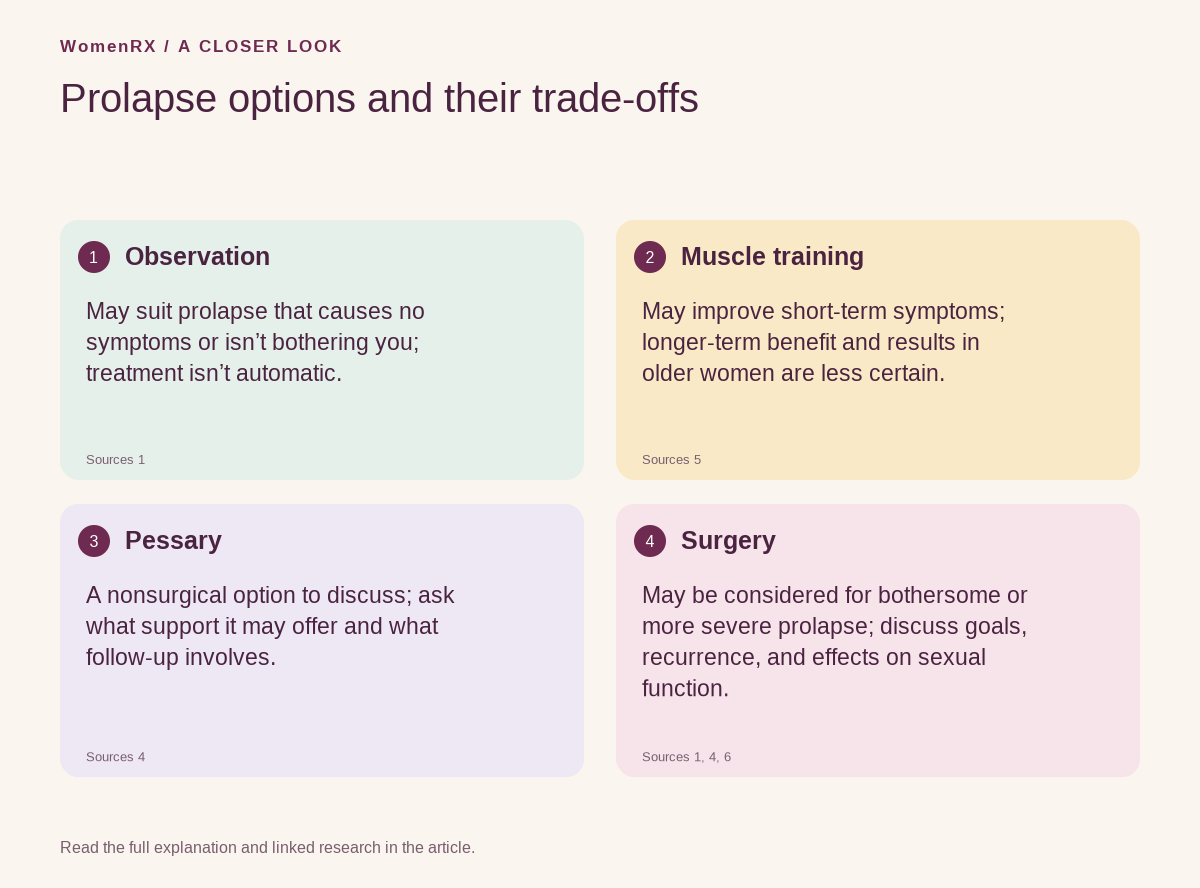
Prolapse options and their trade-offs
Observation: May suit prolapse that causes no symptoms or isn’t bothering you; treatment isn’t automatic.1
Muscle training: May improve short-term symptoms; longer-term benefit and results in older women are less certain.5
Pessary: A nonsurgical option to discuss; ask what support it may offer and what follow-up involves.4
Surgery: May be considered for bothersome or more severe prolapse; discuss goals, recurrence, and effects on sexual function.146
Read the figure as text
The examination helps describe anatomy; your symptoms and priorities help shape whether and how to treat it.- Observation: May suit prolapse that causes no symptoms or isn’t bothering you; treatment isn’t automatic.1
- Muscle training: May improve short-term symptoms; longer-term benefit and results in older women are less certain.5
- Pessary: A nonsurgical option to discuss; ask what support it may offer and what follow-up involves.4
- Surgery: May be considered for bothersome or more severe prolapse; discuss goals, recurrence, and effects on sexual function.146
Sources you can check
- Pelvic organ prolapse - NHSAccessed 2026-09-25Return to first citation
- The relationship between pelvic organ prolapse location, severity and symptoms of pelvic dysfunction.Mančinskienė D, Mikėnaitė M, Barakat M, Kačerauskienė J, Railaitė DR, Bartusevičius A, Maleckienė L, Bartusevičienė E. · International journal of gynaecology and obstetrics: the official organ of the International Federation of Gynaecology and Obstetrics · 2026Return to first citation
- Pelvic organ prolapse.Ackenbom MF. · Menopause (New York, N.Y.) · 2026Return to first citation
- How Can We Improve the Assessment and Indifferent Outcomes From Pelvic Organ Prolapse Management From Conservative and Surgical Therapies? ICI-RS 2025.Kearney R, Wagg A, Bower W, Chapple C, Khullar V, Robinson D, Taithongchai A, Hobson PT, Wein A, Abrams P. · Neurourology and urodynamics · 2026Return to first citation
- Pelvic floor muscle training for pelvic organ prolapse: A systematic review and meta-analysis of randomized controlled trials.Cong Z, Wang Z, Sun J, Tang Z, Yan W. · BMC urology · 2026Return to first citation
- Obliterative Repair for Pelvic Organ Prolapse: Retrospective Cohort Comparing Three Techniques.Mendonça C, Amaral N, Lermann R, Bacalhau D, Veríssimo C. · International urogynecology journal · 2026Return to first citation
- Evaluation and Management of Recurrent Pelvic Organ Prolapse.Rickey LM, Markowitz MA. · Current urology reports · 2025Return to first citation