Low Mood Around Menopause: When to Seek Help
Menopause can be part of the picture, but how long low mood lasts and how it affects your life matter more than its timing.
Low mood during perimenopause or after menopause doesn’t automatically mean depression, and menopause may not be its only cause. Depression becomes a concern when low mood or loss of interest is present most of the day, nearly every day, for at least two weeks and affects daily life. You can seek help sooner if you’re struggling. Thoughts of hurting yourself need help right away. 3
Look at the pattern, not just the timing
You might notice low mood alongside night sweats, poor sleep, or a demanding stretch of life. Those details matter, but they don’t settle whether you have depression. In studies of perimenopausal and postmenopausal women, more bothersome hot flashes and night sweats were associated with more depressive symptoms. The research cannot show that the symptoms caused depression; poor sleep, fatigue, and mood may affect one another. 6
Depression is more than a few difficult days. A clinician assessing it will ask whether low mood or loss of interest has been present most of the day, nearly every day, for at least two weeks, and how much it has affected everyday activities. Depression may show up as lost interest rather than obvious sadness. Sleeping, eating, or working can become difficult. The two-week pattern helps with diagnosis; it isn’t a reason to wait for help when things are already hard. 3
For example, a rough morning after a night of sweats is useful context. So is finding that you no longer enjoy things you usually care about, even on better-rested days. Neither observation diagnoses you. Together, they give a clearer account of what’s happening than “I think it’s my hormones.” 36
Menopause can be part of the picture, not the whole explanation
The distinction between perimenopause and postmenopause is worth keeping, but not because one stage provides a simple answer. Research has found a link between vasomotor symptoms and depressive symptoms in women in both stages. It does not establish that a particular woman’s depression is hormonal or that treating hot flashes will treat depression. 6
Other pieces of your health and life deserve attention too. Depression can occur alongside chronic medical conditions, while some medicines and medical conditions can cause symptoms that look like depression. Family history, trauma, and stressful events may also be relevant. Caregiving, money pressures, or managing an illness can wear down mental health whether or not you’re in the menopause transition. 32
That’s why a useful assessment considers mood and menopause symptoms together. You can describe when the change began, whether loss of interest is part of it, what sleep has been like, and what has become harder to do. Mention ongoing health conditions, medicines, and major stresses. A primary care or mental health clinician can use that history to assess depression and consider other explanations. 32
What help can address
If you have depression, treatments commonly include talk therapy, medication, or both. Menopause symptoms can be discussed alongside that care, rather than assumed to explain away the mood change. 3
Movement may be worth considering as one part of support, if it feels manageable. A review of randomized trials in women during the menopausal transition found that exercise improved depressive-symptom scores compared with control conditions. The trials in a second review included women with symptoms who did not necessarily have a diagnosed depressive disorder. That makes exercise evidence about symptom relief, not proof that it replaces treatment for depression. 54
When not to wait for a routine appointment
If you’re having thoughts of hurting yourself or attempting suicide, get help right away. If there’s immediate danger or you think you may act on those thoughts, call 911. For suicide-related support when it isn’t an immediate emergency, call 988. You don’t need to work out whether menopause is involved before reaching out. 31
If you’re not in immediate danger but low mood or loss of interest is making it hard to work, care for yourself, or manage daily tasks, contact a primary care or mental health clinician for an assessment. You can do that before two weeks have passed. 23
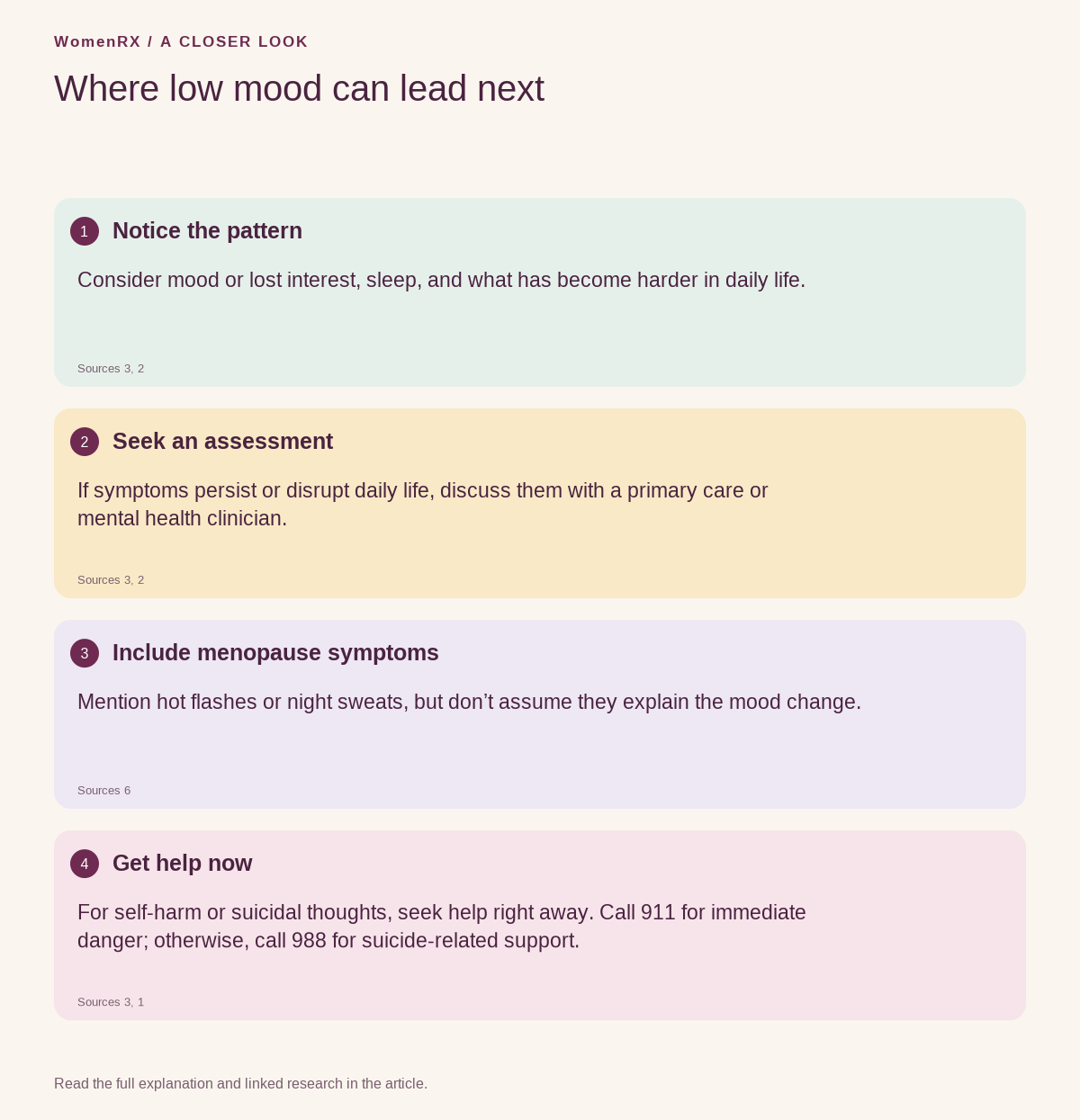
Where low mood can lead next
Notice the pattern: Consider mood or lost interest, sleep, and what has become harder in daily life.32
Seek an assessment: If symptoms persist or disrupt daily life, discuss them with a primary care or mental health clinician.32
Include menopause symptoms: Mention hot flashes or night sweats, but don’t assume they explain the mood change.6
Get help now: For self-harm or suicidal thoughts, seek help right away. Call 911 for immediate danger; otherwise, call 988 for suicide-related support.31
Read the figure as text
These routes help you choose a next step; they are not a diagnostic checklist.- Notice the pattern: Consider mood or lost interest, sleep, and what has become harder in daily life.32
- Seek an assessment: If symptoms persist or disrupt daily life, discuss them with a primary care or mental health clinician.32
- Include menopause symptoms: Mention hot flashes or night sweats, but don’t assume they explain the mood change.6
- Get help now: For self-harm or suicidal thoughts, seek help right away. Call 911 for immediate danger; otherwise, call 988 for suicide-related support.31
Sources you can check
- Suicide: MedlinePlusAccessed 2026-09-25Return to first citation
- Mental Health: MedlinePlusAccessed 2026-09-25Return to first citation
- Depression: MedlinePlusAccessed 2026-09-25Return to first citation
- Optimal doses of different exercise types for improving depressive symptoms in climacteric women: a systematic review and network meta-analysis.Wang H, Li S, Cui S, Wang Y, Zhu Y, Zhou R, Zhong Z, Zhang X, Xiao Z, Qin Q, Feng J, Wang P, Li D. · Frontiers in psychology · 2026Return to first citation
- Physical exercise and mind-body exercise in the menopausal transition: A systematic review and meta-analysis of effects on quality of life, symptoms, and psychological health.Ruiz-Cerezo A, Mendoza Laiz N, Romero Ferreiro C. · European journal of obstetrics, gynecology, and reproductive biology · 2026Return to first citation
- Vasomotor Symptoms and Their Association with Depressive and Anxiety Symptoms in Peri- and Postmenopausal Women: A Systematic Review of Observational Studies.Neda-Stepan O, Enătescu VR, Giurgi-Oncu C, Bernad ES, Neamțu R, Bernad BC, Kadaș AV, Bredicean C. · Medicina (Kaunas, Lithuania) · 2026Return to first citation