What to Track in a Migraine Diary
A few repeatable notes about attacks, treatment, and optional daily context can be more useful than a long list of suspected triggers.
Record when an attack happens, its main symptoms and effect on your day, what medicine you used, and whether it helped. Add sleep, meals, menstrual timing, or a hormonal-medication change only if that context matters to you. Keep the record simple, and look for patterns across days rather than treating one coincidence as proof of a trigger. 1 2 3
Keep the core record small
A useful migraine diary doesn’t have to document everything you ate or did. For each attack, start with a few details:
- Timing: Note when the headache began. A rough time is enough.
- Symptoms and intensity: Record how strong the pain felt and symptoms that stood out, such as nausea or sensitivity to light or sound. 1
- Effect on your day: Mark whether you missed work, had trouble getting things done, or needed to stop usual activities. A checkmark or short phrase will do.
- Treatment and response: Write down what acute medicine you took and whether it helped. If useful, note when you took it so you can describe the sequence later.
A simple calendar-style diary studied in a specialized headache clinic tracked headache occurrence, intensity, medication use and effectiveness, and productivity impact. That supports these as practical fields to consider, not as a requirement to use one particular format. 2
For example, an entry might say: “Started mid-morning; moderate pain and light sensitivity; stopped work for an hour; took my usual medicine; partly better later.” That’s only one possible shorthand. A paper calendar, notes app, or checkboxes can all work if you can keep using them.
Add context only when it helps
If you’re trying to understand a possible pattern, add a small amount of context that feels relevant. You might mark whether sleep was worse than usual or whether you skipped a meal. MedlinePlus suggests keeping a log of suspected migraine triggers and mentions consistent sleep and regular meals as lifestyle considerations. 1
If you want to look for a cycle pattern, note the first day of your period or another simple marker of menstrual timing. Some people have attacks at predictable times before menstruation, but that doesn’t mean every attack is cycle-related. 1 If a hormonal medication changes and you’re curious whether the timing overlaps with attacks, you can note when the change happened too. Treat it as context to review, not evidence by itself that the change caused an attack.
You don’t need to track every possible exposure. Too many fields can make a diary harder to keep and can encourage you to blame a single food, activity, or stressful moment. In a 90-day observational study of 1,125 people with episodic migraine, 24 of 47 tracked factors were more often associated with a lower rather than a higher chance of an attack. That doesn’t show those factors prevent migraine, but it’s a reason not to assume a suspected trigger affects everyone the same way. 3
Look for repetition before changing your routine
When reviewing your notes, look for a pattern that repeats in your own experience. Also notice days when the suspected exposure happened without an attack. This won’t prove cause and effect, but it can help distinguish a recurring possibility from a one-time coincidence. The diary’s job is to organize observations, not diagnose migraine or establish a trigger on its own. 1 3
Avoid making a major restriction based on one entry. If you’re considering avoiding a food or changing a routine, a repeated pattern is more useful to discuss than a single day that happened to come before an attack. MedlinePlus notes that potential triggers vary from person to person, and the observational findings above also show why a universal trigger list can be misleading. 1 3
Make a short review, not a long report
When you want to discuss your diary, summarize how often attacks happened, the symptoms or disruption you noticed, what treatments you used, and how they seemed to work. Add recurring sleep or menstrual timing if you observed it, and label one-off details as uncertain. A diary study found that organized entries about productivity and medication response correlated with related questionnaires in its clinic sample; it did not show that keeping a diary improves treatment outcomes. 2
If detailed tracking starts to feel like another burden, return to the basics: attack timing, impact, and treatment response. The best template is the one that gives you useful information without asking you to record your whole day.
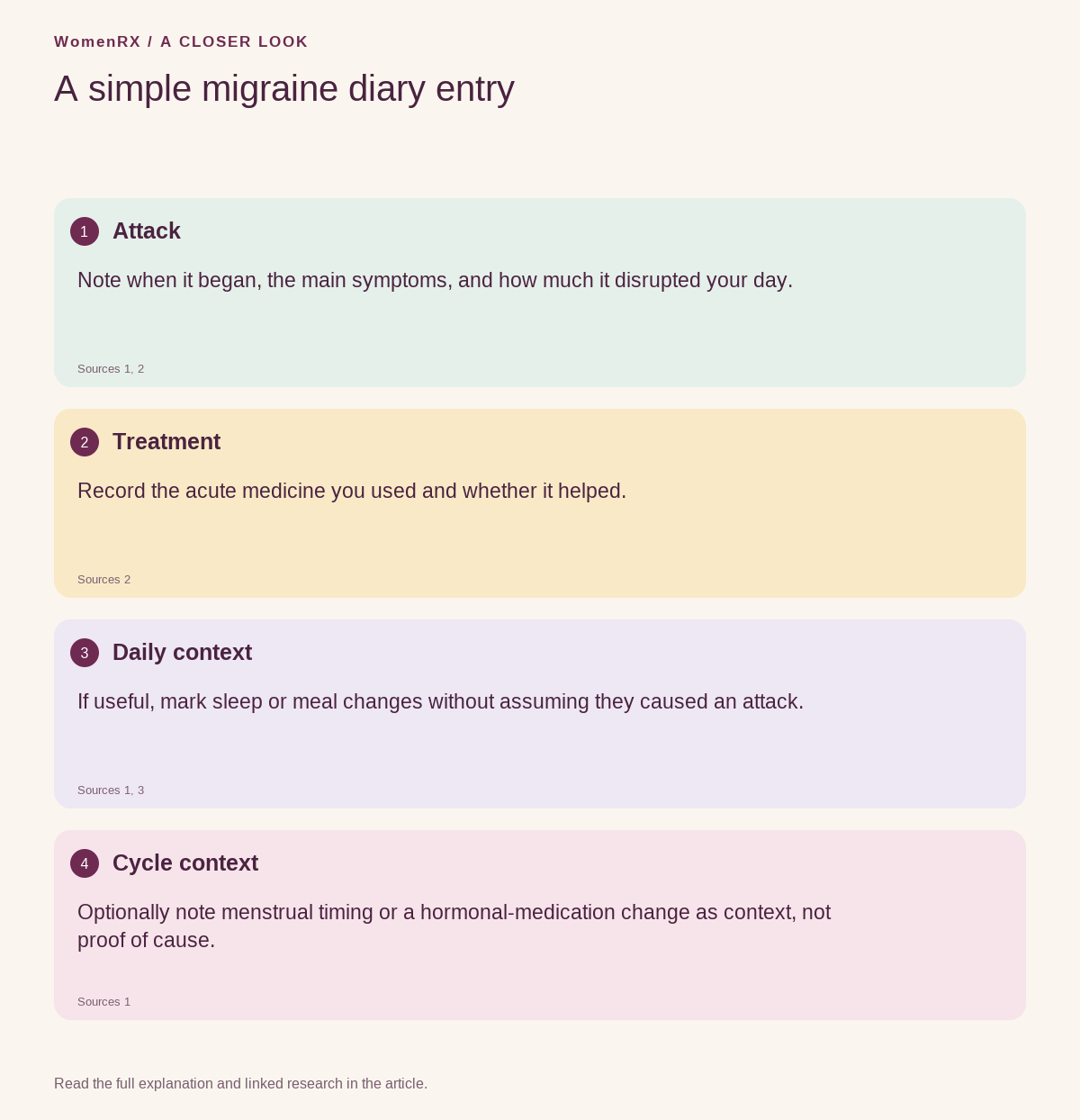
A simple migraine diary entry
Attack: Note when it began, the main symptoms, and how much it disrupted your day.12
Treatment: Record the acute medicine you used and whether it helped.2
Daily context: If useful, mark sleep or meal changes without assuming they caused an attack.13
Cycle context: Optionally note menstrual timing or a hormonal-medication change as context, not proof of cause.1
Read the figure as text
The first two checks cover the attack and treatment. Add daily or cycle context only if it may help you notice a recurring pattern.- Attack: Note when it began, the main symptoms, and how much it disrupted your day.12
- Treatment: Record the acute medicine you used and whether it helped.2
- Daily context: If useful, mark sleep or meal changes without assuming they caused an attack.13
- Cycle context: Optionally note menstrual timing or a hormonal-medication change as context, not proof of cause.1
More questions, answered
Do I need to record every food or possible trigger?
No. Start with attack timing, impact, and treatment response. Add an exposure only if you have a reason to examine it, and look for repetition rather than treating one coincidence as proof. In an observational study, some tracked factors were more often associated with a lower rather than a higher chance of an attack, so a suspected trigger isn’t automatically universal. 2 3
Sources you can check
- Migraine | MedlinePlusAccessed 2026-09-25Return to first citation
- Correlation between novel checkmark-only headache diary and productivity loss and medication effectiveness in migraine patients.Yamamoto S, Tanei T, Oyama S, Ishizaki T, Hashida M, Suzuki T, Hamasaki H, Sakurai T, Mizuno S, Wakabayashi T, Saito R. · Neurological sciences : official journal of the Italian Neurological Society and of the Italian Society of Clinical Neurophysiology · 2025Return to first citation
- The role of avoiding known triggers, embracing protectors, and adhering to healthy lifestyle recommendations in migraine prophylaxis: Insights from a prospective cohort of 1125 people with episodic migraine.Casanova A, Vives-Mestres M, Donoghue S, Mian A, Wöber C. · Headache · 2023Return to first citation