How PCOS Is Diagnosed, and Which Claims Mislead
PCOS is diagnosed from a pattern of findings, not from cysts, one symptom, or a single hormone result.
For adults, PCOS is usually diagnosed when at least two of three features are present: irregular ovulation or menstrual cycles, clinical or blood-test evidence of excess androgens, and polycystic ovarian morphology on ultrasound or, in adults, an elevated AMH result. A clinician also considers other causes of these findings. In adolescents, diagnosis requires both irregular cycles and androgen excess; ultrasound or AMH alone doesn’t establish it. 3
The diagnosis is a pattern, not a single test
There isn’t one blood test or scan that confirms PCOS. For adults, clinicians look for at least two of three features: irregular cycles or ovulation, signs or blood-test evidence of androgen excess, and polycystic ovarian morphology. For the third feature, an adult assessment may use ovarian ultrasound or an AMH blood test. The two are alternatives in the criteria, not a reason to rely on both routinely. 3
This explains why neither a hormone result nor an ultrasound finding on its own proves PCOS. Someone with irregular cycles and androgen excess may meet the adult criteria without polycystic ovarian morphology. And a scan showing that morphology, without another qualifying feature, isn’t enough. 2 3
“Polycystic” can also be misleading. The ultrasound appearance refers to numerous follicles, not necessarily disease-causing ovarian cysts. Not everyone diagnosed with PCOS has that appearance. 4
What counts as androgen excess?
Androgens are hormones that everyone makes, though levels and effects differ. Clinicians may look for signs such as excess coarse facial or body hair, or measure androgen levels in blood. Among skin and hair changes, hirsutism is a stronger clinical sign of androgen excess than acne or scalp hair thinning on their own. Those concerns can be real and worth discussing, but isolated acne or hair loss doesn’t establish PCOS. 3
A blood result needs context, too: the diagnosis depends on the overall pattern, not one hormone number in isolation. The available diagnostic criteria don’t make a particular androgen result a stand-alone test for PCOS. 3
Adolescence calls for a different standard
Cycle changes and acne can occur as the body matures, so applying adult criteria too quickly can lead to overdiagnosis. For adolescents, the criteria described in current guidance require both irregular cycles and clinical or biochemical androgen excess. An ultrasound appearance or AMH result alone isn’t a substitute for those features. 1 3
The menstrual pattern needs to be interpreted in light of development, including how long it has been since periods began. In one observational study of 289 teenagers referred for androgen excess and/or menstrual concerns, the proportion classified as having PCOS varied from about 46% to 59% depending on the criteria used. That referred group isn’t representative of all adolescents; the result illustrates how much the definition can affect diagnosis. 1
Why clinicians check for other explanations
Irregular cycles and androgen-related symptoms can have causes other than PCOS. A diagnostic assessment may include tests for thyroid disorders, high prolactin, and nonclassic congenital adrenal hyperplasia, which can resemble PCOS. Depending on the symptoms and examination, clinicians may also consider less common explanations, including an androgen-secreting growth or Cushing syndrome. 3
This isn’t a reason to assume something serious is likely. It’s part of making sure the combination of symptoms and test results fits PCOS rather than another condition. What gets checked can depend on which features are present; for example, the evaluation differs when someone has both irregular cycles and hirsutism versus only one of those findings. 3
Common claims, checked
- “You need ovarian cysts to have PCOS.” No. The adult criteria allow a diagnosis from other combinations of features, and the ultrasound term refers to follicle appearance rather than requiring cysts. 3 4
- “An ultrasound alone diagnoses PCOS.” No. In adults, morphology is one of three features; at least one other feature is needed. 3
- “One abnormal hormone result confirms it.” No. Androgen testing is one part of a broader assessment. 3
- “Everyone has the same symptoms.” No. PCOS has different adult presentations, and features can vary. Some people meet criteria without polycystic ovarian morphology; others may have that morphology without androgen excess. 2 3
A useful way to start a diagnostic discussion is to describe what’s actually happening: how your cycles have changed, whether you’ve noticed excess facial or body hair, and which test or scan prompted the question. That gives the clinician a clearer basis to assess the diagnostic pattern and decide whether other explanations need checking.
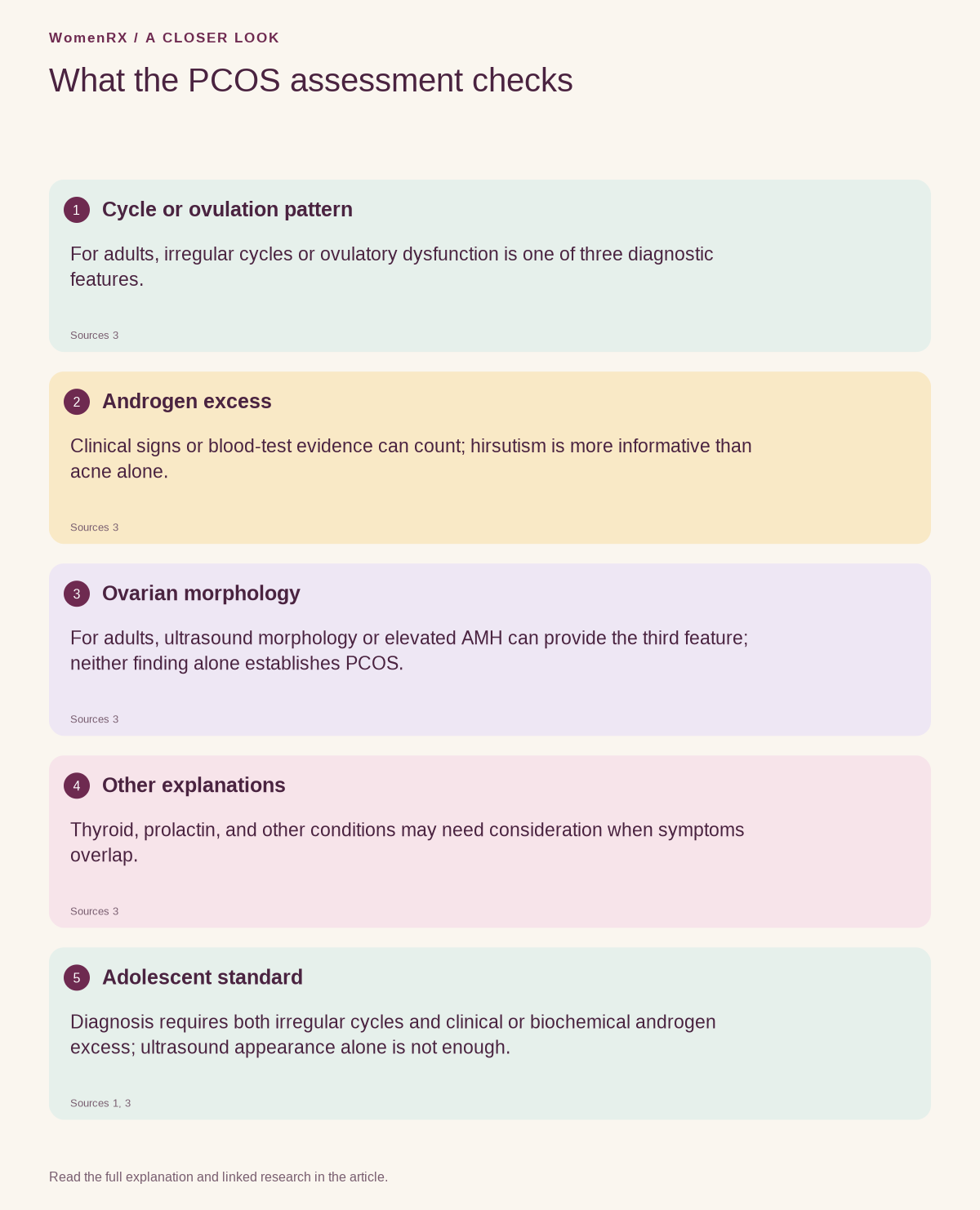
What the PCOS assessment checks
Cycle or ovulation pattern: For adults, irregular cycles or ovulatory dysfunction is one of three diagnostic features.3
Androgen excess: Clinical signs or blood-test evidence can count; hirsutism is more informative than acne alone.3
Ovarian morphology: For adults, ultrasound morphology or elevated AMH can provide the third feature; neither finding alone establishes PCOS.3
Other explanations: Thyroid, prolactin, and other conditions may need consideration when symptoms overlap.3
Adolescent standard: Diagnosis requires both irregular cycles and clinical or biochemical androgen excess; ultrasound appearance alone is not enough.13
Read the figure as text
The criteria depend on age: adult diagnosis uses two of three features, while adolescent diagnosis requires both cycle irregularity and androgen excess.- Cycle or ovulation pattern: For adults, irregular cycles or ovulatory dysfunction is one of three diagnostic features.3
- Androgen excess: Clinical signs or blood-test evidence can count; hirsutism is more informative than acne alone.3
- Ovarian morphology: For adults, ultrasound morphology or elevated AMH can provide the third feature; neither finding alone establishes PCOS.3
- Other explanations: Thyroid, prolactin, and other conditions may need consideration when symptoms overlap.3
- Adolescent standard: Diagnosis requires both irregular cycles and clinical or biochemical androgen excess; ultrasound appearance alone is not enough.13
More questions, answered
Can I have PCOS if an ultrasound looks normal?
Yes. An adult may meet the criteria through irregular cycles and clinical or biochemical androgen excess without polycystic ovarian morphology. 3
Does acne by itself mean I have PCOS?
No. Acne on its own is a relatively weak indicator of androgen excess in the diagnostic assessment. PCOS is based on a combination of features, with other possible explanations considered. 3
Sources you can check
- Prevalence of polycystic ovary syndrome among adolescents depending on the adopted diagnostic criteria.Jakubowska-Kowal K, Skrzyńska K, Kowalczyk K, Gawlik-Starzyk A. · Frontiers in endocrinology · 2026Return to first citation
- Diagnostic Criteria and Genetic Basis of Polycystic Ovary Syndrome: A Narrative Review.Cepero-González MLA, Aguilar-Galarza A, Rodríguez-García VM, García-Gasca T, Moreno Celis U. · Metabolites · 2026Return to first citation
- Approach to the Patient: Diagnostic Challenges in the Workup for Polycystic Ovary Syndrome.Joham AE, Tay CT, Laven J, Louwers YV, Azziz R. · The Journal of clinical endocrinology and metabolism · 2025Return to first citation
- From polycystic ovary syndrome to polyendocrine metabolic ovarian syndrome: what obstetricians and gynecologists need to know.Bahri-Khomami M, Hoeger KM, Huddleston H, Mahalingaiah S, Teede HJ, Dokras A. · American journal of obstetrics and gynecology · 2026Return to first citation