Considering Phentermine Online? What an Assessment Should Cover
A thoughtful remote assessment should look beyond weight and explain the safety checks, treatment plan, and follow-up before any prescription is considered.
Before prescribing phentermine remotely, a clinician should review your health history, including cardiovascular disease and uncontrolled high blood pressure, your current medicines, weight history, and treatment goals. Phentermine is approved for short-term use, and evidence about long-term health outcomes is limited. Ask what will be monitored, how long treatment is intended to last, and what to do if you have a problem. 4
An online visit can be a real clinical assessment, but a quick intake form or a promise of a prescription isn’t the same as one. Before deciding whether phentermine is appropriate, the clinician should understand your health history, review your medicines, and explain how treatment and follow-up would work. A prescription isn’t guaranteed, and a careful assessment may lead to another option. 45
Start with your health history, not just the scale
Expect to discuss your weight history, previous efforts to manage your weight, other health conditions, and what you hope treatment will help with. These details matter because weight-management plans depend on a person’s overall health and circumstances, not weight alone. 3
Be ready to talk specifically about cardiovascular disease and high blood pressure that isn’t controlled. These are listed as contraindications to phentermine in a clinical discussion of the medication. If either applies to you, ask how it affects the decision rather than assuming a remote prescription service can make an exception. 4
A clinician may need more than your answers to an online questionnaire. Ask how they’ll confirm relevant information, such as your current blood pressure, and whether your history calls for an in-person evaluation or other checks. There isn’t one universally agreed screening approach in the clinical discussion, including on whether to use an electrocardiogram for screening. 4
Bring the complete medication picture
Share all prescription medicines, over-the-counter products, and supplements you take, including anything you’ve recently stopped. Ask the clinician to check for interactions with the exact medication being considered. This is especially worth clarifying if the proposed treatment is phentermine alone or phentermine combined with topiramate; the latter is a different product with its own warnings and monitoring requirements.
For example, prescribing information for phentermine/topiramate describes an increased risk of hypertensive crisis when that combination is taken with monoamine oxidase inhibitors (MAOIs). The combination is contraindicated during MAOI treatment and for 14 days after stopping one. That is a finding in phentermine/topiramate product labeling, not a complete interaction list for phentermine alone. 12
The same distinction matters for pregnancy planning. If you could become pregnant, say so and ask how pregnancy possibility and reproductive plans affect the choice. The monthly pregnancy-test requirement in the ACP guideline applies to phentermine/topiramate, not automatically to phentermine alone. 5
Get a clear plan for duration and follow-up
Phentermine is approved for short-term treatment, but the best approach to longer-term use and its health outcomes remains uncertain. A roundtable of obesity specialists describes variation in views about longer-term use and telehealth monitoring, and points to a lack of long-term, prospective randomized studies of health outcomes. 4
Before starting, ask how long the clinician expects treatment to continue, how they’ll judge whether it’s helping, and what would prompt a change. Ask how you’ll report side effects and who will respond if a concern comes up between visits. The evidence does not establish one standard follow-up schedule for every person, so the clinician should explain the plan for your situation. 4
Also ask what to do if treatment is stopped, including whether the clinician wants to guide that decision. Don’t assume that a service will provide ongoing oversight just because it can arrange an initial visit. A clear plan should name the follow-up clinician and explain how to reach them.
Questions that make the visit more useful
- Are you considering phentermine alone or phentermine/topiramate, and how does that change the safety review?
- Does my cardiovascular history or blood pressure affect whether this is suitable?
- How will you review my current medicines and check for interactions with this specific treatment?
- How long is treatment intended to last, and how will we decide whether it’s working?
- What monitoring and follow-up do you recommend, and who should I contact if I have a problem?
- If pregnancy is possible or I’m planning a pregnancy, how does that affect the choice of medication?
A useful assessment ends with more than a yes or no. You should understand what medication is being considered, why it may or may not fit your health history, and how the clinician plans to follow up.
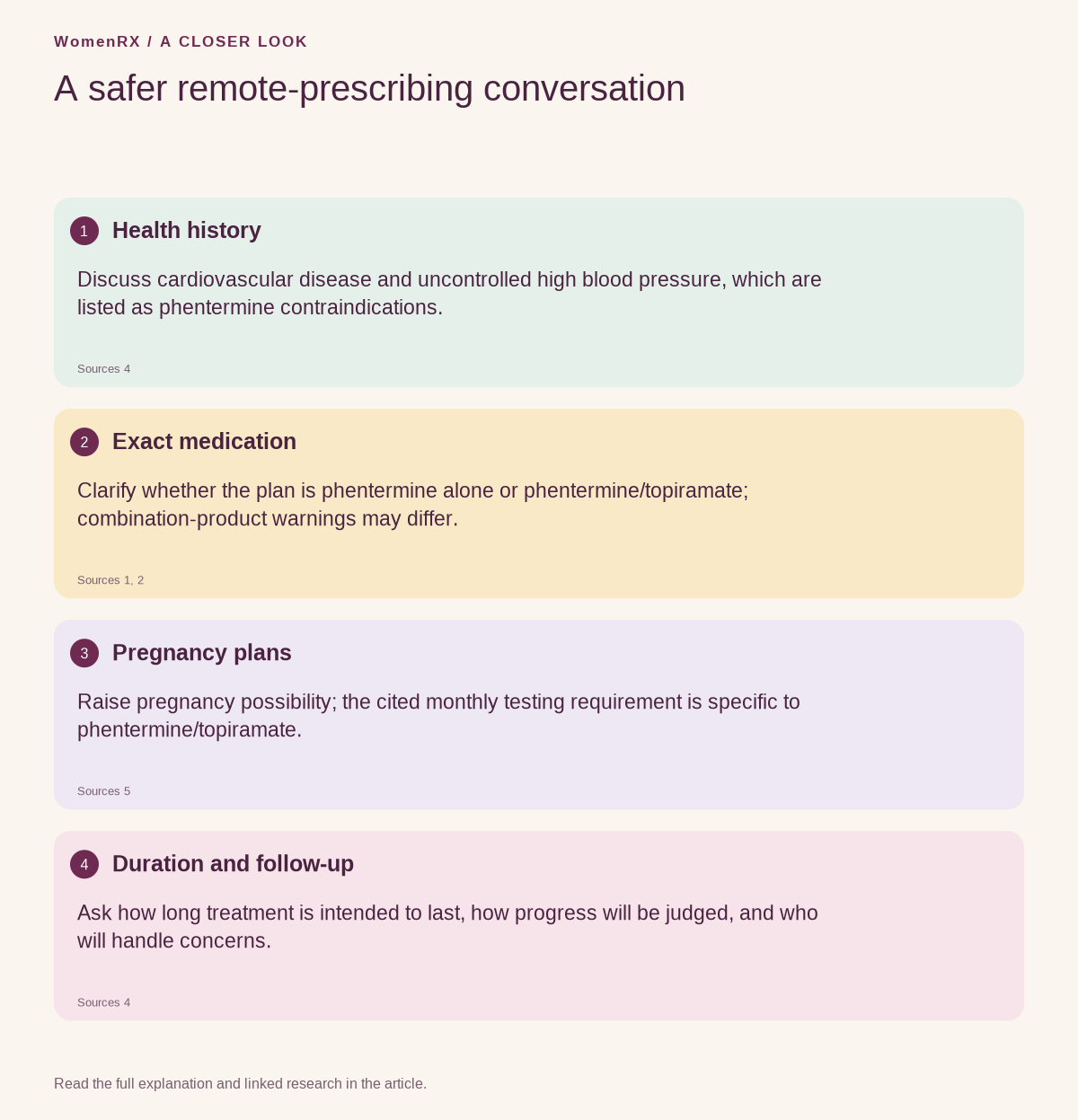
A safer remote-prescribing conversation
Health history: Discuss cardiovascular disease and uncontrolled high blood pressure, which are listed as phentermine contraindications.4
Exact medication: Clarify whether the plan is phentermine alone or phentermine/topiramate; combination-product warnings may differ.12
Pregnancy plans: Raise pregnancy possibility; the cited monthly testing requirement is specific to phentermine/topiramate.5
Duration and follow-up: Ask how long treatment is intended to last, how progress will be judged, and who will handle concerns.4
Read the figure as text
Use these distinct checkpoints to see whether an assessment covers the decision, medication, and follow-up rather than just collecting weight information.- Health history: Discuss cardiovascular disease and uncontrolled high blood pressure, which are listed as phentermine contraindications.4
- Exact medication: Clarify whether the plan is phentermine alone or phentermine/topiramate; combination-product warnings may differ.12
- Pregnancy plans: Raise pregnancy possibility; the cited monthly testing requirement is specific to phentermine/topiramate.5
- Duration and follow-up: Ask how long treatment is intended to last, how progress will be judged, and who will handle concerns.4
More questions, answered
Does an online assessment mean I’ll receive phentermine?
No. A clinician should review whether the medication fits your health history and treatment goals; the decision may be not to prescribe it or to discuss another option. 45
Are pregnancy precautions the same for phentermine alone and phentermine/topiramate?
The monthly pregnancy-test requirement cited in the ACP guideline is for phentermine/topiramate. Ask about pregnancy possibility and plans for any medication being considered, and don’t assume the combination’s requirements apply to phentermine alone. 5
Sources you can check
- QSYMIA (PHENTERMINE AND TOPIRAMATE) CAPSULE, EXTENDED RELEASE [VIVUS LLC] | US prescribing information and patient instructionsAccessed 2026-09-25Return to first citation
- PHENTERMINE AND TOPIRAMATE CAPSULE, EXTENDED RELEASE [TEVA PHARMACEUTICALS, INC.] | US prescribing information and patient instructionsAccessed 2026-09-25Return to first citation
- Obesity: MedlinePlusAccessed 2026-09-25Return to first citation
- Obesity pillars roundtable: Phentermine - Past, present, and future.Bays HE, Lazarus E, Primack C, Fitch A. · Obesity pillars · 2022Return to first citation
- Pharmacologic Treatments With Lifestyle Modifications in Nonpregnant Adults With Overweight or Obesity in Outpatient Settings: A Living Clinical Guideline From the American College of Physicians (April 2026).Qaseem A, Cross JT, Harrod CS, Owens DK, Balk EM, Crandall CJ, Clinical Guidelines Committee of the American College of Physicians, Fitterman N, Gibson M, Lewis J, Mackey K, Miller... · Annals of internal medicine · 2026Return to first citation