What Might Change With Bremelanotide?
In trials of premenopausal women with acquired, generalized HSDD, bremelanotide improved desire and related distress compared with placebo, but those results can’t predict your individual experience.
The clearest trial signals were improvement in sexual desire and less related distress among premenopausal women with acquired, generalized HSDD. Some participants who received bremelanotide also described more physical arousal and better-quality sexual experiences in exit surveys. These are group findings, not a promise that desire, sexual activity, or satisfaction will change for you. 1 3
What the trials measured
The main studies included 1,247 premenopausal women with acquired, generalized hypoactive sexual desire disorder (HSDD). In two randomized, placebo-controlled trials lasting 24 weeks, researchers compared bremelanotide with placebo. HSDD involves more than wanting sex less often: distress about the change is part of the condition. The trial results therefore speak to a particular group, not everyone who has a period of low desire. 1 2
Researchers used patient-reported measures of sexual desire and distress. A phase 2b study also examined measures including the number of sexually satisfying events, and its responder definitions were later used in the phase 3 studies. A satisfying event is not simply a count of how often someone has sex; frequency alone doesn’t tell you whether an experience felt wanted or satisfying. 4 6
What participants said they noticed
In an exit survey and follow-up interviews, some participants who had received bremelanotide described more desire, physical arousal, and improvements in the overall quality of sexual activity with a partner. The survey included 242 volunteers, and 80 also took part in interviews. These accounts add a human perspective, but they came from a volunteer subset and don’t describe a typical or guaranteed result for every person taking the drug. 3
The RECONNECT exit-study abstract, summarizing the primary analyses, reports statistically significant and clinically meaningful improvements in desire and related distress compared with placebo. That tells you the difference between groups was unlikely to be explained by chance alone and was considered meaningful in the study. It doesn’t tell you how much change a particular woman will notice, or whether her own priorities will improve. 3
A practical way to judge whether change matters to you
If you’re considering treatment, it may help to separate three questions rather than relying on a single overall impression:
- Desire: Do you notice more interest, thoughts, or openness to sexual activity than before?
- Distress: Is the change in desire bothering you less, or does it still feel upsetting?
- Satisfaction: Are sexual experiences that happen feeling more satisfying to you, rather than simply happening more often?
These questions echo the kinds of outcomes used in HSDD research, but they aren’t a validated personal scoring tool. They can help you describe what you want to change and what would count as worthwhile for you. A change in one area doesn’t automatically mean change in the others.
Keep the result in proportion
The evidence applies most directly to premenopausal women with acquired, generalized HSDD. It doesn’t establish the same results for someone whose desire has always been low, whose concern isn’t causing distress, or whose situation falls outside the studied group. The FDA prescribing information describes the two 24-week trials and their participants. Because those results describe a trial group, they can’t establish how much change an individual woman will notice. 1 2
There’s also a reason not to treat a single headline result as the whole story. A 2021 re-analysis of the phase 3 trials raised concerns about incomplete reporting of protocol-listed outcomes. That critique doesn’t prove that no one benefits; it does mean that precise claims about how often a specific kind of improvement happens deserve caution. 5
So the most useful expectation is not a promised before-and-after. It’s a set of questions: Is desire changing in a way I value? Is the distress easing? Are satisfying experiences improving? If the answer differs across those areas, that difference is meaningful information about whether the result fits your goals.
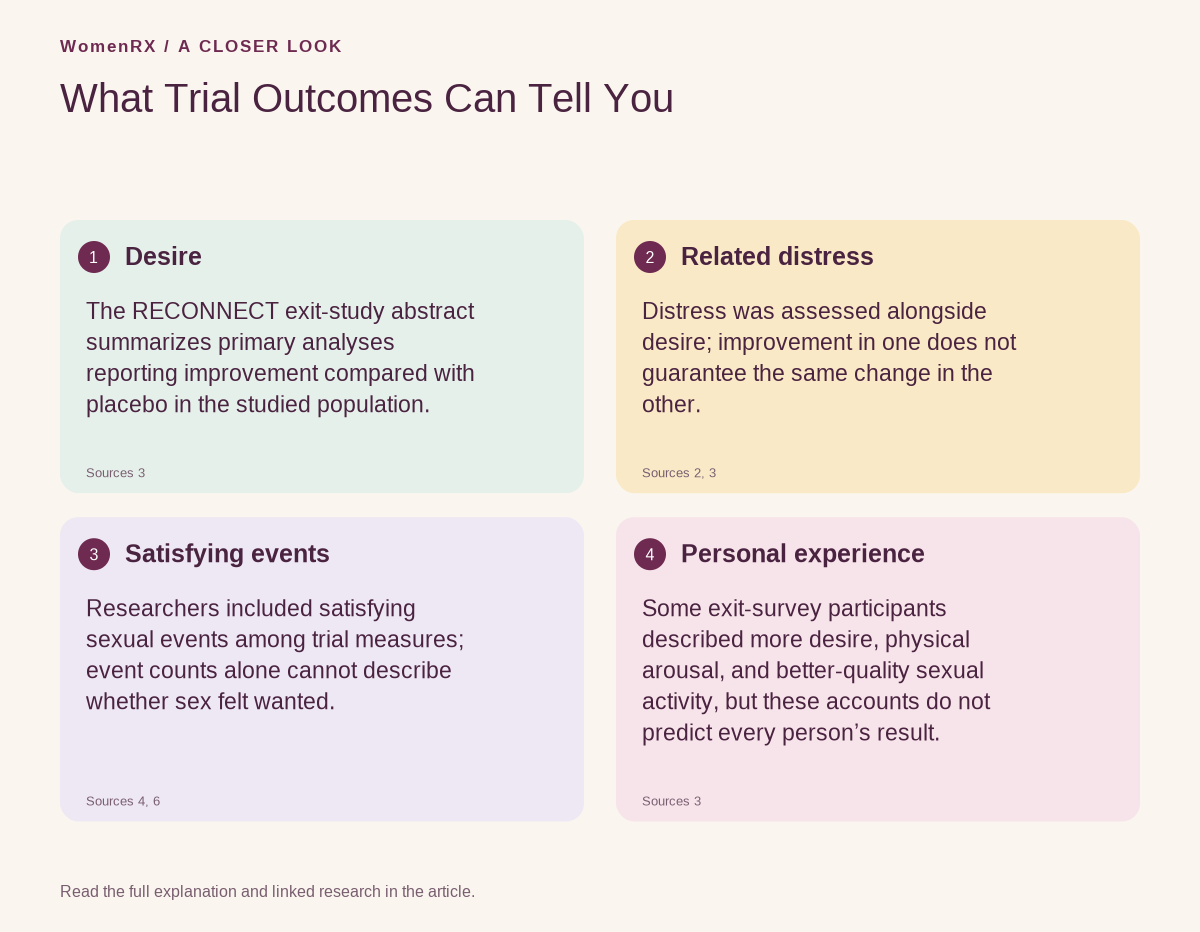
What Trial Outcomes Can Tell You
Desire: The RECONNECT exit-study abstract summarizes primary analyses reporting improvement compared with placebo in the studied population.3
Related distress: Distress was assessed alongside desire; improvement in one does not guarantee the same change in the other.23
Satisfying events: Researchers included satisfying sexual events among trial measures; event counts alone cannot describe whether sex felt wanted.46
Personal experience: Some exit-survey participants described more desire, physical arousal, and better-quality sexual activity, but these accounts do not predict every person’s result.3
Read the figure as text
The studies assessed several kinds of change, but each answers a different question and none guarantees an individual result.- Desire: The RECONNECT exit-study abstract summarizes primary analyses reporting improvement compared with placebo in the studied population.3
- Related distress: Distress was assessed alongside desire; improvement in one does not guarantee the same change in the other.23
- Satisfying events: Researchers included satisfying sexual events among trial measures; event counts alone cannot describe whether sex felt wanted.46
- Personal experience: Some exit-survey participants described more desire, physical arousal, and better-quality sexual activity, but these accounts do not predict every person’s result.3
More questions, answered
Does bremelanotide mean you’ll have sex more often?
This evidence supports improvements in desire and related distress, not a guaranteed increase in how often you have sex. Trial measures included sexually satisfying events, but frequency by itself doesn’t establish that an experience was wanted or satisfying. 3 4 6
Do the trial results apply to postmenopausal women?
The two pivotal trials described in the prescribing information studied premenopausal women with acquired, generalized HSDD. Those results shouldn’t be assumed to establish the same benefit for postmenopausal women. 1
Sources you can check
- VYLEESI (BREMELANOTIDE) INJECTION [COSETTE PHARMACEUTICALS, INC.] | US prescribing information and patient instructionsAccessed 2026-09-25Return to first citation
- Clinical trial evidence on emerging pharmacological therapies for hypoactive sexual desire disorder in women: a systematic review and analysis of completed studies registered on ClinicalTrials.gov.Ashour AM. · Frontiers in medicine · 2026Return to first citation
- The Patient Experience of Premenopausal Women Treated with Bremelanotide for Hypoactive Sexual Desire Disorder: RECONNECT Exit Study Results.Koochaki P, Revicki D, Wilson H, Pokrzywinski R, Jordan R, Lucas J, Williams LA, Sadiq A, Krop J. · Journal of women's health (2002) · 2021Return to first citation
- Responder Analyses from a Phase 2b Dose-Ranging Study of Bremelanotide.Althof S, Derogatis LR, Greenberg S, Clayton AH, Jordan R, Lucas J, Spana C. · The journal of sexual medicine · 2019Return to first citation
- Re-Analyzing Phase III Bremelanotide Trials for "Hypoactive Sexual Desire Disorder" in Women.Spielmans GI. · Journal of sex research · 2021Return to first citation
- Quantification of "Mercy Sex" in Heterosexual Women.Guptan N, Simon JA. · Journal of sex & marital therapy · 2026Return to first citation