What Bremelanotide Reviews Can Tell You
Personal accounts can show what an experience felt like, while clinical trials add comparisons, defined outcomes, and important limits.
A bremelanotide review can describe one person’s experience, but it can’t tell you how likely you are to benefit or have a side effect. For that, look to trials of premenopausal women diagnosed with HSDD, and check what they measured: desire, distress, satisfying sexual events, and treatment harms are different outcomes. Trial participants and online reviewers may not share the same circumstances. 1 2 3 5
Start with what a review can and can’t show
A first-person account can make a treatment feel more tangible. It may describe how someone experienced desire, sexual activity, or an unwanted effect. But one account has no comparison group and no reliable denominator: it can’t show how often an experience happens, or whether the same person would have felt differently without treatment.
Online reviewers are also a self-selected group. People who choose to post may not represent everyone who used the medicine. And a short account may leave out details that change how useful it is for you, such as the reason for low desire, other health concerns, medicines, relationship circumstances, or how long the person used treatment. So read a review as a description, not a forecast.
Trial interviews are personal accounts, too
There is a helpful distinction between online reviews and patient reports collected in a clinical study. In an exit study connected to the RECONNECT trials, 242 participants completed a survey and 80 completed a telephone interview. Participants remained unaware of whether they had received bremelanotide or placebo until after those activities. Women who had received bremelanotide described changes including increased desire, physical arousal, and the quality of sexual activity. Placebo recipients also described benefits, including improved communication with a partner and positive feelings about seeking treatment. 2
Those reports add detail about what trial participants felt. They don’t establish what any one person will experience. The interviews involved a subset of trial participants, not a representative sample of every woman considering treatment, and they happened within a clinical-trial setting. 2
Check which outcome a claim refers to
“Worked” can mean different things. A study might measure desire, distress about low desire, a questionnaire score, or the number of satisfying sexual events. Improvement in one doesn’t automatically mean improvement in all the others.
For example, the Elements of Desire Questionnaire was developed with input from women with HSDD and clinical experts, then evaluated in participants in the RECONNECT trials. Its scores showed reliability and validity in that study population, and scores improved more with bremelanotide than placebo after six months. That supports using the questionnaire to measure desire in those trials. It does not turn a single review’s description into a comparable measure. 6
A phase 2b study also used several approaches to decide what counted as a meaningful change on patient-reported measures. Those analyses involved premenopausal participants with HSDD, female sexual arousal disorder, or both; results from that group may not translate to women with other diagnoses or circumstances. 3
When you read a claim, ask: Is it about desire, distress, arousal, sexual activity, or an unwanted effect? Was it measured with a questionnaire, described in an interview, or posted in a review? Keeping those distinctions clear makes “it helped” more informative without making it more certain than it is.
Notice who the evidence describes
The US prescribing information describes Vyleesi for certain premenopausal women whose low desire is distressing and is not due to a medical or mental health problem, a relationship problem, or medicine or drug use. It is not indicated for postmenopausal women or for improving sexual performance. 1 A review written by someone outside that studied and labeled population may describe a real experience, but it may not answer the same question as the clinical evidence.
A 2026 review of registered drug trials for HSDD found that most included studies primarily enrolled premenopausal women with acquired, generalized HSDD. It also described variation in endpoints and reporting, which limits comparisons across studies. 5 That is a reason to be cautious about applying an average trial result to a person whose diagnosis, health, medicines, or life circumstances differ. It is not a reason to dismiss her account.
Weigh benefits beside drawbacks and reporting limits
The official prescribing information lists nausea among Vyleesi’s common side effects and says it can be severe. It also describes temporary increases in blood pressure and decreases in heart rate after an injection, as well as possible skin darkening that may not go away. 1 A review can help you understand how one person described an effect; the prescribing information gives a broader safety frame, though it cannot predict your individual experience.
There is also a debate about how clearly the phase 3 evidence was reported. A reanalysis of the trials argued that many protocol-listed outcomes were not reported in the primary publication and criticized the reporting of secondary outcomes. 4 A separate review of registered HSDD trials likewise found variation in endpoint selection and reporting completeness. 5 These critiques don’t erase the trial findings, but they are relevant when judging how completely the published results show what researchers planned to measure.
A practical way to read a review is to separate three things: what the person says happened, what outcome that experience relates to, and what context is missing. Then compare those points with trial measures and the known side-effect information. That gives you a more grounded picture than counting positive or negative posts.
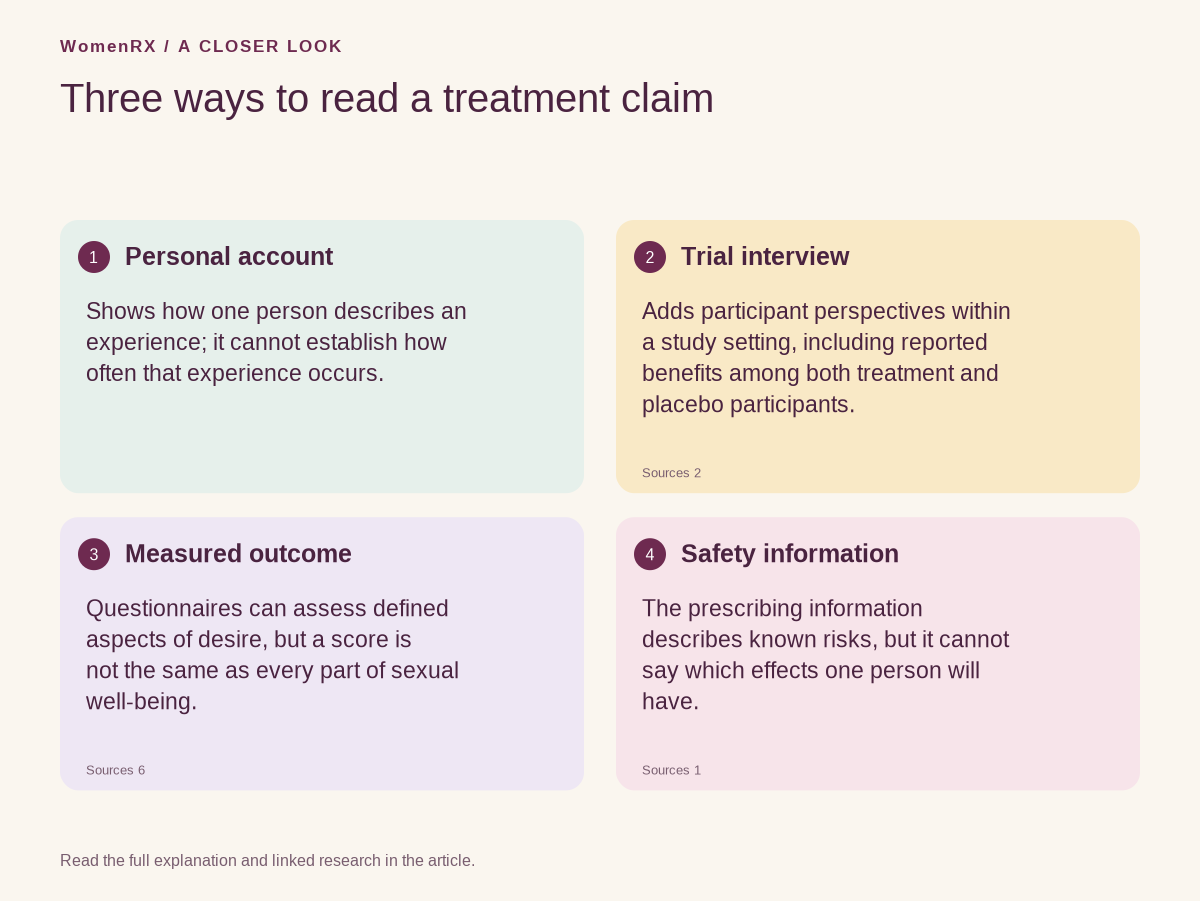
Three ways to read a treatment claim
Personal account: Shows how one person describes an experience; it cannot establish how often that experience occurs.
Trial interview: Adds participant perspectives within a study setting, including reported benefits among both treatment and placebo participants.2
Measured outcome: Questionnaires can assess defined aspects of desire, but a score is not the same as every part of sexual well-being.6
Safety information: The prescribing information describes known risks, but it cannot say which effects one person will have.1
Read the figure as text
Personal accounts, trial measures, and safety information answer different questions. Use them together without treating any one as a personal prediction.- Personal account: Shows how one person describes an experience; it cannot establish how often that experience occurs.
- Trial interview: Adds participant perspectives within a study setting, including reported benefits among both treatment and placebo participants.2
- Measured outcome: Questionnaires can assess defined aspects of desire, but a score is not the same as every part of sexual well-being.6
- Safety information: The prescribing information describes known risks, but it cannot say which effects one person will have.1
More questions, answered
Are trial interviews the same as online reviews?
No. The RECONNECT exit study collected surveys and interviews from trial participants under a defined study process; online reviews are self-selected accounts without the same study context or comparison. Neither can predict one person’s response. 2
Which side effects should I look for in a review?
The prescribing information lists nausea as common and potentially severe. It also describes temporary blood pressure and heart-rate changes and possible skin darkening. A review can describe one person’s experience, while the label summarizes known risks across use. 1
Sources you can check
- VYLEESI (BREMELANOTIDE) INJECTION [COSETTE PHARMACEUTICALS, INC.] | US prescribing information and patient instructionsAccessed 2026-09-25Return to first citation
- The Patient Experience of Premenopausal Women Treated with Bremelanotide for Hypoactive Sexual Desire Disorder: RECONNECT Exit Study Results.Koochaki P, Revicki D, Wilson H, Pokrzywinski R, Jordan R, Lucas J, Williams LA, Sadiq A, Krop J. · Journal of women's health (2002) · 2021Return to first citation
- Responder Analyses from a Phase 2b Dose-Ranging Study of Bremelanotide.Althof S, Derogatis LR, Greenberg S, Clayton AH, Jordan R, Lucas J, Spana C. · The journal of sexual medicine · 2019Return to first citation
- Re-Analyzing Phase III Bremelanotide Trials for "Hypoactive Sexual Desire Disorder" in Women.Spielmans GI. · Journal of sex research · 2021Return to first citation
- Clinical trial evidence on emerging pharmacological therapies for hypoactive sexual desire disorder in women: a systematic review and analysis of completed studies registered on ClinicalTrials.gov.Ashour AM. · Frontiers in medicine · 2026Return to first citation
- Reliability and validity of the elements of desire questionnaire in premenopausal women with hypoactive sexual desire disorder.Revicki DA, Althof SE, Derogatis LR, Kingsberg SA, Wilson H, Sadiq A, Krop J, Jordan R, Lucas J. · Journal of patient-reported outcomes · 2020Return to first citation