Bremelanotide: When to Judge a Dose and Reassess
The dose is taken before anticipated sexual activity, but its effective window is unknown, and a single use is not the same as judging longer-term benefit.
Bremelanotide is taken at least 45 minutes before anticipated sexual activity, but how long any effect lasts is unknown. Notice what happens after a dose, including changes in desire and any unwanted effects, without expecting a guaranteed response. Longer-term studies assessed desire and distress over 24 weeks; that was a trial period, not a proven deadline for every person. Reassess with your prescriber based on your experience and whether treatment is worthwhile to you. 12
Two different clocks: a dose and a treatment decision
Bremelanotide (Vyleesi) is an on-demand injection, not a medication with a proven, predictable response time for everyone. US prescribing information says to take it at least 45 minutes before anticipated sexual activity. It also says the duration of efficacy after a dose is unknown, so the 45-minute lead time does not promise that desire will rise by then or remain changed for a particular number of hours. 1
That makes each use an individual observation, not a pass-or-fail test. You might notice a change in desire, no clear change, or an unwanted effect. The prescribing information says patients may use their experience of the effect on desire and reactions such as nausea to help judge timing. It does not establish a universal window in which every person should feel a benefit. 1
What longer-term studies actually assessed
The two phase 3 studies enrolled premenopausal women with acquired, generalized hypoactive sexual desire disorder (HSDD) lasting at least six months. Their placebo-controlled phase lasted 24 weeks. The studies assessed measures including sexual desire and distress related to low desire. A 52-week open-label extension followed, but because it was uncontrolled, it cannot provide the same comparison with placebo as the main trial period. 12
Those study durations help explain how researchers evaluated treatment across time. They are not evidence that you must wait 24 weeks to judge your experience, or that a particular number of doses guarantees improvement. A review of the trial outcomes found that reported benefits were statistically modest and that several measures had limited evidence of validity for women with HSDD. That makes the meaning of a score or apparent response less certain than a simple number might suggest. 2
Make reassessment about your experience, not just a score
Before discussing whether to continue, it may help to keep a brief, private note after each use: whether you noticed a meaningful change in desire, whether distress about low desire changed, and whether an unwanted effect affected the experience. These are practical prompts, not a validated tracking tool. They reflect the kinds of outcomes and reactions considered in the studies and prescribing information. 12
Then ask whether any change matters in your actual life. For example, a questionnaire score might shift without reducing the distress that led you to seek treatment, or you might feel a meaningful change that is difficult to capture in a score. The trial review raises questions about how well some measures represent treatment response, so it is reasonable to discuss both measured outcomes and your own experience. 2
Review tolerability and how often you use the medication, too. The prescribing information does not recommend more than eight doses per month. If you are reaching that limit, or if unwanted effects are making use difficult, include that in the conversation rather than focusing only on desire. 1
Keep the studied population in view
The main trials studied premenopausal women with acquired, generalized HSDD. Their findings do not establish the same response timeline for every woman or for people outside that studied population. If your situation differs, such as being postmenopausal, ask how applicable the evidence is to you rather than assuming the trial timeline predicts your response. 1
The useful question at reassessment is not simply, “Did I feel something after one dose?” It is whether, across your actual experience, the treatment brings a worthwhile change in desire or related distress, whether its effects and unwanted reactions fit your needs, and whether continued use makes sense for you.
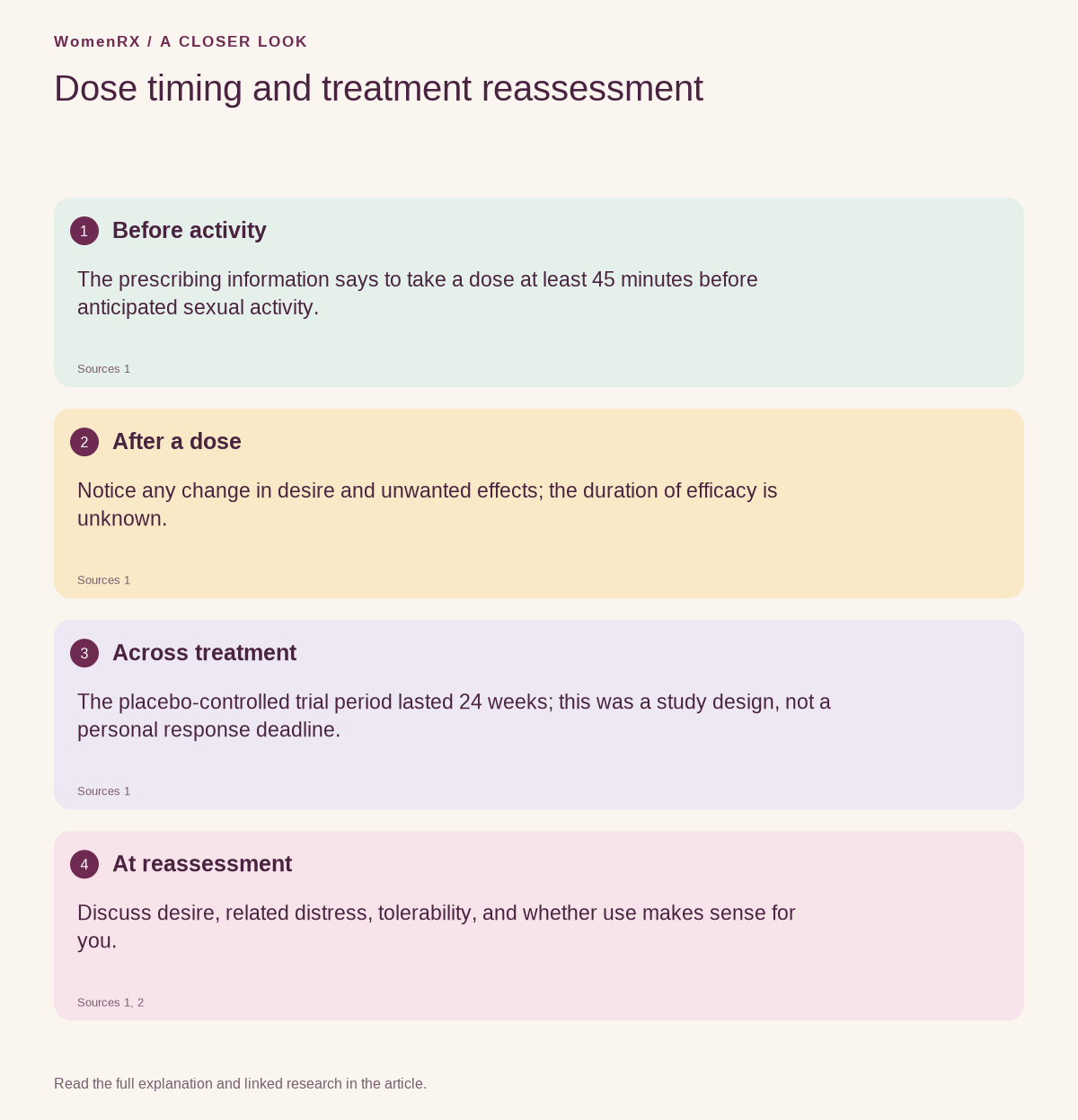
Dose timing and treatment reassessment
Before activity: The prescribing information says to take a dose at least 45 minutes before anticipated sexual activity.1
After a dose: Notice any change in desire and unwanted effects; the duration of efficacy is unknown.1
Across treatment: The placebo-controlled trial period lasted 24 weeks; this was a study design, not a personal response deadline.1
At reassessment: Discuss desire, related distress, tolerability, and whether use makes sense for you.12
Read the figure as text
These are separate reference points: the label gives a before-activity dosing time, while the study period describes how outcomes were evaluated, not a universal response deadline.- Before activity: The prescribing information says to take a dose at least 45 minutes before anticipated sexual activity.1
- After a dose: Notice any change in desire and unwanted effects; the duration of efficacy is unknown.1
- Across treatment: The placebo-controlled trial period lasted 24 weeks; this was a study design, not a personal response deadline.1
- At reassessment: Discuss desire, related distress, tolerability, and whether use makes sense for you.12
More questions, answered
Does the 45-minute timing mean the effect lasts a set number of hours?
No. The prescribing information gives at least 45 minutes before anticipated sexual activity as the timing for a dose, but says the duration of efficacy after each dose is unknown. 1
Sources you can check
- VYLEESI (BREMELANOTIDE) INJECTION [COSETTE PHARMACEUTICALS, INC.] | US prescribing information and patient instructionsAccessed 2026-09-25Return to first citation
- Small Effects, Questionable Outcomes: Bremelanotide for Hypoactive Sexual Desire Disorder.Spielmans GI, Ellefson EM. · Journal of sex research · 2024Return to first citation