Where to Apply Progesterone Cream, and Does the Site Matter?
Follow the directions for your specific product, but don’t assume that applying cream to a particular area makes it reliable for protecting the uterine lining.
There isn’t a proven application site that guarantees progesterone cream will protect the uterine lining. Use the site and schedule specified for your exact product or prescription rather than borrowing directions from another cream or gel. If you’re using estrogen and need progesterone for endometrial protection, ask whether that specific formulation has evidence for that purpose; studies of topical creams leave important questions open. 2
Start with the exact product directions
There’s no single application site you can assume is right for every progesterone cream. The product or prescription matters: follow its own directions for where and how to apply it, and don’t substitute instructions from a different cream or gel. The research discussed below doesn’t establish that one body area is better for protecting the uterine lining.
That distinction matters because where a cream is applied and whether it achieves a treatment goal are separate questions. A product’s application directions tell you how it is intended to be used. They don’t, by themselves, show that the progesterone reaches the endometrium in an amount that protects it.
If the goal is endometrial protection, ask about the formulation
If you have a uterus and are using estrogen, clarify whether the progesterone product you were given is intended and supported for endometrial protection. A review of percutaneous progesterone describes uncertainty about topical creams: blood progesterone levels may be low, and the review says effects on the uterine lining shouldn’t be judged from blood levels alone. It discusses endometrial tissue findings, but doesn’t establish a dependable application site that ensures protection. 2
This is a question about the specific formulation and intended use, not simply whether the cream absorbs through skin. A cream can be absorbed without the available evidence showing that it reliably protects the lining. Don’t change the application area, amount, or schedule to try to improve protection on your own; ask the prescriber whether this product matches your treatment goal.
Why a progesterone blood test may not settle it
Topical progesterone can show different levels in different types of samples. In a randomized crossover study of 10 postmenopausal women, researchers measured progesterone in serum, whole blood, capillary blood, and saliva after cream or gel use. The results varied by sample type and formulation. The study measured hormone levels over a short period, not whether the uterine lining was protected. 3
So a progesterone result from blood isn’t, by itself, proof that a cream is or isn’t protecting the endometrium. The review also cautions that serum levels may not reflect levels in other tissues. 2 Don’t use a lab result to adjust your product without discussing what the test can and can’t tell you with the clinician who prescribed it.
A focused question to ask
If you’re unsure whether the directions match your goal, ask: “Is this exact progesterone formulation intended to protect my uterine lining with the estrogen I use, and what evidence supports that use?” If the answer addresses only where to rub it in, ask specifically about endometrial protection. The North American Menopause Society notes that hormone-therapy risks vary with factors including route and whether a progestogen is used, and that treatment should be individualized. 1
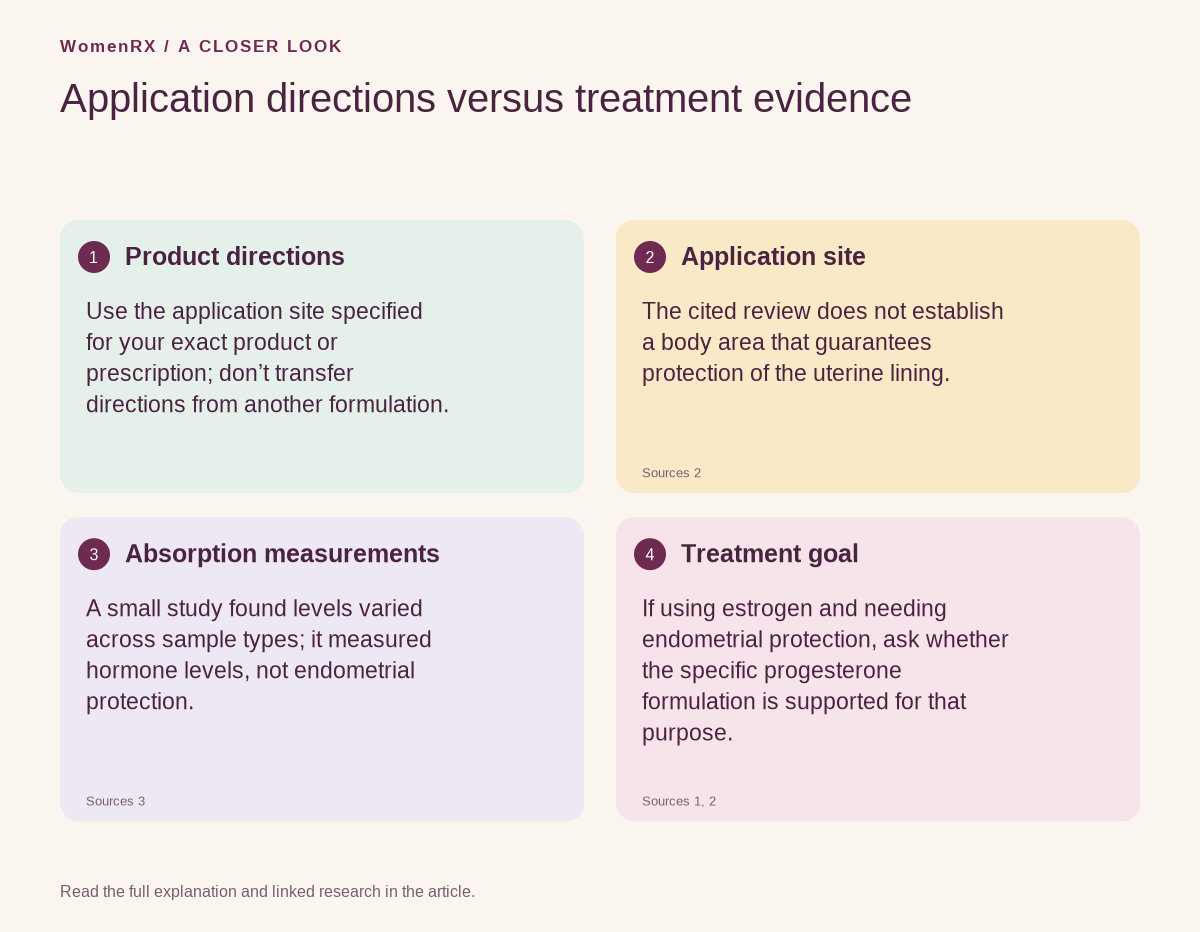
Application directions versus treatment evidence
Product directions: Use the application site specified for your exact product or prescription; don’t transfer directions from another formulation.
Application site: The cited review does not establish a body area that guarantees protection of the uterine lining.2
Absorption measurements: A small study found levels varied across sample types; it measured hormone levels, not endometrial protection.3
Treatment goal: If using estrogen and needing endometrial protection, ask whether the specific progesterone formulation is supported for that purpose.12
Read the figure as text
The product’s directions and evidence for endometrial protection answer different questions.- Product directions: Use the application site specified for your exact product or prescription; don’t transfer directions from another formulation.
- Application site: The cited review does not establish a body area that guarantees protection of the uterine lining.2
- Absorption measurements: A small study found levels varied across sample types; it measured hormone levels, not endometrial protection.3
- Treatment goal: If using estrogen and needing endometrial protection, ask whether the specific progesterone formulation is supported for that purpose.12
More questions, answered
Can I tell whether progesterone cream is working from a blood test?
Not from a progesterone level alone. A review describes a mismatch between serum levels and levels in other tissues, while a small study measured hormone levels rather than endometrial protection. Ask what a test can establish for your specific product and treatment goal. 2 3
Sources you can check
- The 2022 hormone therapy position statement of The North American Menopause Society.“The 2022 Hormone Therapy Position Statement of The North American Menopause Society” Advisory Panel. · Menopause (New York, N.Y.) · 2022Return to first citation
- Percutaneous administration of progesterone: blood levels and endometrial protection.Stanczyk FZ, Paulson RJ, Roy S. · Menopause (New York, N.Y.) · 2005Return to first citation
- Percutaneous progesterone delivery via cream or gel application in postmenopausal women: a randomized cross-over study of progesterone levels in serum, whole blood, saliva, and capillary blood.Du JY, Sanchez P, Kim L, Azen CG, Zava DT, Stanczyk FZ. · Menopause (New York, N.Y.) · 2013Return to first citation