Can progesterone cream protect the uterine lining during estrogen therapy?
A small, short study of one progesterone cream isn’t enough to establish that creams protect the uterine lining from systemic estrogen.
If you have a uterus and use systemic estrogen, don’t assume a progesterone cream provides reliable endometrial protection. One small, six-month study of a specific transdermal cream found no cases of hyperplasia, but it wasn’t large or long enough to establish protection for that product, let alone other creams. Ask whether your exact estrogen and progestogen regimen has evidence for protecting the lining. 4

The safety question is about the whole regimen
Systemic estrogen can stimulate the uterine lining. For a woman with a uterus, adding a progestogen is generally recommended to reduce the risk of endometrial hyperplasia, which can be a precursor to endometrial cancer. The practical question isn’t whether a product is called “progesterone” or “bioidentical.” It’s whether that specific preparation, used with your estrogen regimen, has evidence that it protects the lining. 12
That matters because hormone-therapy risks and effects vary with the type, dose, duration, route, and whether a progestogen is used. You can’t assume that evidence for one formulation or route applies to a cream with a different dose or delivery method. 3
What the cream study did, and didn’t, show
A randomized crossover study enrolled healthy menopausal women and compared estrogen taken with either oral medroxyprogesterone acetate or a particular transdermal progesterone cream. Participants used each combination for six months. Of the 26 women who completed both treatments, none of the biopsies showed endometrial hyperplasia. However, proliferative endometrium was found in five biopsies after the cream treatment and seven after the oral-progestin treatment. 4
Those results are limited reassurance, not proof that progesterone creams reliably prevent endometrial overgrowth. The study was small, lasted only six months per treatment, and tested one cream and one estrogen regimen. It can’t establish long-term protection or tell you whether a different cream, dose, or estrogen combination is adequate. The finding that participants preferred the cream does not answer the safety question. 4
Compare that with evidence for a specific prescribed product
The evidence is product-specific. For example, US prescribing information for the prescription estradiol-and-progesterone capsule BIJUVA reports a 52-week endometrial safety trial in postmenopausal women. Biopsies showed hyperplasia in 1 of 303 women in one treatment group and 1 of 281 in the other; none was reported among 92 placebo recipients. This supports what was observed with those tested capsule regimens over that period. It does not prove that every progestogen regimen is risk-free, or directly compare BIJUVA with a cream. 1
That distinction is the reason not to treat an over-the-counter cream as interchangeable with a studied prescription regimen. The small cream trial and the BIJUVA trial used different products, study designs, populations, and treatment periods. Neither result establishes that a cream you buy or use will protect your lining alongside your particular estrogen dose and route. 14
What to clarify about your situation
If you’re considering or already using a cream with systemic estrogen, bring the exact product name and formulation to the discussion. Ask: “Is this specific cream-and-estrogen combination known to protect the endometrium, or should we use a progestogen regimen with evidence for this purpose?” It’s also reasonable to ask how your estrogen dose and route affect the choice, since hormone-therapy effects vary by regimen. 3
The answer is different after a total hysterectomy: there’s no uterine lining to protect. If you’re unsure whether you had a total hysterectomy, confirm which reproductive organs remain rather than guessing from the name of the operation.
Bleeding also deserves attention. Unusual vaginal bleeding while using hormone therapy should be checked, especially bleeding after menopause. BIJUVA’s patient instructions specifically advise evaluation of unusual bleeding; the Estrace prescribing information also calls for diagnostic assessment when postmenopausal bleeding is persistent or recurring. Don’t use a cream or change your regimen as a substitute for evaluating unexplained bleeding. 12
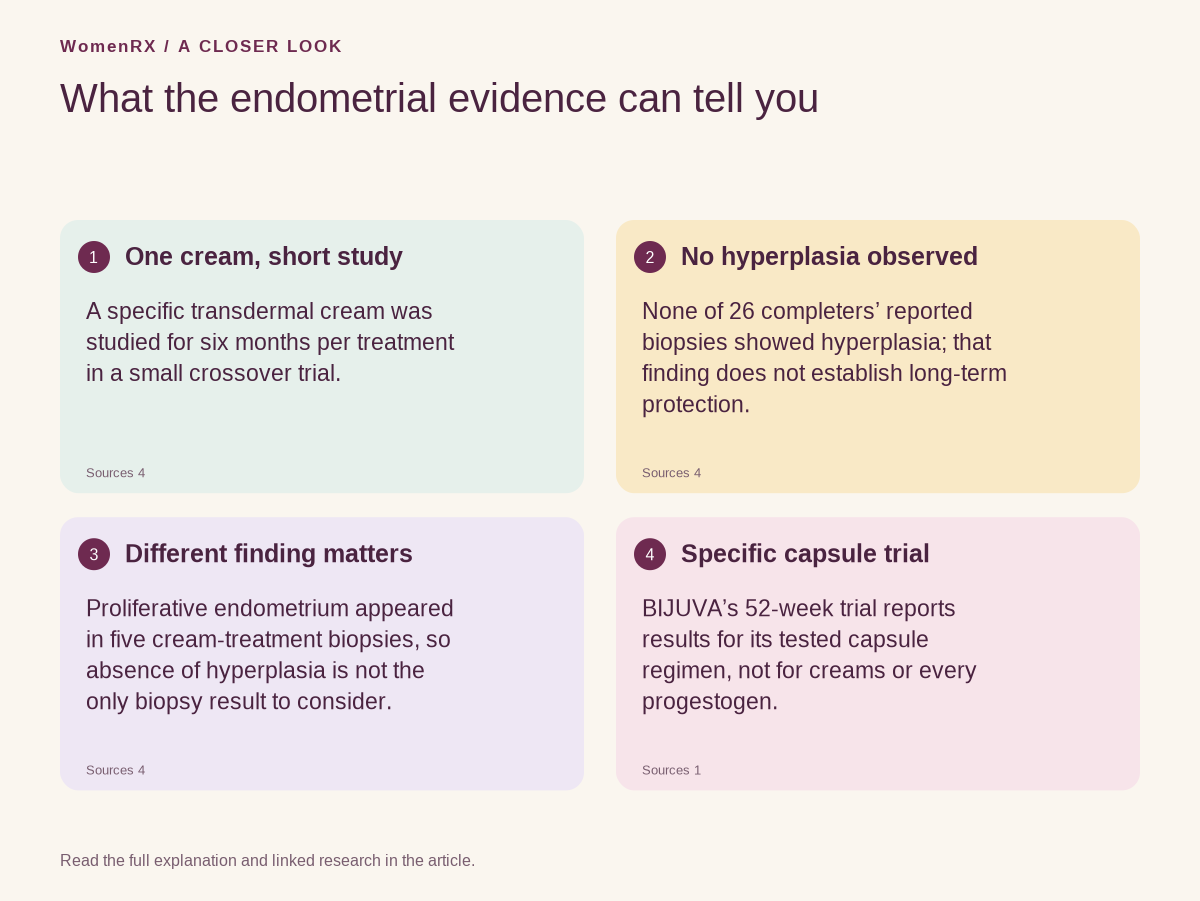
What the endometrial evidence can tell you
One cream, short study: A specific transdermal cream was studied for six months per treatment in a small crossover trial.4
No hyperplasia observed: None of 26 completers’ reported biopsies showed hyperplasia; that finding does not establish long-term protection.4
Different finding matters: Proliferative endometrium appeared in five cream-treatment biopsies, so absence of hyperplasia is not the only biopsy result to consider.4
Specific capsule trial: BIJUVA’s 52-week trial reports results for its tested capsule regimen, not for creams or every progestogen.1
Read the figure as text
These studies provide different kinds and amounts of evidence. Their results shouldn’t be treated as interchangeable.- One cream, short study: A specific transdermal cream was studied for six months per treatment in a small crossover trial.4
- No hyperplasia observed: None of 26 completers’ reported biopsies showed hyperplasia; that finding does not establish long-term protection.4
- Different finding matters: Proliferative endometrium appeared in five cream-treatment biopsies, so absence of hyperplasia is not the only biopsy result to consider.4
- Specific capsule trial: BIJUVA’s 52-week trial reports results for its tested capsule regimen, not for creams or every progestogen.1
More questions, answered
Does “bioidentical” mean the cream is proven to protect the lining?
No. The word doesn’t establish that a particular cream-and-estrogen regimen prevents endometrial hyperplasia. The relevant evidence is for the specific product and regimen, and the small cream study cannot establish protection for other formulations. 4
Sources you can check
- BIJUVA (ESTRADIOL AND PROGESTERONE) CAPSULE [MAYNE PHARMA] | US prescribing information and patient instructionsAccessed 2026-09-25Return to first citation
- ESTRACE (ESTRADIOL) CREAM [ALLERGAN, INC.] | US prescribing information and patient instructionsAccessed 2026-09-25Return to first citation
- The 2022 hormone therapy position statement of The North American Menopause Society.“The 2022 Hormone Therapy Position Statement of The North American Menopause Society” Advisory Panel. · Menopause (New York, N.Y.) · 2022Return to first citation
- Transdermal progesterone cream as an alternative progestin in hormone therapy.Leonetti HB, Landes J, Steinberg D, Anasti JN. · Alternative therapies in health and medicine · 2005Return to first citation