How Are Doses Chosen for Combined Menopause Hormone Therapy?
There’s no single combined dose: the estrogen product, progestogen plan, route, symptoms, and your health history all shape the prescription.
Combined menopause hormone therapy pairs estrogen, used to relieve symptoms, with a progestogen to protect the uterine lining when you have a uterus and use systemic estrogen. The right regimen depends on more than the estrogen amount: the progestogen product and schedule matter too. Check the exact products, strengths, routes, and directions whenever a prescription changes. 134
One prescription, two different jobs
Estrogen is used to relieve menopause symptoms. A progestogen has a different role: for someone with a uterus using systemic estrogen, it helps protect the endometrium, the lining of the uterus. If you’ve had a hysterectomy, estrogen-only therapy may be an option instead. 13
That’s why there isn’t one standard combined dose to apply to everyone. Treatment is individualized, and guidance recommends reviewing its benefits and risks over time. MedlinePlus describes using the lowest dose that helps, but that doesn’t mean choosing an estrogen amount without considering the rest of the regimen. 14
The progestogen schedule is part of the prescription
A continuous regimen uses progestogen on an ongoing basis alongside estrogen. A sequential regimen uses progestogen during a defined part of the treatment cycle or month, rather than continuously. These schedules aren’t interchangeable labels: the specific product and the amount of time it’s used matter for endometrial protection. 35
A 2024 systematic review found studies assessing several progestogens in both continuous and sequential regimens. Most studies demonstrated endometrial protection for the particular dose and period examined, but study quality varied. A separate review reports that sequential use protected the endometrium when progestogen exposure lasted at least 12 days per month. That finding describes the regimens reviewed; it isn’t a universal dosing instruction or a conversion rule between products. 35
So if a prescription changes, don’t assume the old progestogen directions still fit. Confirm which schedule you’re meant to follow and how it pairs with the estrogen product. If you have a uterus and can’t tell from the directions how the progestogen is meant to be taken, get that clarified before relying on your interpretation.
Route matters, but doesn’t set the dose by itself
Estrogen is available in forms such as pills, patches, gels, and sprays. Route belongs in the treatment discussion, but a pill and a patch aren’t instructions to swap products or amounts on your own. Hormone therapy guidance says risks vary with factors including dose, route, timing, duration, and whether a progestogen is used. 14
There’s some evidence that route can affect risk: a meta-analysis of observational studies in postmenopausal women found oral estrogen was associated with a higher risk of a first venous blood clot than transdermal estrogen. The authors described confidence in that evidence as low. It’s a consideration for an individualized discussion, not a rule that determines the right route for every person. 24
What to check when starting or switching
Before you begin a new prescription, or when a product changes, make sure you can identify:
- The estrogen product and strength: Check the product name, strength, and whether it’s a pill, patch, gel, spray, or another form.
- The progestogen product and strength: If you have a uterus and use systemic estrogen, confirm which progestogen is included or prescribed separately.
- The schedule for each component: Ask whether the progestogen is continuous or sequential, and check its specific directions.
- The route and instructions: Don’t assume directions carry over when the product changes.
- The reason for the change and review plan: Symptoms, health history, and preferences all help shape an individualized regimen, which should be reevaluated periodically. 14
These details help prevent a common kind of confusion: knowing the estrogen changed but not knowing whether the progestogen product or schedule changed too. You don’t need to work out dose equivalence yourself. Products and regimens have evidence tied to the particular formulation, dose, and time period studied. 3
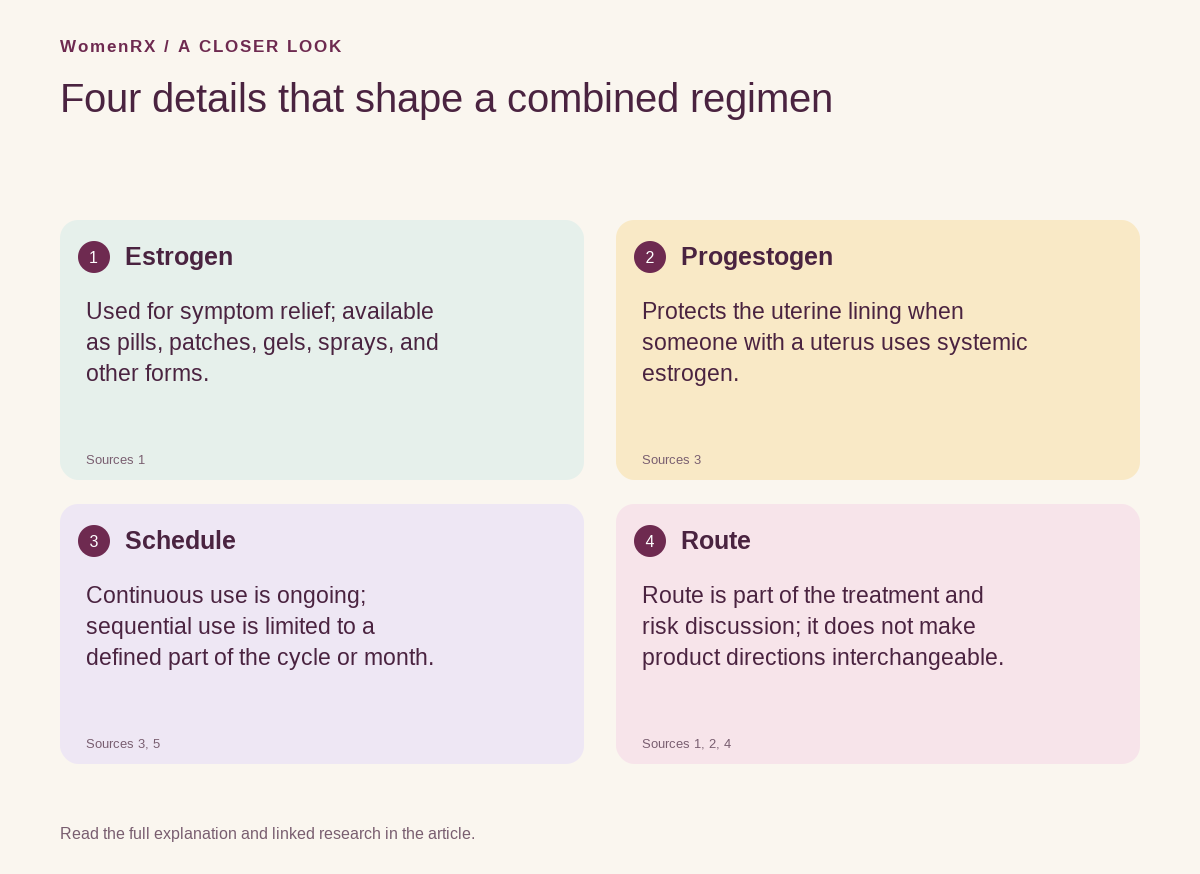
Four details that shape a combined regimen
Estrogen: Used for symptom relief; available as pills, patches, gels, sprays, and other forms.1
Progestogen: Protects the uterine lining when someone with a uterus uses systemic estrogen.3
Schedule: Continuous use is ongoing; sequential use is limited to a defined part of the cycle or month.35
Route: Route is part of the treatment and risk discussion; it does not make product directions interchangeable.124
Read the figure as text
These components have different roles. Compare what each detail means, then confirm the directions for the exact products prescribed.- Estrogen: Used for symptom relief; available as pills, patches, gels, sprays, and other forms.1
- Progestogen: Protects the uterine lining when someone with a uterus uses systemic estrogen.3
- Schedule: Continuous use is ongoing; sequential use is limited to a defined part of the cycle or month.35
- Route: Route is part of the treatment and risk discussion; it does not make product directions interchangeable.124
More questions, answered
Does having a hysterectomy mean I won’t need a progestogen?
Estrogen-only therapy may be recommended after surgery to remove the uterus. If you still have your uterus, MedlinePlus describes estrogen plus progesterone or a similar progestin as a treatment option. Your prescription should reflect your own history. 1
Can I assume a patch and a pill have equivalent doses?
Don’t assume that one product’s strength or directions can be transferred to another route. Estrogen comes in different forms, and route is one factor in the treatment and risk discussion. Confirm the directions for the exact product prescribed. 14
Sources you can check
- Hormone Therapy for Menopause | MedlinePlusAccessed 2026-09-25Return to first citation
- Oral vs Transdermal Estrogen Therapy and Vascular Events: A Systematic Review and Meta-Analysis.Mohammed K, Abu Dabrh AM, Benkhadra K, Al Nofal A, Carranza Leon BG, Prokop LJ, Montori VM, Faubion SS, Murad MH. · The Journal of clinical endocrinology and metabolism · 2015Return to first citation
- Progestogens for endometrial protection in combined menopausal hormone therapy: A systematic review.Stute P, Walker LJ, Eicher A, Pavicic E, Kolokythas A, Theis S, von Gernler M, von Wolff M, Vollrath S. · Best practice & research. Clinical endocrinology & metabolism · 2024Return to first citation
- The 2022 hormone therapy position statement of The North American Menopause Society.“The 2022 Hormone Therapy Position Statement of The North American Menopause Society” Advisory Panel. · Menopause (New York, N.Y.) · 2022Return to first citation
- Progestogens in Menopausal Hormone Therapy: A Double-Edged Sword.Ylikorkala O, Joensuu JM, Siitonen H, Mikkola TS. · Seminars in reproductive medicine · 2025Return to first citation