Postpartum Hair Shedding: What’s Typical and When to Get Help
Postpartum shedding often starts a few months after birth, but its pattern and pace vary, and some kinds of hair loss deserve a closer look.
Diffuse shedding that begins a few months after birth can fit postpartum telogen effluvium, a temporary change linked to hormonal shifts. It often peaks around four months after birth, and many women regain their usual fullness by their baby’s first birthday, but that course isn’t guaranteed. Patchy loss, scalp changes, or thinning that hasn’t improved by a year are reasons to seek assessment. 16
Why shedding can show up after birth
Hair grows in cycles. In telogen effluvium, more hairs than usual shift into a resting phase and later shed, often after a physical or hormonal change. Childbirth and postpartum hormonal changes can trigger this pattern. The shedding is usually spread across the scalp rather than appearing as a single bare patch. 46
A common pattern is increased shedding a few months after delivery. The American Academy of Dermatology says shedding often peaks around four months after birth; most women recover their usual fullness by their baby’s first birthday, sometimes earlier. These are general patterns, not a deadline or a guarantee for any one person. 1
Seeing more hair in the shower or brush can feel alarming, especially while you’re already recovering and caring for a newborn. The amount of visible shedding alone doesn’t tell you what’s causing it. Postpartum telogen effluvium can also occur alongside another hair-loss condition. 3
A practical pattern check
Use these distinctions to decide whether the usual postpartum pattern seems to fit, or whether a closer look would help:
- Spread out or patchy? Diffuse shedding across the scalp can fit telogen effluvium. Sudden, distinct bare patches are a different pattern and can occur with alopecia areata. 6
- Any scalp changes? Redness, scaling, pustules, or crusting around areas of loss can point to an inflammatory or scarring scalp condition rather than routine shedding. 6
- Is the part or top of the scalp gradually thinning? Female-pattern hair loss often shows as diffuse thinning over the top of the scalp. It can coexist with postpartum shedding, so the two aren’t always easy to distinguish by timing alone. 36
- Has the shedding continued or fullness not returned? If your usual fullness hasn’t returned by your baby’s first birthday, the AAD recommends dermatology assessment. You can seek advice sooner if the pattern is patchy, the scalp looks inflamed, or the loss is worrying you. 126
These clues don’t diagnose the cause. In a study of 200 women experiencing postpartum hair loss who received clinical and dermoscopic evaluations, clinicians identified telogen effluvium together with other hair disorders in many participants. Because this was a selected group of women with postpartum hair loss, its percentages shouldn’t be treated as estimates for all people after childbirth. The useful takeaway is narrower: postpartum shedding doesn’t rule out another cause. 3
What an assessment can sort out
A clinician can look at where and how the hair is thinning, examine the scalp, and ask about the timing of the change and other health or medication factors. Hair loss is a symptom, not a diagnosis. Other possible causes include thyroid disturbance, iron deficiency, and medication effects, so the pattern and your history matter when deciding what to check. 46
If you make an appointment, it may help to describe when shedding began, whether it is spread across the scalp or concentrated in certain areas, and whether you’ve noticed scalp irritation. Bring a list of medicines and supplements if you can. These details can help distinguish a temporary shedding pattern from another hair or health condition.
What can help while you wait
For a fuller-looking style, the AAD suggests volumizing shampoo, a light conditioner intended for fine hair, applying conditioner mainly to the ends, or choosing a haircut that gives hair more body. These are appearance measures, not ways to make hair grow faster. Heavy conditioning shampoos and intensive conditioners may weigh fine hair down. 1
Don’t assume a hair-growth medicine or supplement is the right next step just because shedding followed childbirth. Different causes need different approaches, and breastfeeding makes treatment safety a relevant part of the discussion. Guidance on treatments during lactation can be inconsistent, so check a product’s suitability for your circumstances with a clinician rather than starting it on your own. 56
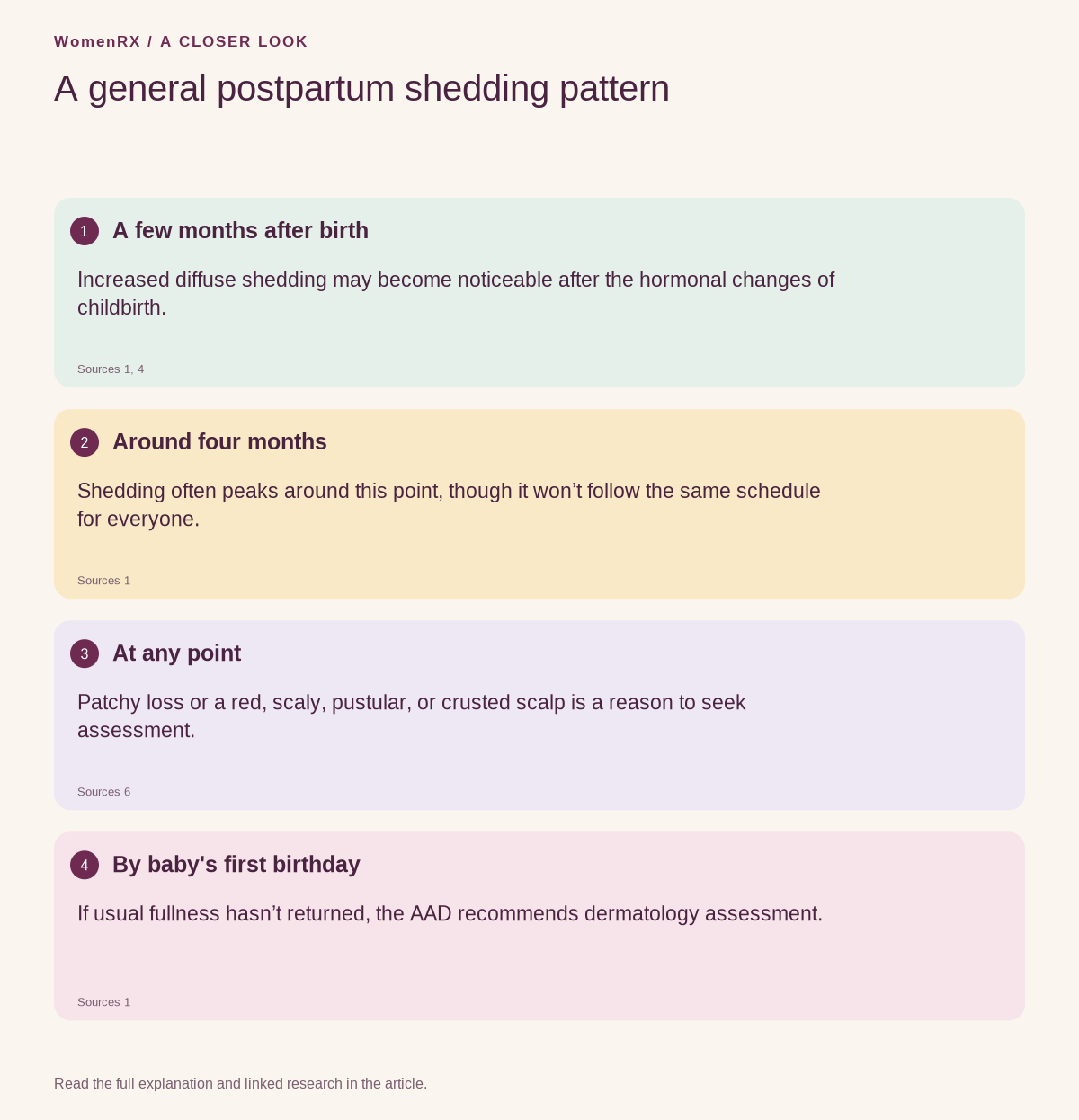
A general postpartum shedding pattern
A few months after birth: Increased diffuse shedding may become noticeable after the hormonal changes of childbirth.14
Around four months: Shedding often peaks around this point, though it won’t follow the same schedule for everyone.1
At any point: Patchy loss or a red, scaly, pustular, or crusted scalp is a reason to seek assessment.6
By baby's first birthday: If usual fullness hasn’t returned, the AAD recommends dermatology assessment.1
Read the figure as text
This shows the broad course described in dermatology guidance, alongside signs that may make an assessment useful. Individual timing varies.- A few months after birth: Increased diffuse shedding may become noticeable after the hormonal changes of childbirth.14
- Around four months: Shedding often peaks around this point, though it won’t follow the same schedule for everyone.1
- At any point: Patchy loss or a red, scaly, pustular, or crusted scalp is a reason to seek assessment.6
- By baby's first birthday: If usual fullness hasn’t returned, the AAD recommends dermatology assessment.1
More questions, answered
Does postpartum shedding always stop by one year?
No. Many women regain their usual fullness by their baby’s first birthday, but that isn’t guaranteed. If fullness hasn’t returned by then, the AAD recommends seeing a dermatologist to look for another cause. 1
Can postpartum shedding happen alongside another hair-loss condition?
Yes. A clinical study of 200 women experiencing postpartum hair loss who received clinical and dermoscopic evaluations found that telogen effluvium sometimes occurred with other hair disorders. Its selected participants don’t represent everyone after birth, but the findings support getting an unusual or persistent pattern assessed. 3
Sources you can check
- Hair loss in new moms: Dermatologist tipsAccessed 2026-09-25Return to first citation
- Hair loss - NHSAccessed 2026-09-25Return to first citation
- Postpartum Telogen Effluvium Unmasking Additional Latent Hair Loss Disorders.Galal SA, El-Sayed SK, Henidy MMH. · The Journal of clinical and aesthetic dermatology · 2024Return to first citation
- Telogen EffluviumHughes EC, Syed HA, Saleh D. · 2026Return to first citation
- Managing Skin Diseases that Flare During Pregnancy and in the Postpartum period: Part 2- Management & Safety Considerations.Lyons CE, Smith AD, Schwartzman G, Buscemi L, Hickman A, Grant-Kels JM. · Journal of the American Academy of Dermatology · 2026Return to first citation
- The Diagnosis and Treatment of Hair and Scalp Diseases.Wolff H, Fischer TW, Blume-Peytavi U. · Deutsches Arzteblatt international · 2016Return to first citation