Postpartum Hair Shedding: What Recovery Can Look Like
All-over shedding a few months after birth often follows a temporary hair-cycle change, but its course varies.
Yes. When postpartum shedding fits telogen effluvium, it’s generally temporary, and hair regrowth can follow as the cycle settles. In one clinical study, researchers observed regrowing hairs in women diagnosed with telogen effluvium, but the study can’t promise a return to your exact previous fullness. Patchy loss or shedding that doesn’t ease deserves a closer look. 2 3 4
Why the shedding starts later
During pregnancy, more hair follicles may stay in their growth phase. After birth, a larger group of follicles shifts toward resting, and the hairs shed later. This is called telogen effluvium. It usually looks like increased shedding across the scalp, not loss confined to one spot. 3 4
For example, you might notice more hair when you wash it or feel that your ponytail is thinner. That can fit postpartum shedding, but the amount in your brush can’t tell you the cause by itself.
What the timing can, and can’t, tell you
In a questionnaire study of 331 women who had given birth at two facilities, the average reported start of shedding was 2.9 months postpartum. It peaked at 5.1 months and ended at 8.1 months on average. The study had a 21% response rate and relied on women’s recollections, so it gives a useful picture of the pattern, not a schedule your hair must follow. 3
Postpartum shedding is also commonly described as beginning about two to four months after birth and lasting roughly six months to a year. These descriptions track when shedding starts and ends, not when or how fully hair density returns. 3
Does postpartum hair loss grow back?
Usually, yes, when the shedding is telogen effluvium. This type of hair loss is nonscarring, and a clinical study of women with postpartum hair loss reported visible regrowing hairs among participants diagnosed with telogen effluvium. That supports regrowth as part of the pattern, but it doesn’t establish how quickly hair returns or guarantee that everyone will regain exactly their previous fullness. 2 4
The distinction matters because postpartum shedding can overlap with other hair-loss conditions. In that same study, researchers found additional diagnoses among women being evaluated for postpartum hair loss. The study doesn’t show how common those conditions are among all postpartum women, but it helps explain why persistent thinning or a pattern that seems unusual may need a closer look. 2
When to look beyond postpartum shedding
The clearest distinction is all-over shedding versus loss concentrated in an area. A distinct bald patch doesn’t match the usual diffuse pattern as well. It’s reasonable to seek an assessment if the loss is patchy, keeps worsening, continues well beyond the commonly described course, or worries you. These are practical reasons to get a closer look, not diagnostic cutoffs. 1 3 4
Tell a clinician about other health changes, too. For example, mention a recent illness, a period of eating very little, or a medication change rather than assuming every change in your hair is due to birth. Illness, low protein intake, iron deficiency, hypothyroidism, and some medications can also trigger diffuse shedding. 4
If you’re breastfeeding, you don’t need to treat shedding alone as evidence that feeding your baby is causing it. A questionnaire study found an association between breastfeeding duration and reported hair loss, but its design couldn’t show that breastfeeding caused the shedding or that stopping would help. 3
A possible course of postpartum shedding
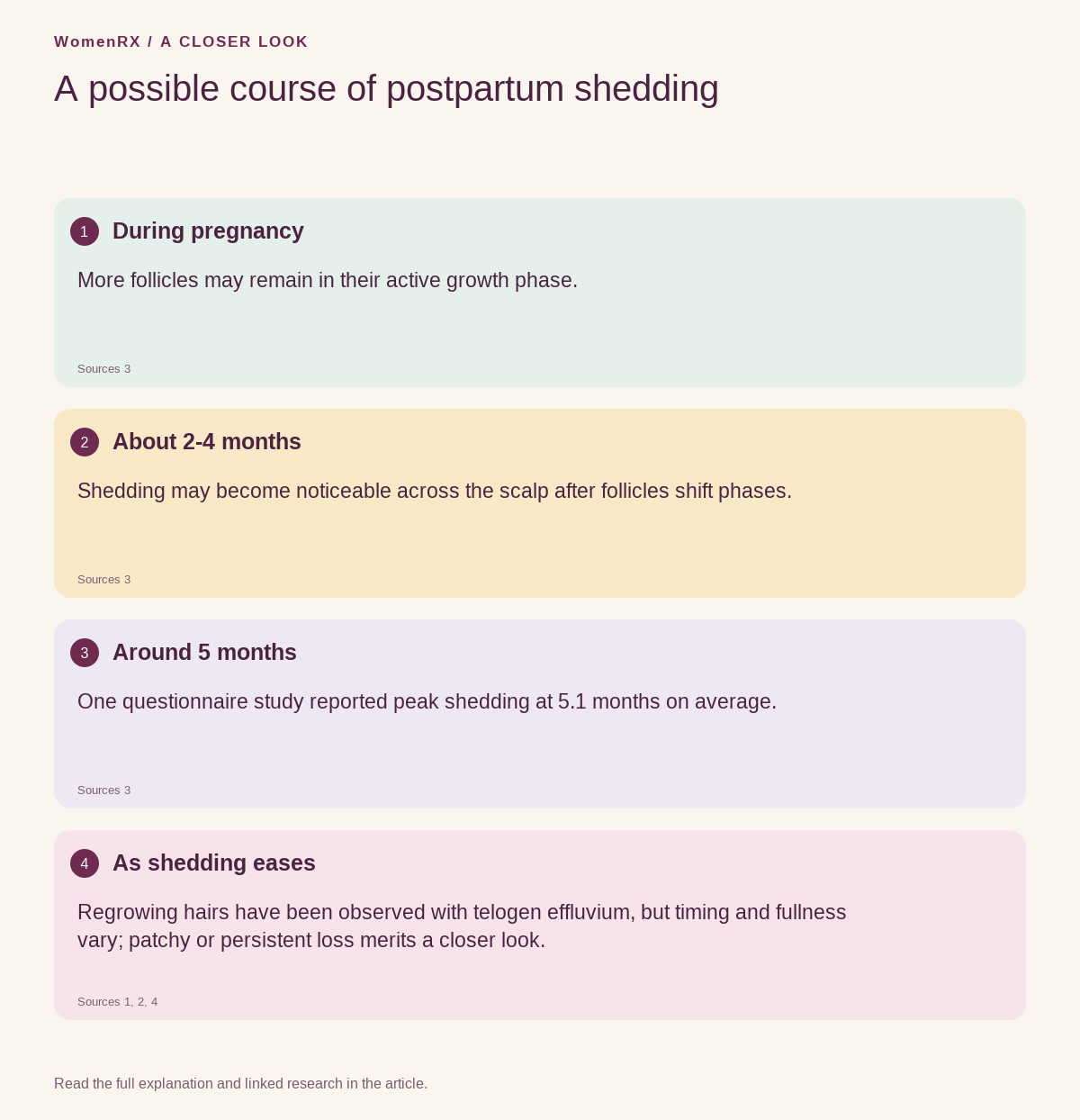
During pregnancy: More follicles may remain in their active growth phase.3
About 2-4 months: Shedding may become noticeable across the scalp after follicles shift phases.3
Around 5 months: One questionnaire study reported peak shedding at 5.1 months on average.3
As shedding eases: Regrowing hairs have been observed with telogen effluvium, but timing and fullness vary; patchy or persistent loss merits a closer look.124
Read the figure as text
This sequence explains the delay between birth and shedding, and separates the average shedding pattern from what research can say about regrowth.- During pregnancy: More follicles may remain in their active growth phase.3
- About 2-4 months: Shedding may become noticeable across the scalp after follicles shift phases.3
- Around 5 months: One questionnaire study reported peak shedding at 5.1 months on average.3
- As shedding eases: Regrowing hairs have been observed with telogen effluvium, but timing and fullness vary; patchy or persistent loss merits a closer look.124
More questions, answered
Will my hair grow back completely?
Hair regrowth is part of the usual temporary telogen-effluvium pattern, but the available clinical study doesn’t establish that everyone returns to their exact previous fullness. If thinning persists or is concentrated in one area, an assessment can help distinguish postpartum shedding from another hair-loss condition. 2 3 4
Sources you can check
- Hair loss - NHSAccessed 2026-09-25Return to first citation
- Postpartum Telogen Effluvium Unmasking Additional Latent Hair Loss Disorders.Galal SA, El-Sayed SK, Henidy MMH. · The Journal of clinical and aesthetic dermatology · 2024Return to first citation
- Investigation of exacerbating factors for postpartum hair loss: a questionnaire-based cross-sectional study.Hirose A, Terauchi M, Odai T, Fudono A, Tsurane K, Sekiguchi M, Iwata M, Anzai T, Takahashi K, Miyasaka N. · International journal of women's dermatology · 2023Return to first citation
- Telogen EffluviumHughes EC, Syed HA, Saleh D. · 2026Return to first citation