Heavy Hair Shedding: What Timing and Pattern Can Tell You
Shedding across the scalp after an illness or childbirth calls for a different look than a widening part or distinct bare patches.
Start with the pattern, not the number of hairs in the drain. Sudden shedding across the scalp can begin a few months after illness, surgery, or childbirth. Gradual widening of the part points toward a different pattern, while distinct patches deserve an examination. Heavy periods make iron deficiency worth considering, but shedding alone can’t establish the cause. 1 2 6 7

First, look at where the hair is changing
A brush full of hair gets your attention, but the amount you see can’t tell you why it’s happening. Two better clues are whether the change was sudden or gradual, and whether hair is coming from all over or thinning in a particular area.
Sudden shedding across the scalp can fit telogen effluvium. In this type of hair loss, a disruption to the hair-growth cycle leaves more hairs in the resting phase before they shed. Physical strain, hormonal changes, and some medications are possible triggers. Gradual thinning around the central part, sometimes with changes near the front or temples, is a different pattern associated with female pattern hair loss. The two can be hard to distinguish without an examination. 4 5 7
Distinct bare patches aren’t the diffuse pattern described for telogen effluvium. Rather than treating them as ordinary shedding, arrange an assessment to find out what kind of hair loss is involved. 4 5
Look back a few months
Hair shedding may lag behind the event that set it off. Telogen effluvium often begins about two to three months after a stressful event. Examples of possible triggers include a fever or acute illness, major surgery, childbirth, substantial dietary restriction, and certain medications. A matching timeline is a clue, not proof of a cause. 5 6
That delay helps explain why postpartum shedding can seem to start out of nowhere. Hormonal changes after delivery are a recognized possible trigger, but they don’t rule out another contributor. If the timing fits, think about what changed in your health or routine before the shedding began, not just in the past week. 5 6
If you recently started or changed a medication, include its name when you seek an assessment rather than assuming it’s responsible. A medication history can help put the timing in context. 5
When heavy periods make iron relevant
Heavy menstrual bleeding increases the risk of iron deficiency. Periods may be heavy if, for example, you need to change a pad or tampon every one to two hours, bleed for more than seven days, bleed through clothing or bedding, or miss activities because of the bleeding. Heavy periods can occur at different times in life, including after pregnancy or as menopause approaches. If bleeding is affecting your life, address that concern as well as the hair change. 1 2
Low ferritin, a measure of iron stores, has been linked with telogen effluvium in some research. In a cross-sectional study of 50 women with telogen effluvium and 50 controls, average ferritin was lower in the shedding group. That finding doesn’t show that low iron caused their hair loss or that iron supplements would reverse it. A separate study of shedding after COVID-19 found lower average ferritin in its shedding group but questioned ferritin’s usefulness as an iron-deficiency marker in that particular setting. 4 6
The useful distinction is between a reason to consider iron deficiency and a reason to take iron. Heavy bleeding, for example, gives a clinician a reason to consider focused evaluation. Shedding by itself doesn’t show that you need a supplement; too much iron can be harmful. 1 2 3
What if there’s no clear trigger?
Thyroid disorders are another possible contributor to diffuse shedding. If the loss is widespread and you can’t identify a likely trigger, a history and scalp examination can help determine whether checking for a thyroid or iron problem makes sense. This is more useful than assuming everyone who sheds needs the same set of tests. 5 7
Also notice what happens next. Shedding that persists beyond six months is described as chronic telogen effluvium, though that label doesn’t tell you the cause or predict your recovery. Arrange an evaluation if shedding continues, your part is gradually widening, you develop distinct patches, or the pattern isn’t clear. The most helpful starting description is simple: when it began, where you’re losing hair, and what changed in the preceding months. 4 7
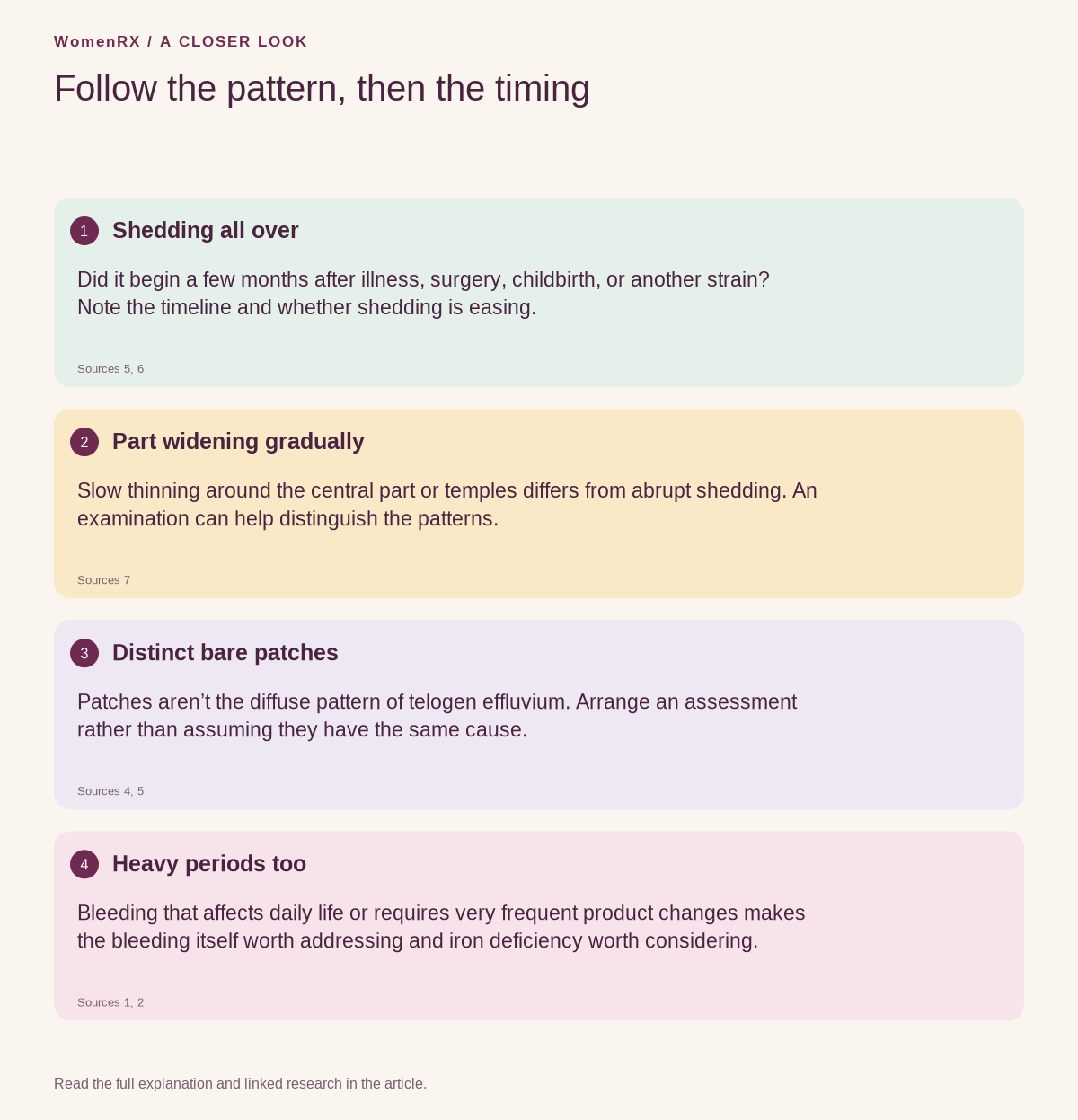
Follow the pattern, then the timing
Shedding all over: Did it begin a few months after illness, surgery, childbirth, or another strain? Note the timeline and whether shedding is easing.56
Part widening gradually: Slow thinning around the central part or temples differs from abrupt shedding. An examination can help distinguish the patterns.7
Distinct bare patches: Patches aren’t the diffuse pattern of telogen effluvium. Arrange an assessment rather than assuming they have the same cause.45
Heavy periods too: Bleeding that affects daily life or requires very frequent product changes makes the bleeding itself worth addressing and iron deficiency worth considering.12
Read the figure as text
Start with where hair is changing. Then consider what happened before shedding began and whether another symptom needs attention.- Shedding all over: Did it begin a few months after illness, surgery, childbirth, or another strain? Note the timeline and whether shedding is easing.56
- Part widening gradually: Slow thinning around the central part or temples differs from abrupt shedding. An examination can help distinguish the patterns.7
- Distinct bare patches: Patches aren’t the diffuse pattern of telogen effluvium. Arrange an assessment rather than assuming they have the same cause.45
- Heavy periods too: Bleeding that affects daily life or requires very frequent product changes makes the bleeding itself worth addressing and iron deficiency worth considering.12
More questions, answered
Does low ferritin prove iron is causing my hair loss?
No. A study in women found lower average ferritin among those with telogen effluvium than among controls, but its cross-sectional design can’t establish cause and effect. Heavy periods or another reason for iron loss can make iron evaluation more relevant to your particular situation. 1 2 4
Sources you can check
- Heavy periods - NHSAccessed 2026-09-25Return to first citation
- Iron - Health Professional Fact SheetAccessed 2026-09-25Return to first citation
- Iron: MedlinePlusAccessed 2026-09-25Return to first citation
- Assessment of Serum Ferritin Levels in Female Patients With Telogen Effluvium.Thamotharan N, Harikumar MV, Sundaram M, Swaminathan A, Rangarajan S. · Cureus · 2025Return to first citation
- Telogen EffluviumHughes EC, Syed HA, Saleh D. · 2026Return to first citation
- Post Covid telogen effluvium: the diagnostic value of serum ferritin biomarker and the preventive value of dietary supplements. a case control study.Bedair NI, Abdelaziz AS, Abdelrazik FS, El-Kassas M, AbouHadeed MH. · Archives of dermatological research · 2024Return to first citation
- Diffuse hair loss in an adult female: approach to diagnosis and management.Shrivastava SB. · Indian journal of dermatology, venereology and leprology · 2009Return to first citation