Hair Shedding on Ozempic: What Does the Timing Tell You?
The most useful clue is how shedding lines up with changes in your weight and health, not simply the date you started Ozempic.
Hair shedding that begins after starting Ozempic deserves attention, but timing alone can’t show whether semaglutide, weight change, or something else is responsible. A study of adults with diabetes or obesity found an association between semaglutide and later hair-loss diagnoses, not proof of a direct drug effect.3 Compare when shedding began with changes in weight, eating, illness, and, if relevant, childbirth. The pattern of loss matters too.167
Start with the kind of change you’re seeing
Are you finding more hair in the shower or brush, or has your hair been gradually thinning? That distinction is more useful than the fact that both changes happened while you were taking Ozempic. Increased shedding can follow a change in the body. Gradual thinning, particularly with a family history of hair loss, is a reason to ask about female-pattern loss, not proof of it. More than one cause can be present at once. A dermatologist’s assessment starts with the history and the hair itself; blood tests may help when a disease, nutritional deficiency, or hormone imbalance is suspected.127
For example, if you’ve noticed handfuls of loose hair after a period when your weight changed and you were eating much less, bring that whole sequence to your diabetes-care clinician. If your part was widening before you started Ozempic, that earlier change matters just as much as the newer shedding. Neither observation is a diagnosis, but each points the conversation in a different direction.17
What the Ozempic evidence can tell you
The US prescribing information for Ozempic injection describes gastrointestinal reactions in its placebo-controlled trials and notes that nausea, vomiting, and diarrhea were reported mostly during dose escalation. The Ozempic label cautions that voluntary post-approval reports generally cannot establish how often a reaction occurs or whether the drug caused it.5
Broader research raises a question worth taking seriously. In a retrospective study of adults with type 2 diabetes or obesity, researchers compared people who used GLP-1 medicines with matched nonusers. They assessed hair-loss diagnoses at one, three, and five years after semaglutide initiation. Higher odds of a telogen-effluvium diagnosis were reported at three and five years, and users with hair-loss outcomes had lower follow-up BMI than users without them. Those findings cannot tell you that shedding should begin three years after your first dose, or separate a drug effect from the effects of weight change.3
Reports to an adverse-event database are different again. An analysis found alopecia among skin-related reports for GLP-1 medicines, but reports are not a count of everyone who used Ozempic and cannot establish an Ozempic-specific chance of hair loss.4 Together, these sources support investigating a new change, not assuming the medication directly caused it or stopping diabetes treatment on your own.
Read the timeline as clues, not a verdict
Think back beyond the day you first noticed hair on your pillow. Did shedding start after a dose change accompanied by nausea or difficulty eating? Did your weight change during that period? Was there an illness, major stress, or childbirth in the preceding months? Illness, stress, poor nutrition, and thyroid problems are among recognized considerations in hair loss.15
The delay after childbirth is one timing clue with clearer guidance: postpartum shedding often appears a few months after delivery as estrogen falls and commonly peaks around four months. If you recently had a baby, starting or changing a medicine in the same period doesn’t make that medicine the only possible explanation. If your usual fullness hasn’t returned by your baby’s first birthday, a dermatologist can assess whether something else is contributing.6
There is no similarly reliable ‘Ozempic shedding clock’ in the research above. The cohort’s one-, three-, and five-year points are times when diagnoses were measured, not a schedule for when an individual woman’s shedding starts.3 A close match between a dose change and shedding is worth mentioning, especially if eating also became difficult, but it does not settle the cause.57
Make room for another cause, including a second one
If thinning has been gradual or hair loss runs in your family, ask whether female-pattern hair loss might be present alongside any new shedding. Hair loss can also relate to thyroid disease, diabetes, stress, or iron deficiency.12 If you’ve been eating much less, mention that too; a dermatologist may consider blood tests if a nutritional deficiency is suspected.17
Life stage belongs in that history, but it isn’t a diagnosis. Recent childbirth has a recognized shedding pattern. If you’re around menopause or past it, mention when gradual thinning began and whether it predates Ozempic; age-related and female-pattern loss remain possibilities.126
At an appointment, a focused question is: ‘Does this look like increased shedding, female-pattern thinning, or both, and does my history suggest a cause we can check?’ Bring the dates you started Ozempic and noticed the change, plus any major changes in weight, eating, health, or postpartum status. That gives your clinician something more useful to assess than a start date by itself.157
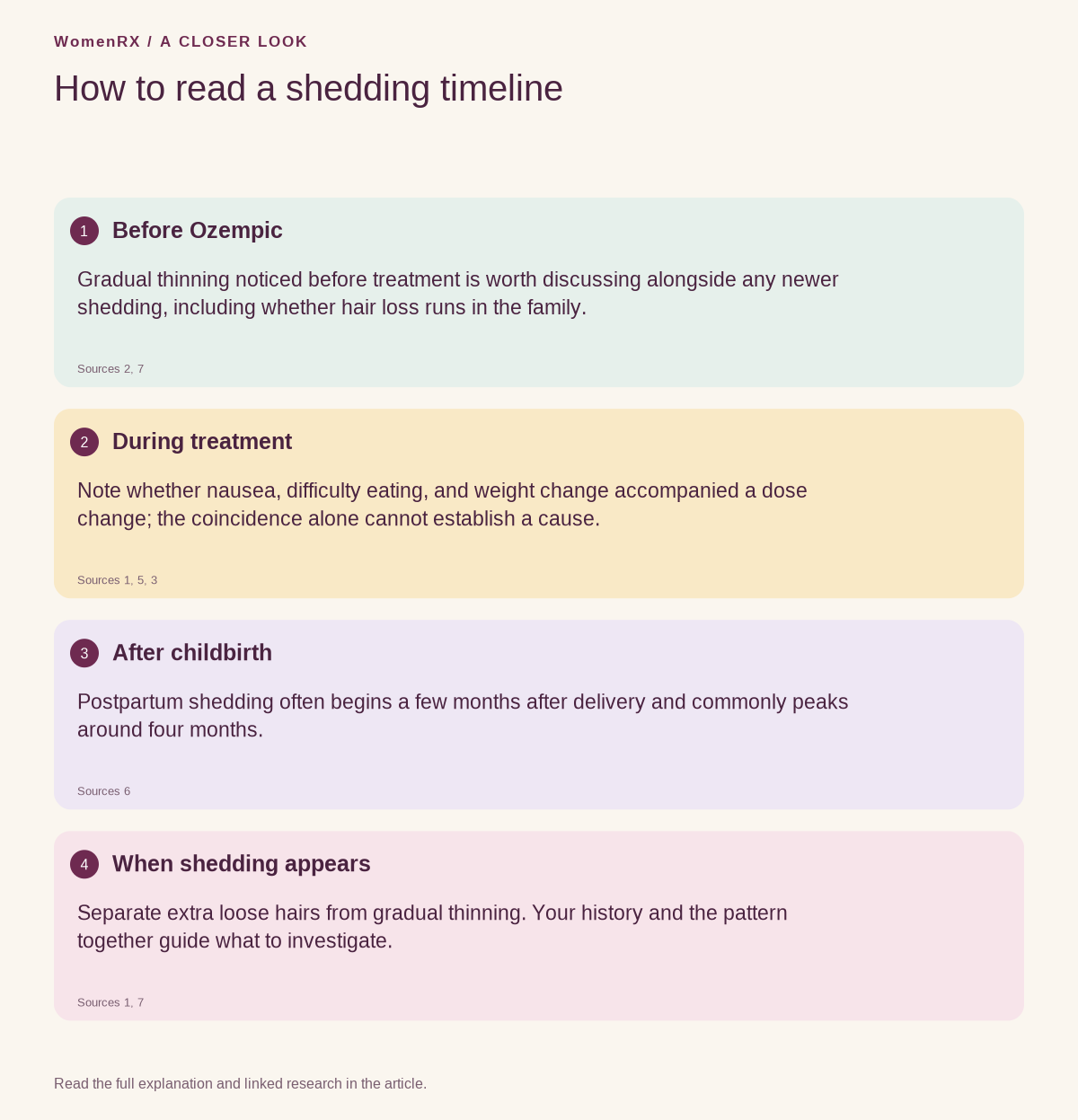
How to read a shedding timeline
Before Ozempic: Gradual thinning noticed before treatment is worth discussing alongside any newer shedding, including whether hair loss runs in the family.27
During treatment: Note whether nausea, difficulty eating, and weight change accompanied a dose change; the coincidence alone cannot establish a cause.153
After childbirth: Postpartum shedding often begins a few months after delivery and commonly peaks around four months.6
When shedding appears: Separate extra loose hairs from gradual thinning. Your history and the pattern together guide what to investigate.17
Read the figure as text
These anchors show what timing can add to an assessment without turning sequence into proof of cause.- Before Ozempic: Gradual thinning noticed before treatment is worth discussing alongside any newer shedding, including whether hair loss runs in the family.27
- During treatment: Note whether nausea, difficulty eating, and weight change accompanied a dose change; the coincidence alone cannot establish a cause.153
- After childbirth: Postpartum shedding often begins a few months after delivery and commonly peaks around four months.6
- When shedding appears: Separate extra loose hairs from gradual thinning. Your history and the pattern together guide what to investigate.17
More questions, answered
Can I tell from the start date whether Ozempic caused my hair loss?
No. A start date shows that exposure came before the change, but it can’t distinguish a direct medication effect from weight change or a separate cause. The semaglutide cohort found an association with later diagnoses, not an individual onset rule or proof of causation.3
Sources you can check
- Hair Loss | Alopecia | Alopecia Areata | MedlinePlusAccessed 2026-09-25Return to first citation
- Hair loss - NHSAccessed 2026-09-25Return to first citation
- Nonscarring Alopecia in Adults Treated With GLP-1s: A Propensity Score Matched TriNetX Cohort Study.Katragadda R, Hayden J, Saltagi AK, Welschmeyer AF, Quereshy HA, Karasik D, Rabbani CC, Gourishetti SC, Goslawski AM. · The Laryngoscope · 2026Return to first citation
- A Retrospective Comparative Analysis of Cutaneous Adverse Reactions in GLP-1 Agonist Therapies.Daniel S, Waggett S, Lyles E, Sagut P, Shamaei Zadeh P, Marcelletti A, Stegura C, Wine Lee L. · Journal of drugs in dermatology : JDD · 2025Return to first citation
- OZEMPIC (SEMAGLUTIDE) INJECTION, SOLUTION [NOVO NORDISK PHARMACEUTICAL INDUSTRIES, LP] | US prescribing information and patient instructionsAccessed 2026-09-25Return to first citation
- Hair loss in new moms: Dermatologist tipsAccessed 2026-09-25Return to first citation
- Hair loss: Diagnosis and treatmentAccessed 2026-09-25Return to first citation