Does Iron Help With Hair Loss When Iron Is Low?
Low iron stores may be relevant to shedding, but a ferritin result alone can’t tell you why your hair is falling out or whether iron will restore it.
If testing finds iron deficiency, it’s worth addressing for your health, and low iron may be one factor in hair shedding. But studies linking ferritin and hair loss don’t prove that iron supplements regrow hair. Ferritin below 30 mcg/L suggests iron deficiency generally; it isn’t a proven hair-loss cutoff or a target for regrowth. 2 5
A low ferritin result is a clue, not a diagnosis
Ferritin reflects your body’s iron stores. A low result can point to iron deficiency even before anemia is present, so it may be relevant when you’re shedding. But hair loss has more than one possible cause. In a study of 180 women with diffuse hair loss, researchers reported different findings across hair-loss diagnoses, and some women had more than one possible cause. 2 6
The distinction matters: finding low iron alongside hair loss doesn’t show that iron caused the shedding. And an association between lower ferritin and hair loss doesn’t prove that taking iron will bring hair back. A case-control study found lower average ferritin in 100 women with diffuse, non-scarring hair loss than in 100 controls, but that kind of comparison cannot establish cause or treatment effect. 5
Ferritin has a general threshold, not a hair-growth target
The NIH Office of Dietary Supplements says ferritin below 30 micrograms per liter suggests iron deficiency. That’s a general guide to iron status, not a validated point at which hair loss begins or regrowth becomes likely. Inflammation can raise ferritin, too, which may make a result harder to interpret. 2
Hair-loss studies don’t point to one simple ferritin number. For example, a study of 108 women with diffuse hair loss found similar ferritin levels in its acute and chronic telogen effluvium groups. That comparison doesn’t answer whether iron treatment helps, but it illustrates why ferritin needs to be interpreted alongside the type of hair loss and the rest of your health picture. 4
There isn’t a hair-specific ferritin target established by these findings. If your iron stores are adequate, this evidence doesn’t support taking iron in hopes of regrowth.
When iron testing may be more relevant
Your history can help make sense of a test. Heavy periods can increase the chance of low iron; pregnancy is also a time when iron deficiency is more common. Low intake and problems absorbing iron are other possible contributors. These details make iron status worth considering, but they don’t establish that iron is the cause of your hair loss. 2 3
The pattern matters, too. Diffuse shedding and female-pattern hair loss are not interchangeable diagnoses, and hair loss can have temporary or longer-term causes. A clinician can use your history and an examination to help sort through them rather than treating every case of shedding as an iron problem. 1 6
What an iron check can and can’t tell you
Ferritin is one part of the picture. Blood-count measures such as hemoglobin and hematocrit are commonly used to assess iron deficiency and anemia, but they are not sensitive or specific enough on their own to describe the full range of iron status. Ferritin is useful for assessing iron stores, though inflammation can affect it. A clinician may consider more than one measure when interpreting results. 2
If testing confirms iron deficiency, addressing it is different from taking iron for hair when your stores are already adequate. Iron supplements are commonly used to treat low iron and iron-deficiency anemia, but that doesn’t establish that they will resolve shedding. Too much iron can cause digestive symptoms, including constipation, nausea, vomiting, abdominal pain, and diarrhea; very high levels can damage organs. 3
The practical takeaway: consider iron as one possible part of the explanation, especially when your history suggests risk, but don’t use a single ferritin number as a hair-loss diagnosis or a promise of regrowth.
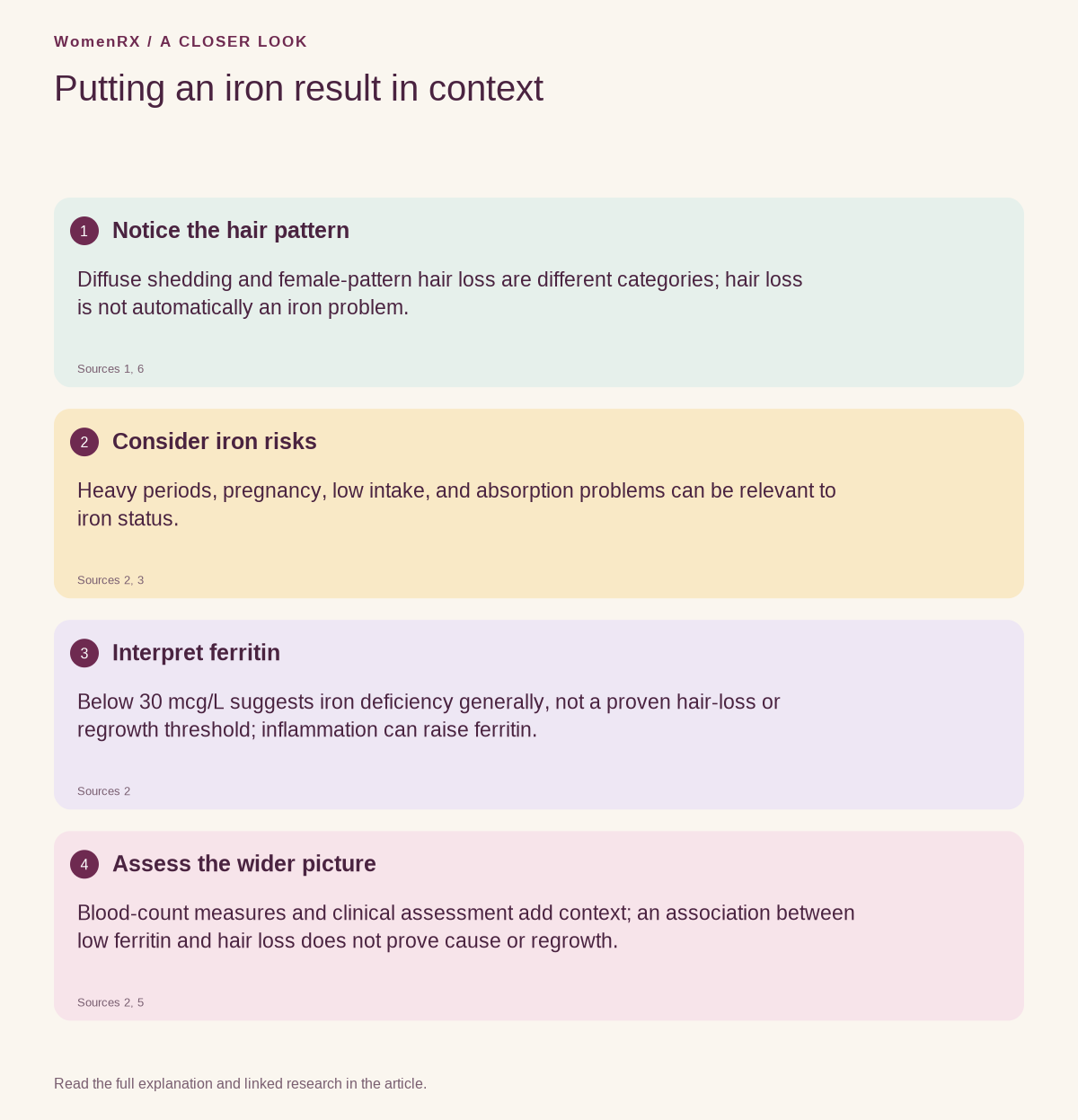
Putting an iron result in context
Notice the hair pattern: Diffuse shedding and female-pattern hair loss are different categories; hair loss is not automatically an iron problem.16
Consider iron risks: Heavy periods, pregnancy, low intake, and absorption problems can be relevant to iron status.23
Interpret ferritin: Below 30 mcg/L suggests iron deficiency generally, not a proven hair-loss or regrowth threshold; inflammation can raise ferritin.2
Assess the wider picture: Blood-count measures and clinical assessment add context; an association between low ferritin and hair loss does not prove cause or regrowth.25
Read the figure as text
Hair-loss pattern and iron-risk history help frame a ferritin result; neither a symptom nor one number proves that iron is the cause.- Notice the hair pattern: Diffuse shedding and female-pattern hair loss are different categories; hair loss is not automatically an iron problem.16
- Consider iron risks: Heavy periods, pregnancy, low intake, and absorption problems can be relevant to iron status.23
- Interpret ferritin: Below 30 mcg/L suggests iron deficiency generally, not a proven hair-loss or regrowth threshold; inflammation can raise ferritin.2
- Assess the wider picture: Blood-count measures and clinical assessment add context; an association between low ferritin and hair loss does not prove cause or regrowth.25
More questions, answered
Does ferritin below 30 mean iron is causing my hair loss?
No. Below 30 mcg/L suggests iron deficiency generally, but it is not a proven hair-loss cutoff. The result needs context, including possible inflammation and the pattern of hair loss. 2
Is it worth taking iron if my ferritin is normal?
This evidence doesn’t establish a hair benefit from iron when stores are adequate. Extra iron can cause digestive problems, and excessive amounts can be harmful. 3
Sources you can check
- Hair loss - NHSAccessed 2026-09-25Return to first citation
- Iron - Health Professional Fact SheetAccessed 2026-09-25Return to first citation
- Iron: MedlinePlusAccessed 2026-09-25Return to first citation
- Evaluation of the relationship of digital phototrichogram findings of patients with diffuse hair loss with blood TSH, ferritin and vitamin B12 levels.Bilik L, Kokcam I, Esen M. · Northern clinics of Istanbul · 2024Return to first citation
- Quantitative Analysis of Selected Circulating Hematological Biomarkers, Essential Minerals, Vitamins, and Thyroid Hormones in Females Affected by Hair Loss.Al-Fawaeir S, Al-Odat I. · Diseases (Basel, Switzerland) · 2025Return to first citation
- A Hospital-based Study to Determine Causes of Diffuse Hair Loss in Women.Malkud S. · Journal of clinical and diagnostic research : JCDR · 2015Return to first citation