Ferritin, Iron Tests, and Hair Loss: What Results Mean
A low ferritin can point to depleted iron stores, but it can’t prove that iron deficiency caused your hair loss.
Ferritin reflects stored iron, while hemoglobin helps show whether iron deficiency has progressed to anemia; clinicians may use several iron measures together because no one result tells the whole story. Low iron is associated with hair loss in some studies, but that doesn’t establish cause or prove a hair-growth target such as ferritin 60 is needed. 2 4 6
Start with what ferritin measures
Ferritin is a blood marker of the iron your body has stored. It can fall before hemoglobin does, so a normal hemoglobin result doesn’t necessarily rule out low iron stores. Hemoglobin and hematocrit are commonly used to assess anemia, but they don’t describe every stage of iron depletion. 2
A ferritin below 30 micrograms per liter (mcg/L) suggests iron deficiency in the NIH Office of Dietary Supplements reference. That’s a useful clue, not a hair-loss diagnosis or a universal cutoff that settles every case. Inflammation can raise ferritin, which may make the result harder to interpret; clinicians may consider other iron measurements and your health context too. 2
Other tests answer different questions. Hemoglobin helps assess anemia. Iron circulates in the blood bound to transferrin, a transport protein; transferrin saturation is another measure used in evaluating iron status. No single number explains why your hair is shedding. 2 5
What the result says about your hair, and what it doesn’t
Research finds an association, not a settled cause-and-effect answer. A 2022 systematic review and meta-analysis included 36 studies and 10,029 participants. Women with nonscarring hair loss had lower ferritin on average than women without it, but that comparison can’t show whether low iron caused the hair loss or whether raising ferritin would restore hair. 4
A separate study of people tested for hair loss in primary care found iron deficiency in some patients, particularly women. Because it was observational and couldn’t analyze the relationship by hair-loss type, it doesn’t establish that deficiency caused their hair loss. 3
Hair loss has other possible explanations, including thyroid problems, illness, stress, some medicines, and poor nutrition. The pattern and timing of loss matter too. A ferritin result is one part of figuring out what’s happening, not a substitute for considering other causes. 1
Why “ferritin 60 for hair” isn’t a settled target
You may see a proposed ferritin target of 40 to 60 or at least 60 mcg/L for hair growth. One retrospective study at a single medical center defined iron deficiency as ferritin below 60 and proposed that level as a new “normal” range. That was the authors’ proposal, not proof from a controlled trial that reaching 60 improves hair growth for women generally. 6
The broader research doesn’t settle the question either. The meta-analysis found lower ferritin in women with nonscarring hair loss, but it did not establish a hair-specific threshold or show that iron treatment reliably reverses hair loss. Treating a confirmed deficiency may be appropriate for your overall health, but the lab result alone can’t promise a hair outcome. 4
Put the number in your context
Iron deficiency can occur with blood loss, low dietary intake, or problems absorbing nutrients. Menstrual blood loss may be relevant if your periods are heavy; pregnancy is another time when iron deficiency is more common. These factors can help explain iron status, but they do not prove that iron is the reason for your hair loss. 2
When reviewing results, useful questions include: Is my ferritin low by the lab’s range and the clinical context? Does my hemoglobin suggest anemia, or could I have low stores without anemia? Do other iron measures change the interpretation? Could inflammation affect ferritin? And is there a likely reason for low iron, such as ongoing blood loss or difficulty getting or absorbing enough iron? 2
If iron deficiency is found, ask what may be contributing and how the plan will address it. Don’t start iron just to chase a hair-specific number: the evidence doesn’t establish one universal target, and a ferritin result needs interpretation alongside the rest of your health picture. Hair loss can have several causes, so a low result may be a relevant clue without being the whole explanation. 1 2 4
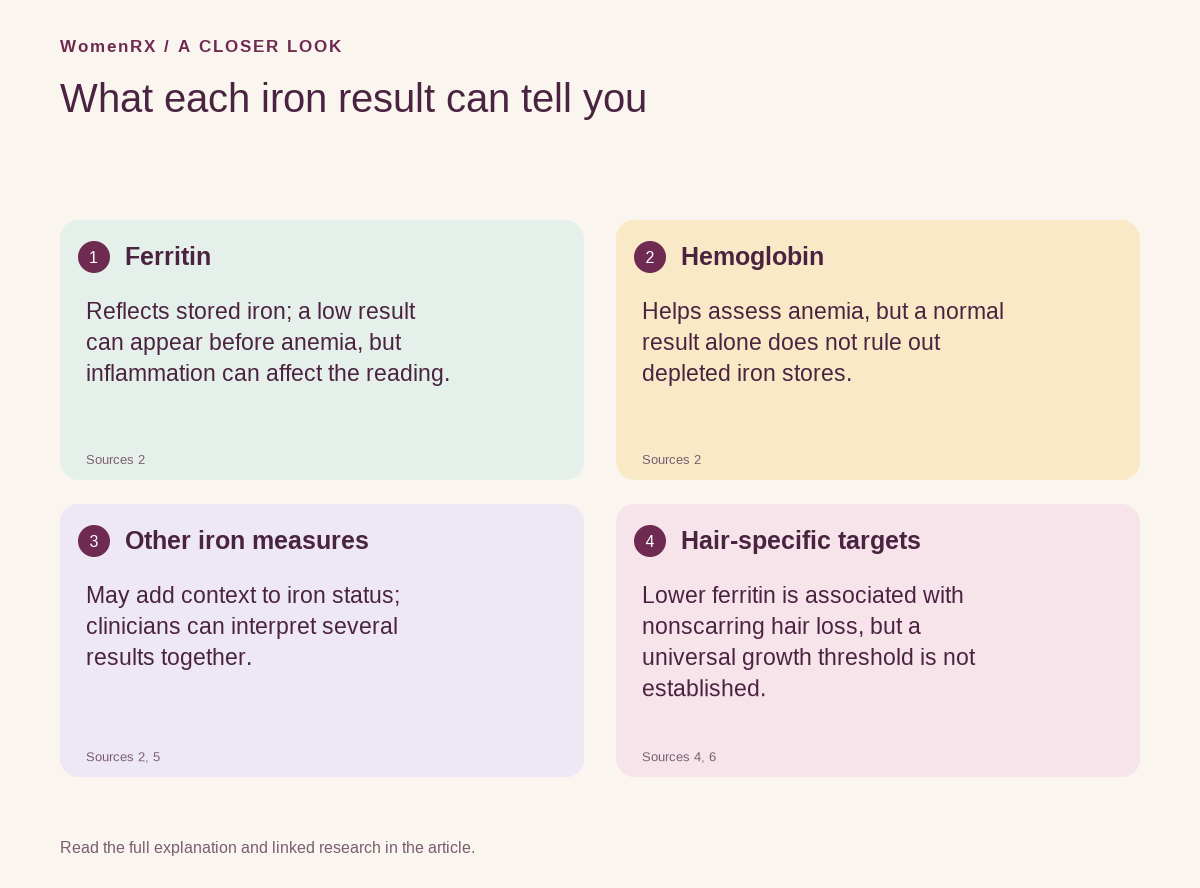
What each iron result can tell you
Ferritin: Reflects stored iron; a low result can appear before anemia, but inflammation can affect the reading.2
Hemoglobin: Helps assess anemia, but a normal result alone does not rule out depleted iron stores.2
Other iron measures: May add context to iron status; clinicians can interpret several results together.25
Hair-specific targets: Lower ferritin is associated with nonscarring hair loss, but a universal growth threshold is not established.46
Read the figure as text
These tests describe different parts of iron status; none can identify the cause of hair loss on its own.- Ferritin: Reflects stored iron; a low result can appear before anemia, but inflammation can affect the reading.2
- Hemoglobin: Helps assess anemia, but a normal result alone does not rule out depleted iron stores.2
- Other iron measures: May add context to iron status; clinicians can interpret several results together.25
- Hair-specific targets: Lower ferritin is associated with nonscarring hair loss, but a universal growth threshold is not established.46
More questions, answered
Can iron deficiency exist without anemia?
Yes. Iron stores can become depleted before hemoglobin falls, so ferritin may indicate low iron even when a blood count doesn’t show anemia. 2
Does a low ferritin prove iron caused my hair loss?
No. Studies have found an association between lower ferritin and nonscarring hair loss in women, but they don’t establish that low iron caused an individual’s hair loss or that raising ferritin will restore it. 4
Sources you can check
- Hair Loss | Alopecia | Alopecia Areata | MedlinePlusAccessed 2026-09-25Return to first citation
- Iron - Health Professional Fact SheetAccessed 2026-09-25Return to first citation
- Alopecia and Iron Deficiency: An Interventional Pilot Study in Primary Care to Improve the Request of Ferritin.Salinas M, Leiva-Salinas M, Flores E, López-Garrigós M, Leiva-Salinas C. · Advances in hematology · 2020Return to first citation
- Iron Deficiency and Nonscarring Alopecia in Women: Systematic Review and Meta-Analysis.Treister-Goltzman Y, Yarza S, Peleg R. · Skin appendage disorders · 2022Return to first citation
- Beyond anemia: a comprehensive analysis of iron deficiency symptoms in women and their correlation with biomarkers.Özbilen M, Kaya Y. · BMC women's health · 2025Return to first citation
- Diagnosis and treatment of female alopecia: Focusing on the iron deficiency-related alopecia.Lin CS, Chan LY, Wang JH, Chang CH. · Tzu chi medical journal · 2023Return to first citation