Can Low Iron Contribute to Hair Loss? What Testing Can Tell You
Iron deficiency may be part of the picture, but a ferritin result can’t prove that iron is causing your shedding or set a hair-growth target.
Yes, iron deficiency can be associated with diffuse hair shedding, and it may occur before anemia shows up on a blood count. A clinician may consider a CBC and ferritin, especially if you have heavy periods, dietary restrictions, or a history of low iron. But no ferritin cutoff is established as a hair-regrowth target, and shedding has other possible causes. 2 4 5
What the iron-hair connection does, and doesn’t, show
Low iron can contribute to hair shedding, but the relationship isn’t simple enough to diagnose from hair loss alone. In a systematic review and meta-analysis of women with nonscarring hair loss, ferritin levels were lower on average than in women without hair loss. That’s an association: it doesn’t show that low iron caused the shedding, or that raising ferritin will restore hair. 5
A cross-sectional study of menstruating women also found that ferritin at or below 20 micrograms per liter was associated with recent hair loss among participants without anemia. It describes a relationship in that study population, not a proven cutoff for diagnosing iron-related shedding or a treatment goal for hair growth. 6
Diffuse shedding can also reflect changes in the hair cycle and can have other possible contributors, including thyroid or nutritional issues, physical stress, or psychological stress. Hair loss can also take forms other than diffuse shedding, such as pattern hair loss. Finding low iron doesn’t automatically mean it explains the whole picture. 1 3
Why ferritin and a blood count answer different questions
A CBC includes hemoglobin, commonly used to screen for iron-deficiency anemia. But hemoglobin and hematocrit aren’t sensitive or specific enough to describe every stage of iron depletion. Ferritin reflects stored iron and can fall before anemia develops. That means a normal hemoglobin result alone may not settle whether iron stores are low. 2
Ferritin is useful, but it needs context. In general assessment, the NIH Office of Dietary Supplements says a ferritin value below 30 micrograms per liter suggests iron deficiency. Inflammation can raise ferritin, though, so one result may not tell the whole story; clinicians may use more than one measure when evaluating iron status. That general iron-deficiency threshold is not a validated hair-regrowth target. 2
Hair-loss studies have used different ferritin cutoffs, which is one reason not to treat a number such as 40 as a universal goal. In a study of 108 women with diffuse hair loss, researchers divided participants into groups below and above 40 ng/mL; that study design does not establish 40 as the threshold at which hair loss begins or improves. 3
When iron testing may be worth discussing
Testing makes more sense as a question about your whole context, rather than as a routine answer for everyone who sheds hair. An observational study of primary-care patients with alopecia found iron deficiency in some people who were tested, but it also described the evidence as insufficient to recommend universal screening for hair loss. Its results don’t settle who should be tested in every setting. 4
Mention heavy periods, previous low iron, dietary restriction, and pregnancy or multiple pregnancies when you discuss shedding. Blood loss and dietary restriction can contribute to iron deficiency, and pregnancy is a group in which iron deficiency is recognized as a concern. Those details can help make sense of a ferritin or CBC result, but they don’t prove iron is the cause of your hair loss. 2 4
A useful conversation can cover whether a CBC and ferritin fit your situation, whether inflammation or other factors affect interpretation, and whether your hair pattern or other symptoms suggest checking for another cause. If testing does show deficiency, ask what might be driving it and what follow-up will show whether it has been corrected. 2 3
Why not start iron just in case?
Hair shedding alone doesn’t establish that you need iron. Testing helps separate a documented deficiency from a guess, and iron status can’t be judged by hair symptoms alone. People with hereditary hemochromatosis are at increased risk of iron overload, so taking iron without establishing a need isn’t a harmless shortcut for everyone. 2
If a deficiency is found, correcting it and understanding its cause are different from taking iron empirically. The evidence supports checking iron status when it fits your situation; it doesn’t establish a single ferritin level that guarantees hair will grow back. Keep the other possible causes of shedding in view, too.
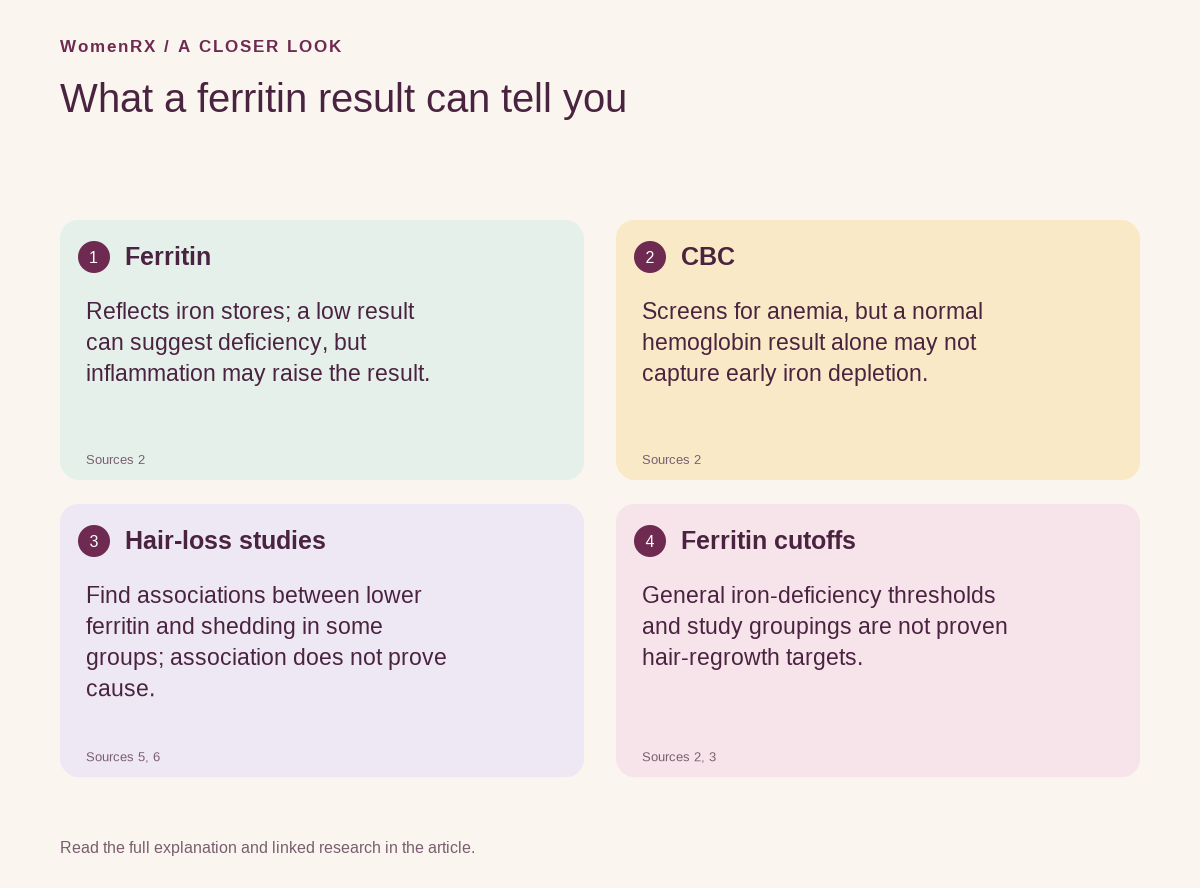
What a ferritin result can tell you
Ferritin: Reflects iron stores; a low result can suggest deficiency, but inflammation may raise the result.2
CBC: Screens for anemia, but a normal hemoglobin result alone may not capture early iron depletion.2
Hair-loss studies: Find associations between lower ferritin and shedding in some groups; association does not prove cause.56
Ferritin cutoffs: General iron-deficiency thresholds and study groupings are not proven hair-regrowth targets.23
Read the figure as text
Separate what iron tests measure from what hair-loss studies can establish.- Ferritin: Reflects iron stores; a low result can suggest deficiency, but inflammation may raise the result.2
- CBC: Screens for anemia, but a normal hemoglobin result alone may not capture early iron depletion.2
- Hair-loss studies: Find associations between lower ferritin and shedding in some groups; association does not prove cause.56
- Ferritin cutoffs: General iron-deficiency thresholds and study groupings are not proven hair-regrowth targets.23
More questions, answered
Can iron be low even if I’m not anemic?
Yes. Ferritin can fall as iron stores decline before anemia develops, so a blood count alone may not describe the full picture. 2
Is ferritin below 40 a hair-loss diagnosis?
No established hair-loss threshold is shown here. One study grouped women with diffuse shedding using a cutoff of 40 ng/mL, but that doesn’t prove it is a diagnostic or hair-growth target. 3
Sources you can check
- Hair loss - NHSAccessed 2026-09-25Return to first citation
- Iron - Health Professional Fact SheetAccessed 2026-09-25Return to first citation
- Evaluation of the relationship of digital phototrichogram findings of patients with diffuse hair loss with blood TSH, ferritin and vitamin B12 levels.Bilik L, Kokcam I, Esen M. · Northern clinics of Istanbul · 2024Return to first citation
- Alopecia and Iron Deficiency: An Interventional Pilot Study in Primary Care to Improve the Request of Ferritin.Salinas M, Leiva-Salinas M, Flores E, López-Garrigós M, Leiva-Salinas C. · Advances in hematology · 2020Return to first citation
- Iron Deficiency and Nonscarring Alopecia in Women: Systematic Review and Meta-Analysis.Treister-Goltzman Y, Yarza S, Peleg R. · Skin appendage disorders · 2022Return to first citation
- Non-anemic iron deficiency: correlations between symptoms and iron status parameters.Beatrix J, Piales C, Berland P, Marchiset E, Gerbaud L, Ruivard M. · European journal of clinical nutrition · 2022Return to first citation