Could Low Iron Be Contributing to Your Fatigue?
Low iron can contribute to tiredness before anemia appears, but fatigue alone can’t tell you whether your iron stores are low.
Iron deficiency is one possible cause of fatigue, and it can develop before a blood count shows anemia. A clinician may consider both a blood count and ferritin, which reflects stored iron but can be affected by inflammation. Heavy periods and pregnancy are relevant context, not proof of deficiency. If iron is low, understanding why helps guide what to do next. 1 2 3
Fatigue points to a question, not a diagnosis
Iron helps your body make hemoglobin, the protein in red blood cells that carries oxygen. As iron stores decline, ferritin can fall before hemoglobin does. So it’s possible to have low iron stores without anemia showing up on a blood count. 2 3
But fatigue isn’t specific to iron deficiency. It can also be related to sleep, stress, pregnancy, mental health, or other medical conditions. If you’ve felt tired for weeks or it’s getting in the way of everyday life, looking for the cause is more useful than guessing that iron is the answer. 1
What the tests can, and can’t, tell you
A blood count can help show whether anemia is present. Ferritin gives information about iron stores. The NIH Office of Dietary Supplements says a ferritin result below 30 micrograms per liter suggests iron deficiency. It’s a clue to interpret in context, not a result to read in isolation: inflammation can affect ferritin, and clinicians may use more than one measurement. 2
This is why a normal hemoglobin result doesn’t necessarily settle the question of iron stores. If you’re discussing persistent fatigue, you can ask whether checking ferritin alongside a blood count makes sense for your situation. 2
Share the context, then look for a cause
Iron deficiency can result from blood loss, too little iron in the diet, or difficulty absorbing iron. Heavy periods are one recognized risk factor, and pregnancy is a context in which iron deficiency is more common. If you’re pregnant or recently gave birth, mention that when discussing fatigue and testing; neither that history nor tiredness alone establishes a deficiency. 2 3 4
If tests do show low iron, the reason matters. For example, ongoing blood loss and trouble absorbing iron are different problems from low dietary intake. Useful questions include: “Do my results suggest anemia, low iron stores without anemia, or neither?” and “What might explain a low result in my case?” 2 3
Iron may help when deficiency is the issue
Iron supplements are used to treat iron deficiency, but they aren’t a general fatigue remedy. In an uncontrolled pilot study, 23 women aged 18 to 30 with iron-deficiency anemia enrolled in an eight-week iron-supplementation study. The reported before-and-after results were for 16 participants. Their fatigue scores were lower after treatment, but without a comparison group the study can’t show how much of the change was caused by iron. It also doesn’t establish that iron will relieve fatigue when iron status is normal. 5
Taking more iron than your body needs can cause problems, including nausea, constipation, vomiting, abdominal pain, or diarrhea; extremely high levels can damage organs. That’s a reason to base supplementation on an assessment of iron status and its likely cause, rather than trying iron as a general energy boost. 3
If iron tests don’t point to deficiency, fatigue still deserves attention. There are many possible causes, and iron is only one of them. 1
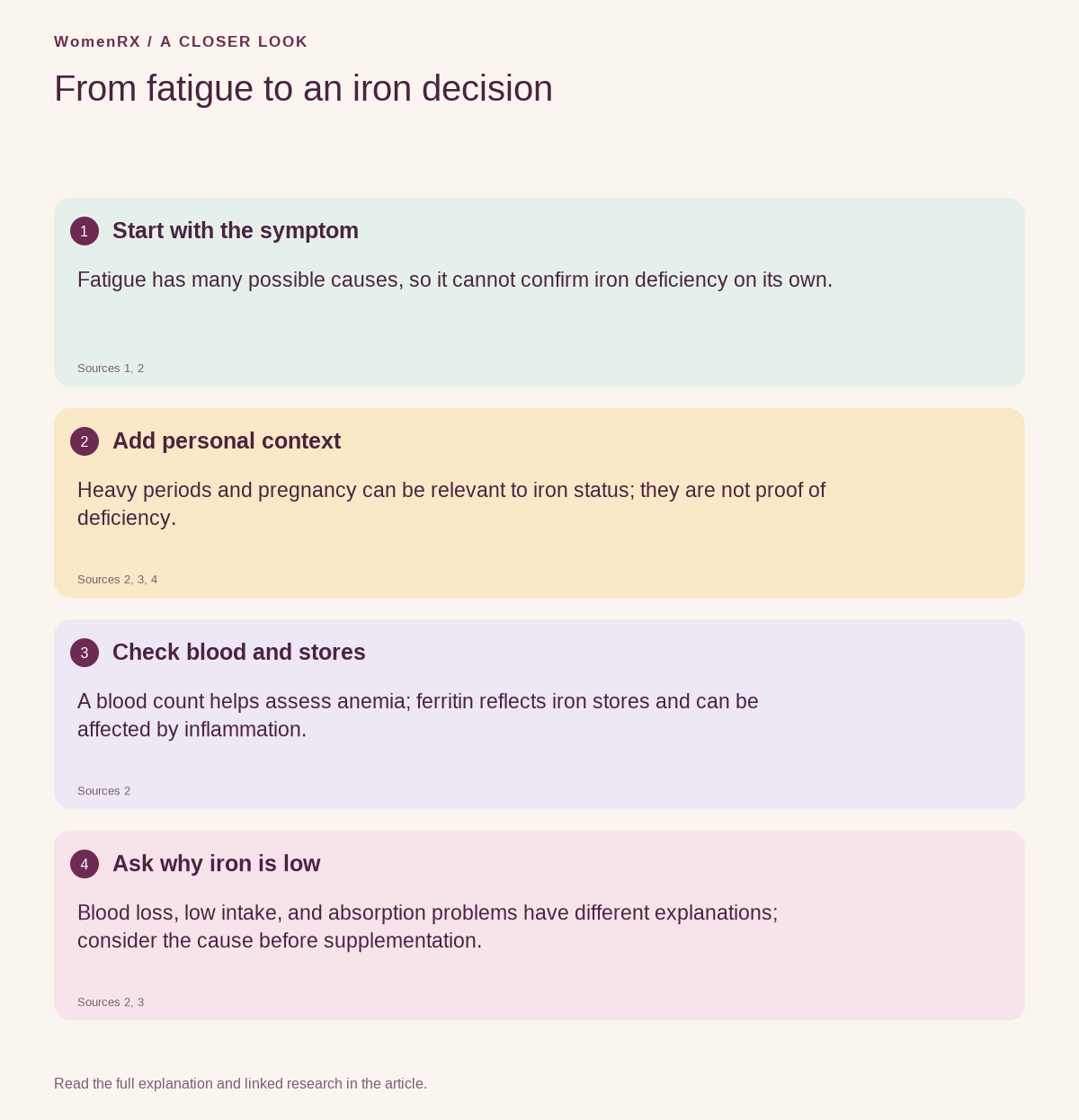
From fatigue to an iron decision
Start with the symptom: Fatigue has many possible causes, so it cannot confirm iron deficiency on its own.12
Add personal context: Heavy periods and pregnancy can be relevant to iron status; they are not proof of deficiency.234
Check blood and stores: A blood count helps assess anemia; ferritin reflects iron stores and can be affected by inflammation.2
Ask why iron is low: Blood loss, low intake, and absorption problems have different explanations; consider the cause before supplementation.23
Read the figure as text
Fatigue can raise the question of low iron, but symptoms, test results, and possible causes each add different information.- Start with the symptom: Fatigue has many possible causes, so it cannot confirm iron deficiency on its own.12
- Add personal context: Heavy periods and pregnancy can be relevant to iron status; they are not proof of deficiency.234
- Check blood and stores: A blood count helps assess anemia; ferritin reflects iron stores and can be affected by inflammation.2
- Ask why iron is low: Blood loss, low intake, and absorption problems have different explanations; consider the cause before supplementation.23
More questions, answered
Can you have low iron without anemia?
Yes. Ferritin, a measure of iron stores, can fall before hemoglobin declines enough for anemia to show on a blood count. 2
Sources you can check
- Fatigue: MedlinePlusAccessed 2026-09-25Return to first citation
- Iron - Health Professional Fact SheetAccessed 2026-09-25Return to first citation
- Iron: MedlinePlusAccessed 2026-09-25Return to first citation
- [Practical Recommendations from Clinical Experts for Optimizing Screening, Diagnosis, and Treatment of Iron Deficiency during Pregnancy in Portugal].Mairos J, Monteiro N, Clode N, Maricoto T, Catarino R, Dias BF. · Acta medica portuguesa · 2025Return to first citation
- Efficacy of 8-week oral iron supplementation on fatigue and physical capacity in young women with iron deficiency anemia: An uncontrolled pilot clinical trial.Harrabi MA, Fendri T, Chaari F, Ayed R, Hadadi A, Boughattas W, Mezghani I, Kallel C, Rebai H, Turki M, Ayadi F, Sahli S. · PloS one · 2025Return to first citation