Fatigue During Perimenopause: What Could Be Contributing?
Broken sleep and heavy periods can drain your energy during perimenopause, but they aren’t the only possible explanations.
Fatigue during perimenopause isn’t necessarily caused by changing hormones. Night sweats may interrupt sleep, while heavy periods can contribute to iron deficiency anemia. Mood changes, medicines, sleep disorders, and other health conditions belong in the picture too. Notice what changed alongside your energy, and seek assessment if the fatigue lasts several weeks without improving. 124
Look at what changed alongside your energy
A stretch of low energy can feel like one more part of perimenopause. But fatigue is a symptom, not a diagnosis. Too little sleep, anemia, depression, anxiety, sleep disorders, and conditions such as thyroid disease or diabetes can all contribute. The useful question isn’t just “Could this be perimenopause?” It’s “What else is happening when I feel this tired?” 1
You don’t need to sort every possibility yourself. Start with two changes that can be especially easy to miss during the menopause transition: how you’re sleeping and how much you’re bleeding.
If your nights are broken, notice what wakes you
Night sweats are a menopause symptom, and too little sleep can leave you fatigued. For example, if you wake sweaty several times and feel worn out the next day, the interrupted night is worth addressing. That pattern is a clue, not proof that night sweats explain all your fatigue. 12
Notice, too, if you’re tired despite what seems like enough time asleep. Sleep apnea and other sleep disorders can cause fatigue, so persistent exhaustion deserves a broader look even if you’re also having menopause symptoms. Improving sleep habits may help, but it doesn’t replace finding out why you keep waking or why rest isn’t helping. 1
If hot flashes or night sweats are repeatedly disrupting your life, there are treatments for those symptoms. The Menopause Society identifies hormone therapy as the most effective treatment for hot flashes and night sweats and recommends certain nonhormone options, including cognitive-behavioral therapy and several prescription treatments. Those are options for the disruptive symptoms, not treatments for every possible cause of fatigue. 56
Give heavy periods their own attention
If your periods have become much heavier, don’t write that off as simply part of getting older. Heavy menstrual bleeding during perimenopause can contribute to iron deficiency anemia, whose symptoms may overlap with symptoms attributed to the transition. Bleeding can also have different causes, including fibroids and changes in ovulation. Finding the cause matters alongside relieving the bleeding. 4
You can’t tell whether you have anemia from tiredness alone. If bleeding has changed or is affecting what you can do, describe that change when you seek care. An assessment can consider both the bleeding and whether blood tests for anemia or iron deficiency are appropriate. 134
Keep other explanations in view
Mood, pain, stress, and other health changes can affect your energy. Depression and anxiety are among the possible causes of fatigue, as are infections and several medical conditions. Having night sweats or irregular periods doesn’t rule any of these out. 1
Include recent medicine changes when you think back over when the tiredness began. Medicines and other treatments can be part of the picture; for example, clonidine, which may be used for menopause-related night sweats, can cause drowsiness. If you’re unsure whether a medicine is affecting you, a clinician or pharmacist can review what you take rather than having you guess. 12
Use a short record to make the pattern clearer
For a few days, jot down when your energy is lowest, whether you woke during the night, any night sweats, and whether you’re bleeding. Add a new symptom or medicine change if there is one. A fatigue diary can help reveal patterns, but it isn’t a test: feeling worse after a heavy period or a broken night doesn’t establish the cause. 14
If the fatigue hasn’t improved after several weeks, seek assessment rather than assuming it will pass with perimenopause. A clinician may ask about sleep, daily activities, appetite, and exercise and may use an exam or tests to investigate. Mention heavy bleeding even if you came in mainly to talk about your energy. 14
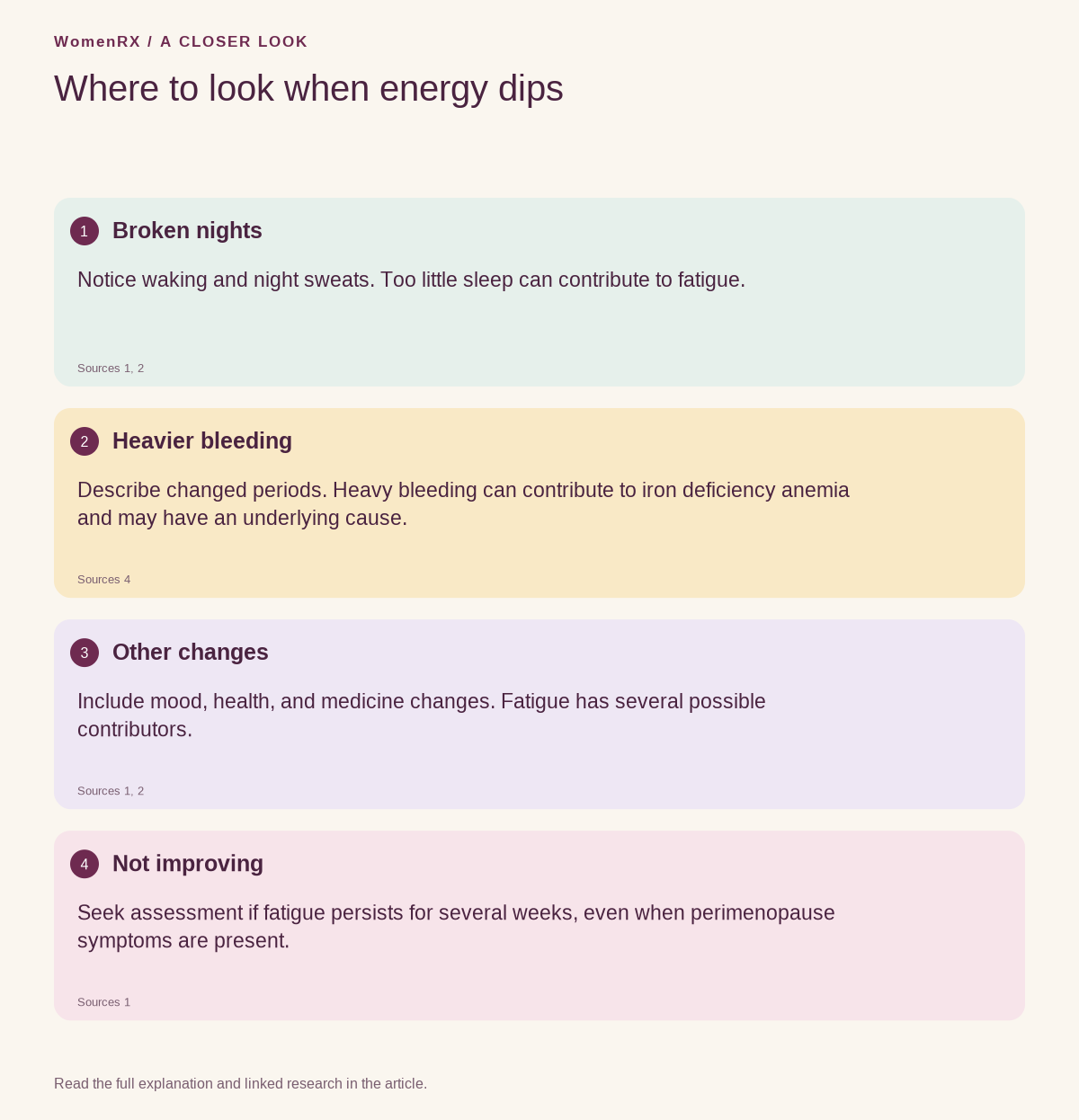
Where to look when energy dips
Broken nights: Notice waking and night sweats. Too little sleep can contribute to fatigue.12
Heavier bleeding: Describe changed periods. Heavy bleeding can contribute to iron deficiency anemia and may have an underlying cause.4
Other changes: Include mood, health, and medicine changes. Fatigue has several possible contributors.12
Not improving: Seek assessment if fatigue persists for several weeks, even when perimenopause symptoms are present.1
Read the figure as text
Follow the changes that accompany your fatigue. Each can guide a conversation, but none diagnoses the cause on its own.- Broken nights: Notice waking and night sweats. Too little sleep can contribute to fatigue.12
- Heavier bleeding: Describe changed periods. Heavy bleeding can contribute to iron deficiency anemia and may have an underlying cause.4
- Other changes: Include mood, health, and medicine changes. Fatigue has several possible contributors.12
- Not improving: Seek assessment if fatigue persists for several weeks, even when perimenopause symptoms are present.1
More questions, answered
Does feeling tired during heavy periods mean I’m anemic?
No. Heavy menstrual bleeding can contribute to iron deficiency anemia, but fatigue has many possible causes. The bleeding pattern is a reason to discuss whether assessment and blood tests make sense, not a way to diagnose anemia by yourself. 134
Sources you can check
- Fatigue: MedlinePlusAccessed 2026-09-25Return to first citation
- Other medicines for menopause symptoms - NHSAccessed 2026-09-25Return to first citation
- Investigation and Management of Iron Deficiency Anemia in Non-pregnant Reproductive-Age Women: A Retrospective Analysis.Peracha A, Soomar SM, Rana S. · Cureus · 2026Return to first citation
- Addressing the perimenopause: what's blood got to do with it?Cutts BA, Fennessy K. · Research and practice in thrombosis and haemostasis · 2025Return to first citation
- The 2022 hormone therapy position statement of The North American Menopause Society.“The 2022 Hormone Therapy Position Statement of The North American Menopause Society” Advisory Panel. · Menopause (New York, N.Y.) · 2022Return to first citation
- The 2023 nonhormone therapy position statement of The North American Menopause Society.Menopause (New York, N.Y.) · 2023Return to first citation