Natural Hair-Loss Remedies: What the Evidence Supports
Some oils and supplements have been studied, but finding the cause of hair loss is usually more useful than choosing a product first.
A natural remedy isn’t a reliable substitute for finding out why your hair is shedding or thinning. Rosemary oil has limited human evidence for pattern hair loss, while studies of commercial supplements show preliminary, product-specific results. Biotin, iron, and zinc may be useful when a deficiency is identified, but they aren’t universal hair-growth treatments. 1 2 3 6
First, notice what kind of change you’re seeing
Hair coming out in larger amounts after childbirth, gradual thinning, and hair breaking from damaging styles don’t necessarily call for the same response. More than one cause can also be present: postpartum shedding, for example, may occur alongside early hereditary thinning. A dermatologist can use the timing of the change and an examination of your scalp and hair to look for clues, then consider tests if a deficiency, hormone issue, infection, or other condition is suspected. 1
This is why a promising result for pattern hair loss doesn’t tell you whether an oil will help with shedding or breakage. Some hair loss resolves without treatment; other types may benefit from treatment or changes in hair care. No single approach works for everyone. 1
Supplements: a deficiency is different from a hair-growth claim
Biotin is often sold for hair, but biotin deficiency is rare. Deficiency can cause hair loss; evidence that extra biotin improves hair in people without a deficiency is limited to case reports in children with an unusual hair condition, not trials showing regrowth in otherwise healthy women. High biotin intake can also interfere with some blood tests, including thyroid tests. If you take it, tell the person ordering your lab work. 2
Iron and zinc are worth thinking about differently from an all-purpose hair supplement. If testing shows a deficiency, a clinician may recommend replacing the missing nutrient. Hair loss alone doesn’t establish that you need either one, and too much iron can be harmful. 1
A small randomized trial offers a useful reality check on supplement claims. It compared zinc sulfate, calcium pantothenate, their combination, and topical minoxidil in 73 women aged 15 to 45 over four months. Some measures improved in supplement groups, but this short study doesn’t establish that those nutrients help women with hair loss generally. It excluded women with certain known causes, including recently diagnosed uncontrolled anemia, hypothyroidism, and polycystic ovarian disease; pregnancy or plans to become pregnant were separate exclusions. 5
Commercial hair-supplement blends are another category again. A 2026 review combined 14 studies involving 967 adults and several different products. Pooled results favored supplements over placebo on some hair-growth measures, but the difference in total hair count was not statistically significant. The authors called the findings preliminary and recommended more rigorous, independent research. Those combined results don’t establish that any particular blend will work for you, and the reported summary doesn’t give a separate result for women. 6
Oils and botanicals: match the study to the condition
Rosemary oil has been studied for androgenetic alopecia, also called pattern hair loss. A 2025 review of controlled studies identified one randomized trial of rosemary oil and concluded that stronger research on nonprescription products is needed. It also reviewed ingredients including pumpkin seed oil and saw palmetto. That’s reason for interest, not a basis to promise regrowth or assume an oil performs like an established treatment. 3
The type of hair loss matters here, too. Central centrifugal cicatricial alopecia is a scarring form of hair loss that commonly affects women of African descent. A systematic review found no clinical trials evaluating natural ingredients as treatment for that condition. Results from studies of pattern hair loss shouldn’t be applied to it. 4
What’s a sensible next move?
If you’re considering a supplement, ask whether it’s meant to correct a deficiency or is being marketed as a general hair-growth product. For an oil or botanical, check whether its human studies concern the kind of hair loss you actually have. A finding for one ingredient or blend doesn’t automatically carry over to a differently formulated product. 1 3 6
If the cause isn’t clear, a scalp and hair examination is more informative than trying several remedies at once. And if your hair is breaking or a hairstyle is putting stress on it, changing that habit may help stop ongoing damage. That’s a practical step, but it won’t substitute for identifying a separate cause of thinning or shedding. 1
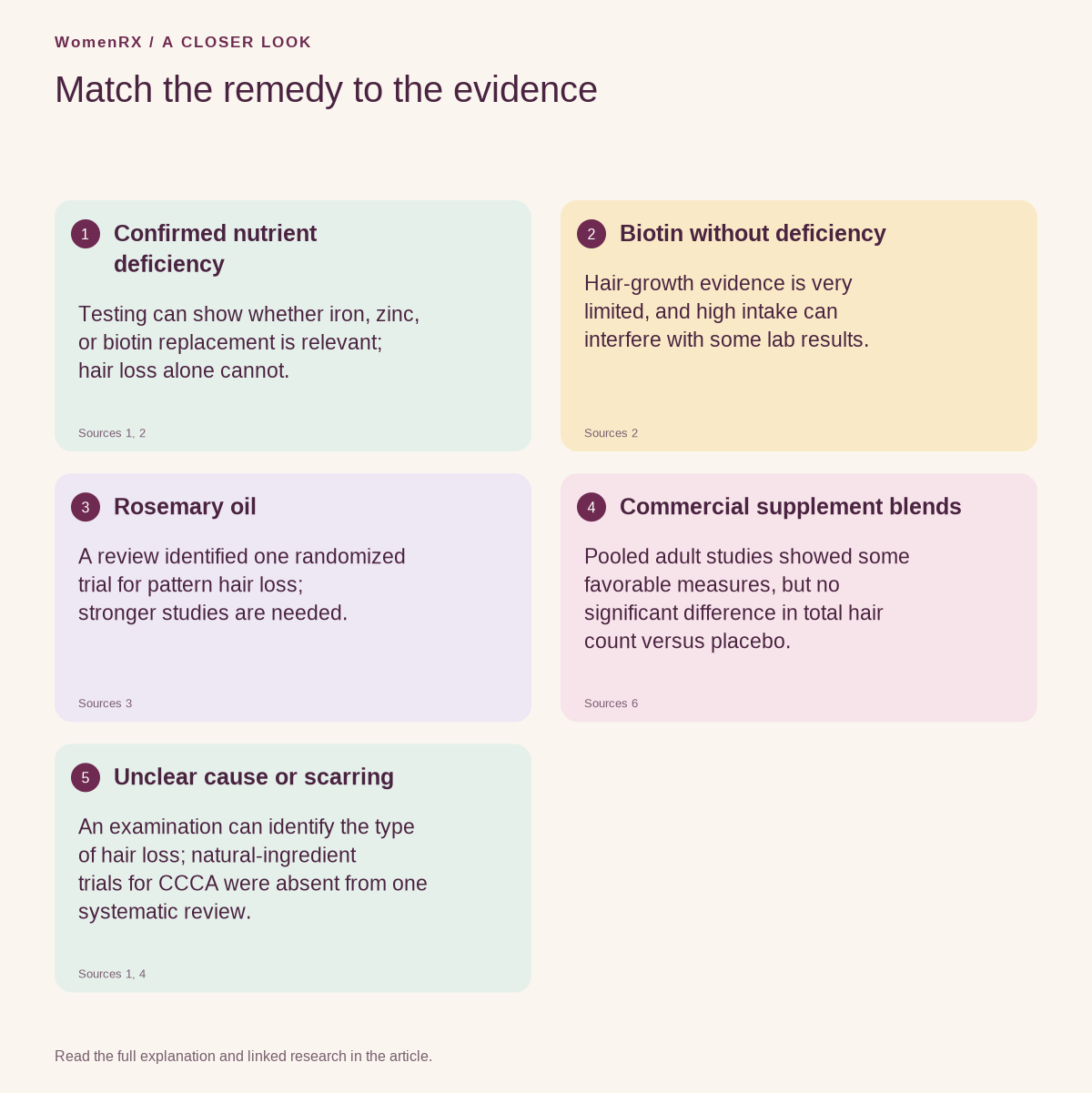
Match the remedy to the evidence
Confirmed nutrient deficiency: Testing can show whether iron, zinc, or biotin replacement is relevant; hair loss alone cannot.12
Biotin without deficiency: Hair-growth evidence is very limited, and high intake can interfere with some lab results.2
Rosemary oil: A review identified one randomized trial for pattern hair loss; stronger studies are needed.3
Commercial supplement blends: Pooled adult studies showed some favorable measures, but no significant difference in total hair count versus placebo.6
Unclear cause or scarring: An examination can identify the type of hair loss; natural-ingredient trials for CCCA were absent from one systematic review.14
Read the figure as text
These approaches answer different questions. Evidence for one cause of hair loss shouldn’t be treated as evidence for another.- Confirmed nutrient deficiency: Testing can show whether iron, zinc, or biotin replacement is relevant; hair loss alone cannot.12
- Biotin without deficiency: Hair-growth evidence is very limited, and high intake can interfere with some lab results.2
- Rosemary oil: A review identified one randomized trial for pattern hair loss; stronger studies are needed.3
- Commercial supplement blends: Pooled adult studies showed some favorable measures, but no significant difference in total hair count versus placebo.6
- Unclear cause or scarring: An examination can identify the type of hair loss; natural-ingredient trials for CCCA were absent from one systematic review.14
More questions, answered
Does postpartum shedding mean I need a hair supplement?
Not necessarily. Shedding after childbirth can occur alongside another cause of hair loss. A supplement makes more sense when a deficiency has been identified than as an automatic response to postpartum shedding. 1
Sources you can check
- Hair loss: Diagnosis and treatmentAccessed 2026-09-25Return to first citation
- Biotin - Health Professional Fact SheetAccessed 2026-09-25Return to first citation
- Do Non-Prescription Products Help in Managing Androgenic Alopecia?Gupta AK, Wang H, Wang T, Talukder M. · Skin appendage disorders · 2025Return to first citation
- The Use of Natural Ingredients in the Treatment of Alopecias with an Emphasis on Central Centrifugal Cicatricial Alopecia: A Systematic Review.Ezekwe N, King M, Hollinger JC. · The Journal of clinical and aesthetic dermatology · 2020Return to first citation
- Comparing the Effects of Zinc Sulfate, Calcium Pantothenate, Their Combination and Minoxidil Solution Regimens on Controlling Hair Loss in Women: A Randomized Controlled Trial.Siavash M, Tavakoli F, Mokhtari F. · Journal of research in pharmacy practice · 2017Return to first citation
- Evaluating the Effectiveness of Commercial Oral Supplements for Hair Growth: A Systematic Review and Meta-Analysis.Alanazi R, Alshammari S, Aldossari K, Alwatban R, Aljeribah D, Alanazi S, Alsalhi A, Alhumam A, Alajlan A. · Journal of cosmetic dermatology · 2026Return to first citation