Rosemary Oil for Hair Loss: What the Evidence Shows
Hair counts rose in a six-month trial involving men, but that result doesn’t tell us whether rosemary oil treats pattern hair loss in women.
Rosemary oil is worth further study, but it isn’t an established substitute for hair-loss treatment. In a six-month trial of 100 men with pattern hair loss, hair counts rose in both the rosemary-oil and 2% minoxidil groups. The lack of a statistically significant difference doesn’t prove equal effectiveness, or show that rosemary oil works for women. Finding out why your hair is thinning is the more useful first move. 2 3 1

The human trial answers a narrow question
The best-known direct comparison assigned 100 men with androgenetic alopecia, also called pattern hair loss, to rosemary oil or 2% minoxidil for six months. Neither group had a statistically significant change in mean hair count at three months. At six months, hair counts had increased in both groups compared with baseline, and the researchers found no statistically significant difference between the groups. 2 3
That last finding is easy to overread. Not detecting a difference is not the same as demonstrating that two treatments work equally well. And because the participants were men, the trial doesn’t directly answer whether rosemary oil helps women with diagnosed pattern hair loss. 2 3
There is also a study involving women, but it tested a serum containing rosemary oil and several other ingredients. It was open-label and had no comparison group. Any changes observed during the study can’t be attributed to rosemary oil alone, and the study doesn’t establish an effect in women with diagnosed pattern hair loss. 6
Why a plausible mechanism isn’t proof of regrowth
Rosemary has attracted interest partly because of proposed effects on scalp inflammation and other processes involved in hair loss. Those ideas help explain why researchers might test it; they don’t demonstrate that applying an oil regrows hair in women. A study of a rosemary-based gel loaded with metformin, for example, assessed hair growth in rats. Its findings can’t tell you what plain rosemary oil will do on a human scalp. 3 4
The bottle and your scalp both matter
The six-month trial compared particular interventions. It did not compare rosemary products with one another or test a range of concentrations. Its result therefore gives no basis to assume that a homemade blend, a serum with added ingredients, and the preparation used in the trial will perform alike. The women’s serum study is a good illustration of the problem: testing several ingredients together cannot isolate rosemary oil’s contribution. 2 6
Nor should “oil” be taken to mean irritation-free. Scalp itching increased from baseline in both groups in the six-month trial, although it was reported more frequently in the minoxidil group at the assessed follow-ups. Those results don’t predict how your scalp will respond to a different rosemary product. 2
A 2025 Canadian expert consensus did not recommend rosemary oil for androgenetic alopecia. That doesn’t prove nobody could benefit, but it puts the promising-sounding trial result in perspective: the evidence has not made rosemary oil an established treatment choice. 5
Don’t let a product guess stand in for a diagnosis
Hair loss isn’t one condition. Alongside inherited pattern thinning, possible contributors include certain medical conditions, medicines, stress, and poor nutrition. What helps depends on the cause. If your hair loss is continuing, looks patterned, or concerns you, getting it assessed is more useful than assuming an oil addresses it. 1
You can then weigh rosemary oil for the problem you actually have. The practical distinction is between considering an uncertain product and relying on it while the cause of ongoing hair loss remains unknown. 1 2 3
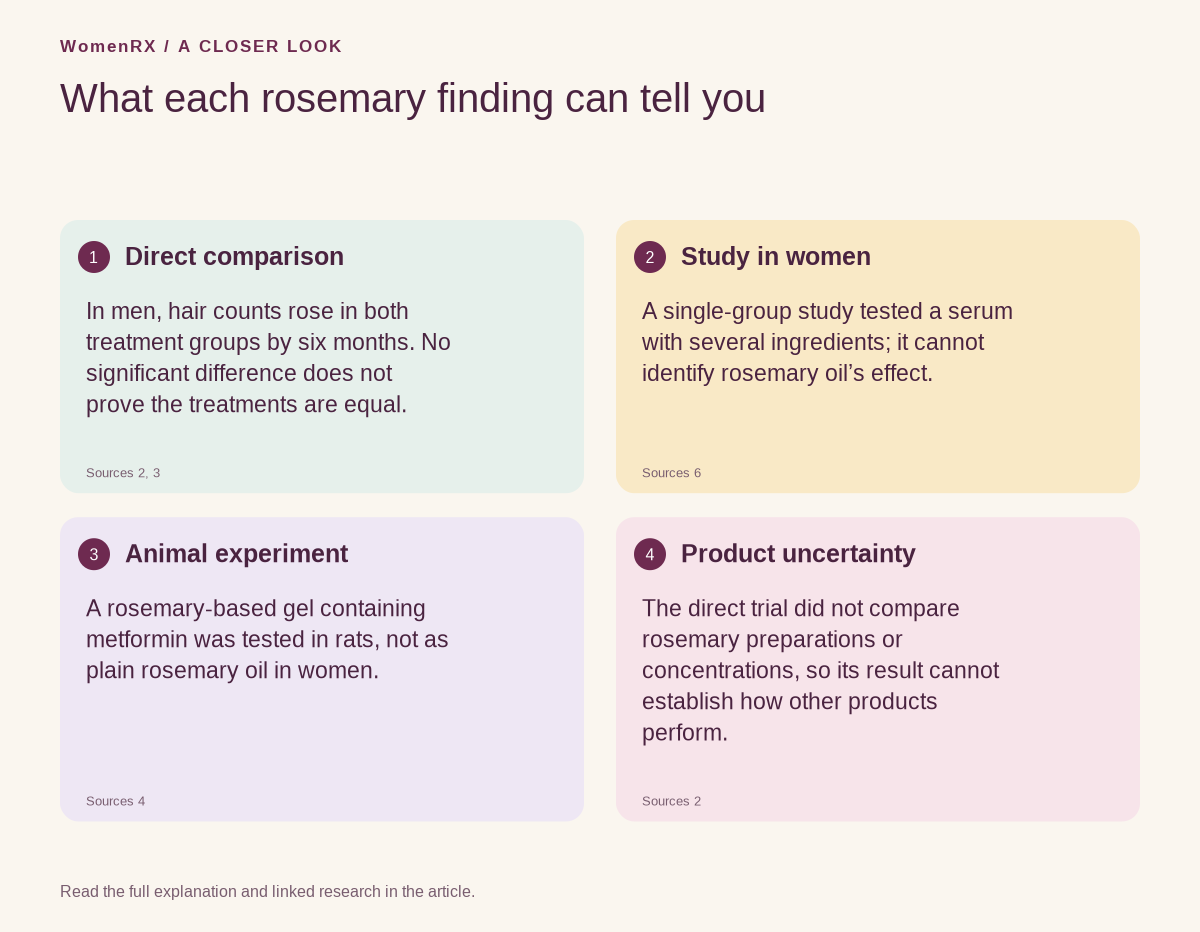
What each rosemary finding can tell you
Direct comparison: In men, hair counts rose in both treatment groups by six months. No significant difference does not prove the treatments are equal.23
Study in women: A single-group study tested a serum with several ingredients; it cannot identify rosemary oil’s effect.6
Animal experiment: A rosemary-based gel containing metformin was tested in rats, not as plain rosemary oil in women.4
Product uncertainty: The direct trial did not compare rosemary preparations or concentrations, so its result cannot establish how other products perform.2
Read the figure as text
These findings involve different populations and preparations, so they cannot be treated as the same test of rosemary oil for women’s pattern hair loss.- Direct comparison: In men, hair counts rose in both treatment groups by six months. No significant difference does not prove the treatments are equal.23
- Study in women: A single-group study tested a serum with several ingredients; it cannot identify rosemary oil’s effect.6
- Animal experiment: A rosemary-based gel containing metformin was tested in rats, not as plain rosemary oil in women.4
- Product uncertainty: The direct trial did not compare rosemary preparations or concentrations, so its result cannot establish how other products perform.2
Sources you can check
- Hair Loss | Alopecia | Alopecia Areata | MedlinePlusAccessed 2026-09-25Return to first citation
- Rosemary oil vs minoxidil 2% for the treatment of androgenetic alopecia: a randomized comparative trial.Panahi Y, Taghizadeh M, Marzony ET, Sahebkar A. · Skinmed · 2015Return to first citation
- An Overview of Commonly Used Natural Alternatives for the Treatment of Androgenetic Alopecia, with Special Emphasis on Rosemary Oil.Bin Rubaian NF, Alzamami HFA, Amir BA. · Clinical, cosmetic and investigational dermatology · 2024Return to first citation
- Alopecia Management Potential of Rosemary-Based Nanoemulgel Loaded with Metformin: Approach Combining Active Essential Oil and Repurposed Drug.Abla KK, Alamoudi MK, Soliman GA, Abdel-Kader MS, Aldawsari MF, Mehanna MM. · International journal of nanomedicine · 2025Return to first citation
- A Canadian Consensus on Androgenetic Alopecia: Approach and Management.Landells I, Chow E, Gupta AK, Jasso Olivares JC, Thuraisingam T, Ahluwalia R, Tan JKL, Pratt M, Yadav G, Chivers Q, Vezina N, Laforest T, Raad E, Owen J, Dayeh NR. · Journal of cutaneous medicine and surgery · 2025Return to first citation
- A Clinical Evaluation of the Safety, Efficacy, and Tolerability of the Soulflower Rosemary Redensyl Hair Growth Serum, Tetragain™, in Healthy Female Subjects for the Treatment of Alopecia: Promoting Hair Growth and Reducing Gray Hair.Patel M, Tuli N, Patel N, Merja A. · Cureus · 2025Return to first citation