Keratin Supplements After 40: What to Expect
A study included women up to age 65, but the reported results don’t establish that keratin is more helpful after 40.
There’s no clear evidence here that keratin works better after 40, or that perimenopause or menopause-related hair or nail changes respond to it. One trial of a specific hydrolyzed keratin product enrolled women aged 35 to 65, but the results cited here don’t establish whether benefits differed by age or menopausal status. A separate trial tested keratin alongside vitamins and minerals, so it can’t show keratin was the active ingredient. 1 2
What the age evidence actually says
The most directly relevant study enrolled 99 healthy women aged 35 to 65 who had visible skin aging and brittle hair or nails. Their average age was about 50. The researchers tested a particular hydrolyzed keratin from poultry feathers against a placebo for 90 days. They reported improvements in hair and nail appearance, along with skin measures. The results cited here don’t establish whether benefit differed for women over 40 or according to menopausal status. So this offers a signal in a mixed-age group of adult women, not proof of an age-specific benefit. 1
A second placebo-controlled trial included 50 women and also lasted 90 days. The tested product combined keratin with several vitamins and minerals. Because the ingredients were taken together, the results can’t tell us whether keratin itself made a difference. The study also doesn’t establish that women over 40 benefited more. 2
Bottom line: Being over 40 is not, by itself, a reason to expect more benefit from a keratin supplement. The available trial results don’t establish a special benefit for perimenopause or postmenopause.
“Keratin” doesn’t mean every product is the same
Keratin is a structural protein found in hair and nails, but supplements can differ in how the keratin is processed and what else is included. The women’s trial tested a specific, extensively hydrolyzed poultry-feather product. The other trial tested a sheep-wool keratin product combined with vitamins and minerals. Results from either product can’t automatically be applied to a different formula, or to keratin as a standalone ingredient. 1 2
There’s also a useful distinction between a product improving an appearance measure and treating the reason hair is thinning or nails are changing. These trials don’t show that keratin corrects a particular cause of hair loss, or that it treats changes associated with menopause.
When the supplement question may be the wrong question
Hair growth and keratin production involve specialized cells in the hair follicle. Hair biology can be affected by genetic, hormonal, and environmental factors, and nutrient deficiencies may play a role too. That means a change in hair isn’t automatically evidence that you need more keratin. 3
If you’re noticing a new or persistent change in hair loss, hair volume, or nail strength, consider whether you need help identifying the cause rather than simply trying a supplement. A study of adult women with hair loss compared two different multi-ingredient supplements; because both included keratin and other ingredients, it can’t identify keratin’s separate effect or show that it’s the right choice for a particular person. 4
A practical way to weigh the claim
If you’re considering a product, ask what exact formulation was studied and whether it matches the product you’re looking at. Then check whether the study measured the outcome you care about, such as hair shedding, hair appearance, or nail strength. A result for a combination formula or a particular hydrolysate is not evidence that any product labeled “keratin” will do the same thing. 1 2
For now, the fairest expectation is modest: one trial in adult women reported hair and nail appearance improvements with a specific hydrolyzed product, and another reported improvements with a multi-ingredient formula. Neither establishes that age 40 changes the likely benefit, or that keratin is a treatment for menopause-related hair or nail changes. 1 2
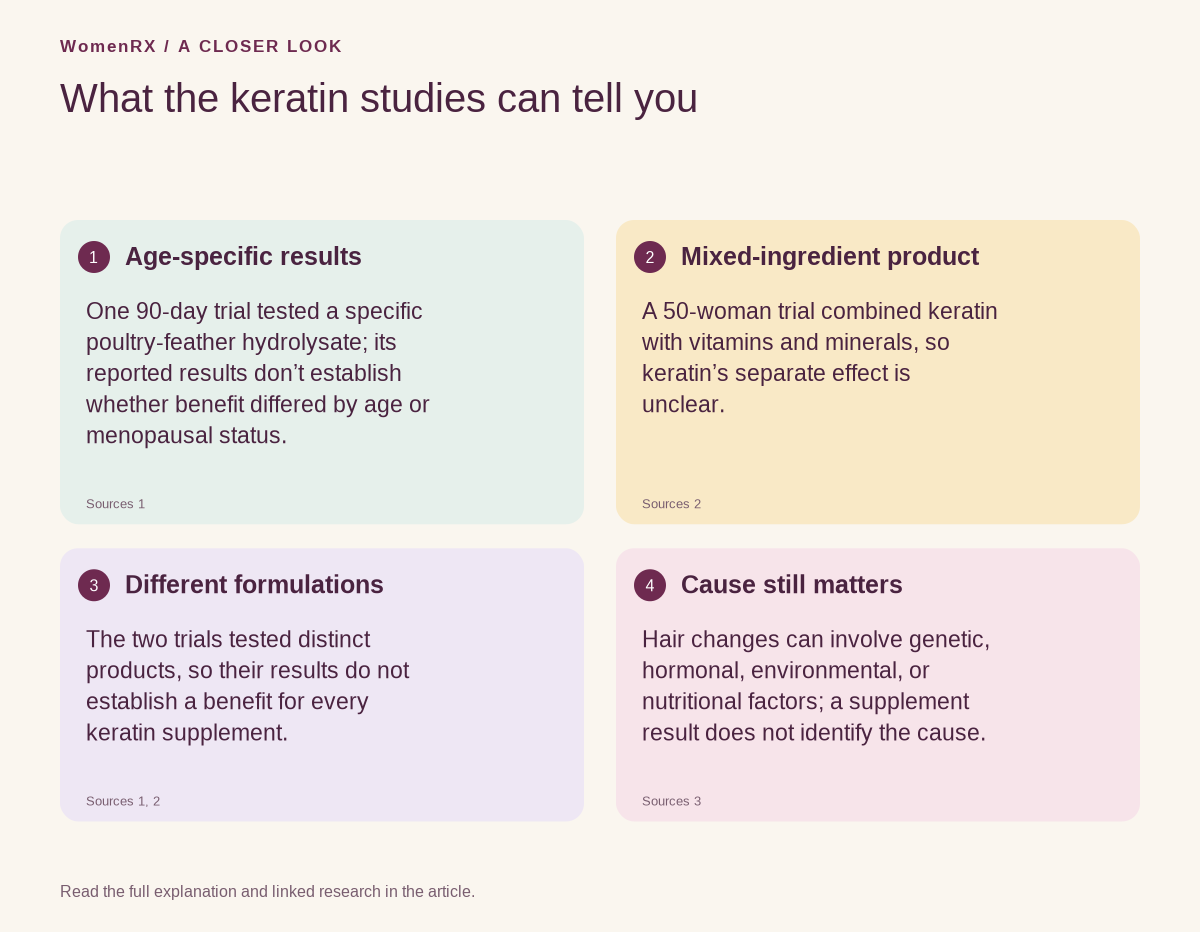
What the keratin studies can tell you
Age-specific results: One 90-day trial tested a specific poultry-feather hydrolysate; its reported results don’t establish whether benefit differed by age or menopausal status.1
Mixed-ingredient product: A 50-woman trial combined keratin with vitamins and minerals, so keratin’s separate effect is unclear.2
Different formulations: The two trials tested distinct products, so their results do not establish a benefit for every keratin supplement.12
Cause still matters: Hair changes can involve genetic, hormonal, environmental, or nutritional factors; a supplement result does not identify the cause.3
Read the figure as text
The studies include adult women, but the reported results cited here don’t establish whether age or menopause changes the likely benefit.- Age-specific results: One 90-day trial tested a specific poultry-feather hydrolysate; its reported results don’t establish whether benefit differed by age or menopausal status.1
- Mixed-ingredient product: A 50-woman trial combined keratin with vitamins and minerals, so keratin’s separate effect is unclear.2
- Different formulations: The two trials tested distinct products, so their results do not establish a benefit for every keratin supplement.12
- Cause still matters: Hair changes can involve genetic, hormonal, environmental, or nutritional factors; a supplement result does not identify the cause.3
More questions, answered
Have perimenopausal or postmenopausal women been shown to benefit?
The reported results from the trial of women aged 35 to 65 don’t establish whether outcomes differed by age or menopausal status. They therefore can’t tell us whether perimenopausal or postmenopausal women benefit differently. 1
Can a study of a keratin blend show that keratin works on its own?
No. One trial tested keratin together with vitamins and minerals, so its results can’t separate keratin’s effect from the other ingredients. 2
Sources you can check
- The Effects of an Oral Supplementation of a Natural Keratin Hydrolysate on Skin Aging: A Randomized, Double-Blind, Placebo-Controlled Clinical Study in Healthy Women.Tursi F, Nobile V, Cestone E, De Ponti I, Lepoudere A, Sergheraert R, Soulard JP. · Journal of cosmetic dermatology · 2025Return to first citation
- A clinical trial to investigate the effect of Cynatine HNS on hair and nail parameters.Beer C, Wood S, Veghte RH. · TheScientificWorldJournal · 2014Return to first citation
- Induction of Hair Keratins Expression by an Annurca Apple-Based Nutraceutical Formulation in Human Follicular Cells.Piccolo M, Ferraro MG, Maione F, Maisto M, Stornaiuolo M, Tenore GC, Santamaria R, Irace C, Novellino E. · Nutrients · 2019Return to first citation
- Comparative evaluation between two nutritional supplements in the improvement of telogen effluvium.Sant'Anna Addor FA, Donato LC, Melo CSA. · Clinical, cosmetic and investigational dermatology · 2018Return to first citation