Keratin Supplements: What the Hair Evidence Can Tell You
A few small studies tested specific keratin products, but their results don’t show that every keratin supplement works or explain why your hair or nails have changed.
There is limited human evidence for particular oral keratin products, not a general finding that keratin supplements treat hair loss. One small trial tested keratin alongside vitamins and minerals; another tested a specific hydrolyzed keratin ingredient in women. Before buying, check what form and full formula were studied, what outcomes improved, and whether a persistent change needs its cause assessed. 2 3
Start with what was actually tested
“Keratin supplement” can describe products that aren’t identical. The studies in women looked at specific ingredients and formulas, so their findings don’t automatically apply to a different product with a different keratin source, processing method, or added ingredients.
In one randomized, placebo-controlled trial, 50 women were assigned to take either a sheep-wool-derived keratin product with vitamins and minerals or a placebo for 90 days. The researchers reported improvements in measured hair and nail outcomes compared with placebo. Because the active product included several ingredients, the trial can’t show how much of the result came from keratin itself. The authors also called for a larger, longer study and a comparison of the product with and without its added vitamins and minerals. 2
A later randomized, placebo-controlled study enrolled 99 women aged 35 to 65 and tested a specific hydrolyzed keratin ingredient made from poultry feathers. The researchers reported improvements in hair and nail appearance among a group selected for signs including damaged or brittle hair and brittle nails. That result applies to the ingredient and participants studied; it doesn’t establish that other keratin products help, or that the product treats hair loss from a medical cause. 3
These trials are a reason to look closely at a product’s evidence, not a basis for naming one “best” supplement. Neither establishes that keratin supplements work for every kind of hair shedding, thinning, or nail change.
A four-part label and evidence check
1. Match the ingredient. Look for the product form used in the study: for example, keratin peptides in the earlier trial or a specific hydrolyzed keratin ingredient in the later one. “Keratin” on the front label alone doesn’t establish that the formula matches either study. The trials evaluated distinct products and sources. 2 3
2. Read the whole formula. Check whether the product includes vitamins, minerals, or other active ingredients. If several ingredients were tested together, the results don’t tell you whether keratin alone produced the improvement. That uncertainty was present in the earlier trial itself. 2
3. Find the outcome, not just the promise. Ask whether the study measured shedding, hair growth, hair appearance, nail strength, or another outcome. Those aren’t interchangeable. A study reporting changes in hair and nail parameters for a particular product does not prove it will stop your shedding or address its cause. 2 3
4. Check who was studied. The first trial included 50 women; the later trial enrolled women with visible signs of skin aging and brittle hair or nails. Neither study establishes a benefit specifically after pregnancy or around menopause. Pregnancy and lactation were exclusion criteria in the later trial, so it doesn’t answer whether the product helps during those stages. 2 3
When finding the cause matters more
Hair loss can be temporary or part of a longer-lasting pattern, and it can sometimes signal a medical condition. The NHS notes that hair loss may follow an illness and that some forms, including hereditary pattern hair loss, may be permanent. That makes the pattern and context of the change relevant: a supplement trial in women with brittle hair is not evidence that keratin treats every kind of hair loss. 1 2 3
If your hair change is persistent, worrying, or affecting your wellbeing, getting an assessment of what may be causing it can be more useful than choosing a supplement by its headline claim. The NHS advises seeing a GP if you’re worried about hair loss and getting an idea of its cause before going to a commercial hair clinic. 1
For changes after pregnancy or around menopause, the timing may help describe what you’re noticing, but the keratin trials don’t show that either life stage creates a keratin deficiency or that supplementation treats life-stage-related hair changes. One study excluded pregnancy and lactation, and neither trial reported a specific postpartum or menopause subgroup. 2 3
The practical takeaway: treat a study as evidence for the product and group it tested, not for the whole category. If a product doesn’t identify its keratin form and full ingredient list clearly, or its claims don’t say what outcome was measured, you can’t reliably connect its marketing to these trial results.
Check the keratin evidence before buying
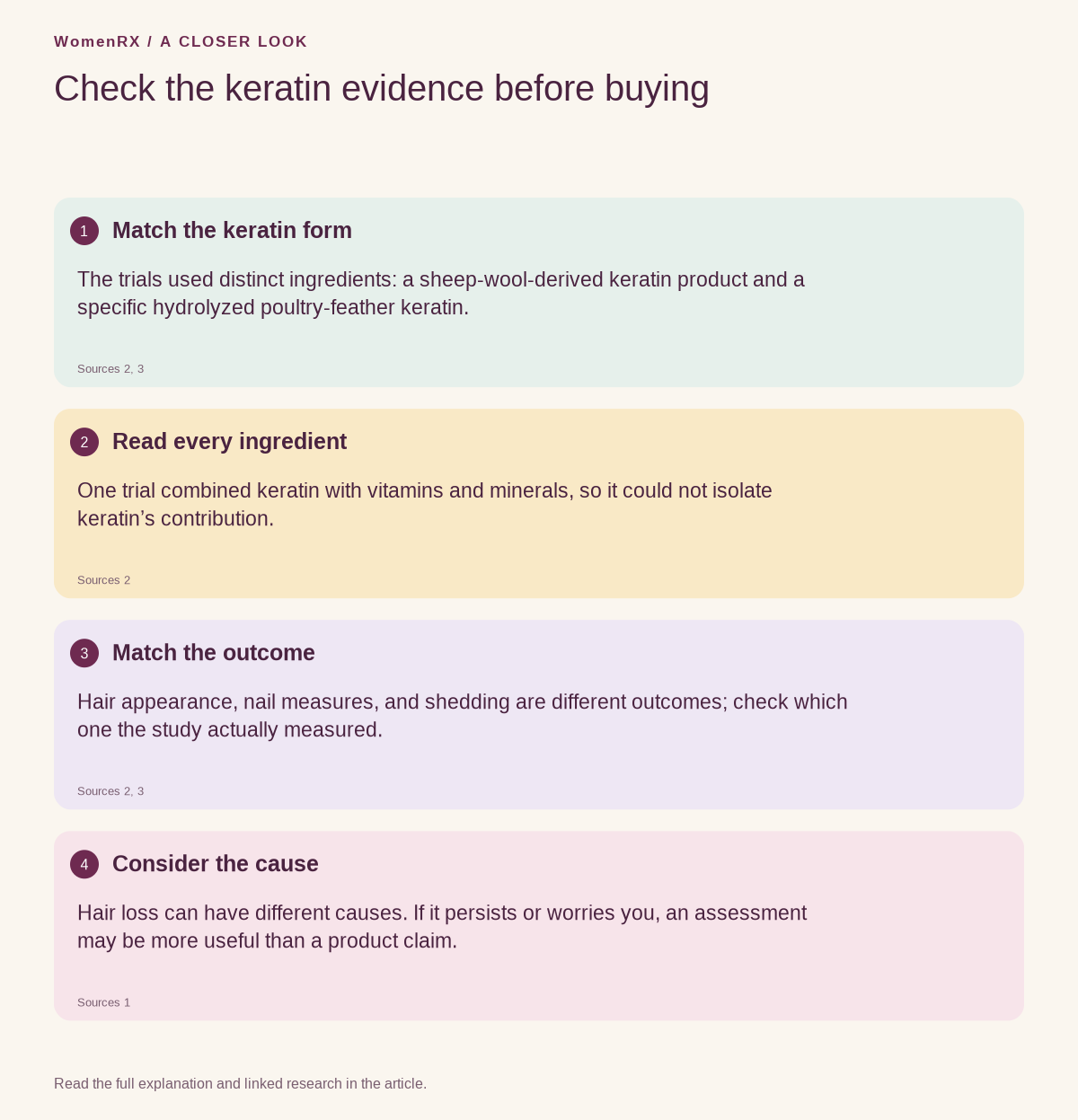
Match the keratin form: The trials used distinct ingredients: a sheep-wool-derived keratin product and a specific hydrolyzed poultry-feather keratin.23
Read every ingredient: One trial combined keratin with vitamins and minerals, so it could not isolate keratin’s contribution.2
Match the outcome: Hair appearance, nail measures, and shedding are different outcomes; check which one the study actually measured.23
Consider the cause: Hair loss can have different causes. If it persists or worries you, an assessment may be more useful than a product claim.1
Read the figure as text
Use these checks to see whether a study really matches the product, outcome, and situation you’re considering.- Match the keratin form: The trials used distinct ingredients: a sheep-wool-derived keratin product and a specific hydrolyzed poultry-feather keratin.23
- Read every ingredient: One trial combined keratin with vitamins and minerals, so it could not isolate keratin’s contribution.2
- Match the outcome: Hair appearance, nail measures, and shedding are different outcomes; check which one the study actually measured.23
- Consider the cause: Hair loss can have different causes. If it persists or worries you, an assessment may be more useful than a product claim.1
More questions, answered
Does hair shedding mean I’m low in keratin?
No. Hair shedding by itself doesn’t establish a keratin deficiency. Hair loss can have different causes, including temporary loss after an illness and hereditary pattern hair loss, so the supplement studies don’t identify the cause of an individual’s shedding. 1 2
Do these studies show keratin helps hair after pregnancy or during menopause?
They don’t answer that specifically. The trials didn’t report postpartum or menopause results, and the later study excluded participants who were pregnant or lactating. 2 3
Sources you can check
- Hair loss - NHSAccessed 2026-09-25Return to first citation
- A clinical trial to investigate the effect of Cynatine HNS on hair and nail parameters.Beer C, Wood S, Veghte RH. · TheScientificWorldJournal · 2014Return to first citation
- The Effects of an Oral Supplementation of a Natural Keratin Hydrolysate on Skin Aging: A Randomized, Double-Blind, Placebo-Controlled Clinical Study in Healthy Women.Tursi F, Nobile V, Cestone E, De Ponti I, Lepoudere A, Sergheraert R, Soulard JP. · Journal of cosmetic dermatology · 2025Return to first citation