Keratin Supplements for Hair or Nails: How to Read the Evidence
A keratin ingredient on the label doesn’t show that keratin itself improves hair or nails.
The human hair study compared two multi-ingredient oral supplements in women with idiopathic hair shedding; it didn’t compare keratin alone with a placebo. So it can’t show that keratin caused the reported hair findings, and it says nothing about nails or topical treatments. Check whether a product’s exact ingredients, format, and promised outcome match what was actually studied. 2
If you’re looking at a keratin product because your hair is shedding or your nails are brittle, start by separating the label’s ingredient claim from the outcome claim. “Contains keratin” tells you something about the formula. It doesn’t, by itself, show that the product reduces shedding, grows hair, or improves nails.
What the hair study tested
A randomized study compared two oral supplement formulas in adult women with idiopathic telogen effluvium, a type of diffuse hair shedding. The study lasted 180 days. One formula included several vitamins and minerals along with amino acids described as components of keratin and collagen. The other listed keratin alongside several other ingredients. Neither formula contained keratin alone, and there was no placebo group. 2
The study reported improvement on clinical hair assessments in both groups. For digital trichoscopy, a method used to examine the scalp and hair, significant improvement was reported only in the first group. Because the formulas differed in multiple ingredients, the comparison can’t tell whether keratin, another ingredient, or the combination contributed to the findings. Nor does a comparison between two products show how either would perform against no supplement. 2
That makes the study a limited piece of evidence about two particular blends in women with idiopathic shedding. It isn’t proof that oral keratin alone treats hair loss or that either formula works for every reason hair can shed. The study reported hair outcomes, not nail outcomes. 2
Match the product claim to the ingredient and outcome
When you read a label or product claim, check three things:
- What form is named? The study’s formulas weren’t identical: one included amino acids described as keratin and collagen components, while the other listed keratin as an ingredient. Those descriptions don’t establish the same thing. 2
- What outcome was studied? Hair findings don’t establish a nail benefit. If a product promises stronger nails, look for human research that actually measured nails.
- Was the ingredient tested by itself? A study of a blend can’t show which ingredient made a difference, if any. The cited comparison did not isolate keratin. 2
The word “keratin” can also appear in research about a different body area. For example, a randomized placebo-controlled study of a hibiscus extract supplement in people with dry, photoaged skin measured a skin keratin index alongside skin hydration and other skin outcomes. It did not test a keratin supplement or measure hair or nails. That kind of result shouldn’t be used to support a hair or nail claim. 1
Oral supplements aren’t topical treatments
An oral supplement and a topical hair treatment are different products used in different ways. The human study described above tested oral formulas, not topical keratin treatments. Its results therefore can’t establish what a topical product does to hair, and claims about topical products need evidence for that format and outcome specifically. 2
Hair shedding after pregnancy is a separate question
If your shedding began after pregnancy, don’t take a study in women with idiopathic telogen effluvium as proof that a keratin supplement addresses your situation. That study did not examine postpartum shedding. A product label can tell you what’s in a supplement, but it can’t identify why your hair is shedding or establish that you have a keratin deficiency. 2
A more grounded way to assess a product is to ask whether the research studied the same ingredients, taken in the same way, in people with the same concern, and whether it measured the outcome you care about. For the hair trial here, the answer is narrow: it compared two blends in women with idiopathic shedding. It doesn’t establish a keratin-only benefit, a nail benefit, or a result for topical treatments.
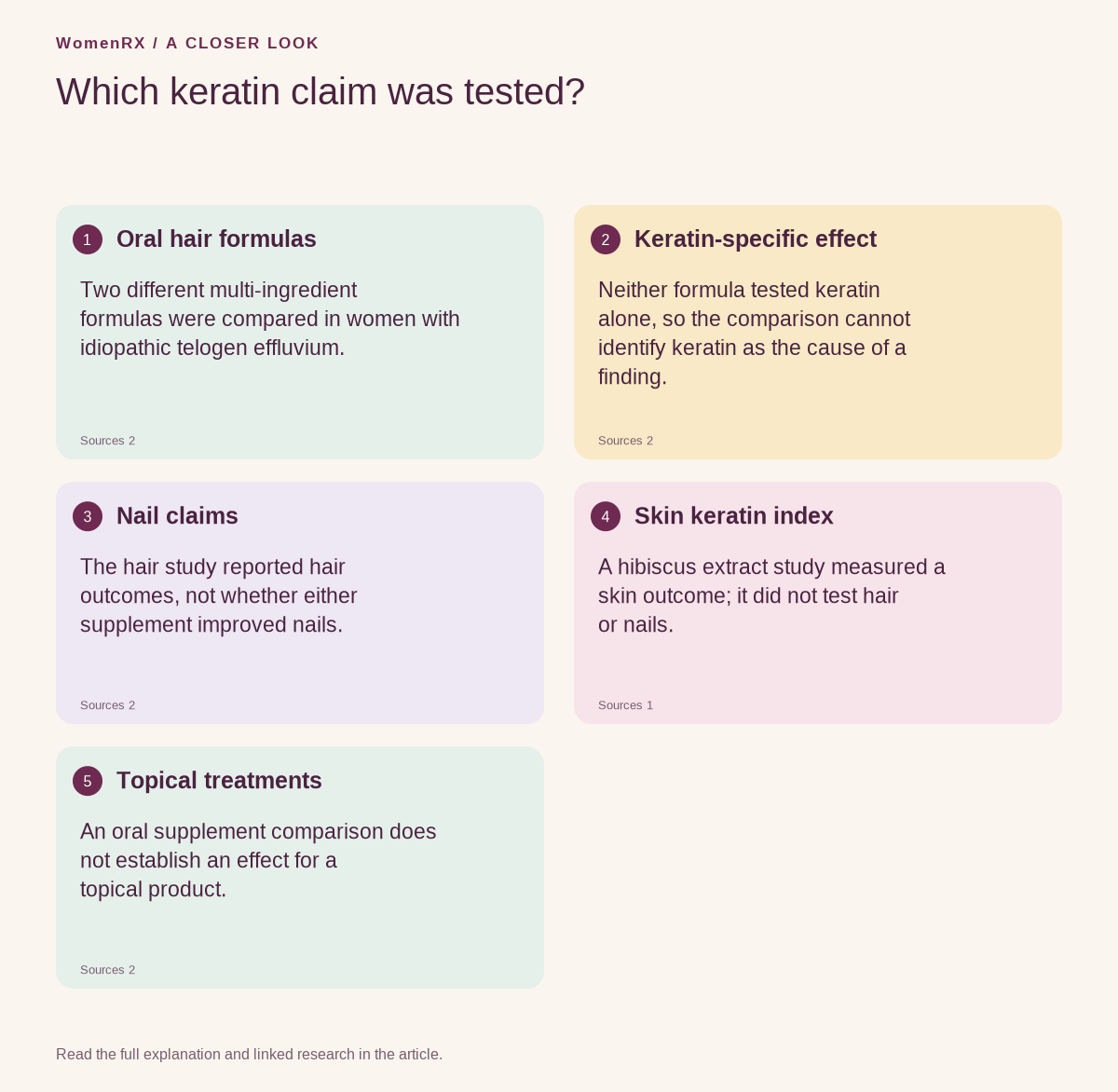
Which keratin claim was tested?
Oral hair formulas: Two different multi-ingredient formulas were compared in women with idiopathic telogen effluvium.2
Keratin-specific effect: Neither formula tested keratin alone, so the comparison cannot identify keratin as the cause of a finding.2
Nail claims: The hair study reported hair outcomes, not whether either supplement improved nails.2
Skin keratin index: A hibiscus extract study measured a skin outcome; it did not test hair or nails.1
Topical treatments: An oral supplement comparison does not establish an effect for a topical product.2
Read the figure as text
Compare the product format and outcome with the research actually described.- Oral hair formulas: Two different multi-ingredient formulas were compared in women with idiopathic telogen effluvium.2
- Keratin-specific effect: Neither formula tested keratin alone, so the comparison cannot identify keratin as the cause of a finding.2
- Nail claims: The hair study reported hair outcomes, not whether either supplement improved nails.2
- Skin keratin index: A hibiscus extract study measured a skin outcome; it did not test hair or nails.1
- Topical treatments: An oral supplement comparison does not establish an effect for a topical product.2
More questions, answered
Does the hair study show that keratin supplements strengthen nails?
No. It reported hair-related outcomes in women with idiopathic telogen effluvium, not nail outcomes. The findings can’t establish a nail benefit. 2
Does a study mentioning a “keratin index” support a hair supplement?
Not necessarily. One cited study measured a keratin index as a skin outcome in a trial of hibiscus extract for photoaged skin. It did not test a keratin supplement or assess hair or nails. 1
Sources you can check
- Hibiscus Collagen Alternative (VC-H1) as an Oral Skin Rejuvenating Agent: A 12-Week Pilot Study.Baek Y, Nguyen NH, Lee YI, Jung MJ, Kim IA, Lee SJ, Kim HM, Lee JH. · International journal of molecular sciences · 2025Return to first citation
- Comparative evaluation between two nutritional supplements in the improvement of telogen effluvium.Sant'Anna Addor FA, Donato LC, Melo CSA. · Clinical, cosmetic and investigational dermatology · 2018Return to first citation