Keratin Supplements for Hair and Nails: What the Studies Show
A trial in women found changes in hair and nail appearance with one oral keratin ingredient, but it did not test whether the supplement treats hair thinning or the causes of nail changes.
One placebo-controlled trial found improvements in hair and nail appearance after 90 days with a specific oral keratin hydrolysate. It did not establish that keratin regrows thinning hair or explains a new nail change. Check whether a claim matches the ingredient and outcome actually studied; if shedding persists or a nail changes in a concerning way, finding the cause matters more than choosing a supplement. 378
Start with what the keratin trial measured
“Keratin supplement” can describe products that aren’t equivalent. A randomized, double-blind, placebo-controlled trial tested one oral ingredient: a hydrolysate made from poultry feathers. It enrolled 99 women ages 35 to 65 who had signs of physiological aging, including brittle or damaged hair and brittle nails. The women took one of two amounts of that ingredient or a placebo for 90 days. Researchers reported improvements in measured features including hair gloss, nail gloss and nail hardness, along with participants’ self-assessments. 3
That’s a useful finding for the ingredient tested, but appearance and hardness aren’t the same outcomes as reduced shedding or hair regrowth. The trial doesn’t establish that a product simply labeled “keratin,” a hydrolysate from another source, or a blend with added ingredients will have the same effect. Nor can it tell you why your hair is thinning or a nail is changing. 3
Oral supplements and topical treatments aren’t interchangeable
An oral hydrolysate is swallowed; a topical hair product is applied to the hair or scalp. Evidence about one route can’t establish an effect from the other. The trial above studied an oral supplement, not a topical keratin treatment, and it didn’t compare the two. 3
That distinction matters when reading a claim. “Contains keratin” doesn’t tell you whether the product was studied in people, what form of keratin it contains, or whether researchers measured hair or nail outcomes. A laboratory study of keratin proteins, for example, demonstrated antioxidant activity in assays and cultured human cells. It did not test whether people taking a supplement had healthier hair or nails. 4
A practical claim check
Before treating a hair or nail claim as evidence, ask:
- Was the exact ingredient tested? The women’s trial tested a specific feather-derived hydrolysate, not every keratin ingredient. 3
- Was it taken orally or applied? Don’t transfer a result from one route to another. 3
- Who took part? The trial involved women ages 35 to 65 with visible aging signs and brittle or damaged hair and nails. It doesn’t tell us whether the findings apply to every woman considering a supplement. 3
- What did researchers measure? Hair gloss and nail hardness are relevant to appearance and brittleness; neither is a measure of hair regrowth or a diagnosis of a nail problem. 3
- Was keratin tested on its own? A separate randomized study in women with telogen effluvium compared two multi-ingredient supplements. One contained keratin; the other contained amino acids associated with keratin and collagen. Neither comparison isolates keratin’s effect. 5
When the change needs more than a supplement
Diffuse shedding can follow childbirth, illness or other stressors. Hair loss can also be associated with thyroid problems, some medicines, inadequate nutrition or inherited pattern hair loss. A widening part, for example, can be an early sign of female pattern hair loss. These possibilities call for different approaches, which is why the cause matters. 26
Postpartum shedding is a distinct context: it often begins a few months after birth, commonly peaks around four months, and most women regain their usual fullness by their baby’s first birthday. If fullness hasn’t returned by then, a dermatologist can look for another cause. 1 If thinning starts around menopause, timing alone doesn’t show why it’s happening or that keratin will help. The keratin trial included women ages 35 to 65 but did not report results separately by menopausal status. 3 For new or persistent hair loss outside an expected postpartum course, an assessment can distinguish shedding from other forms of loss and guide what might help. 67
Nails deserve their own look. The supplement trial measured nail features in women with brittle nails; it did not test treatments for nail disease. Roughness or splitting can occur with inflammatory nail conditions, while lifting or discoloration can have other causes, including fungal disease or a reaction to artificial nails. If a change persists, particularly when a nail lifts, becomes rough or changes color, an exam can help identify what’s happening rather than assuming it needs keratin. 39
A new dark streak in one nail calls for particular attention if it widens or darkens, develops irregular borders, or pigment extends onto the nearby skin. Many nail streaks are benign, but those features can raise concern for nail melanoma and warrant prompt dermatology evaluation, not a trial of a supplement. 8
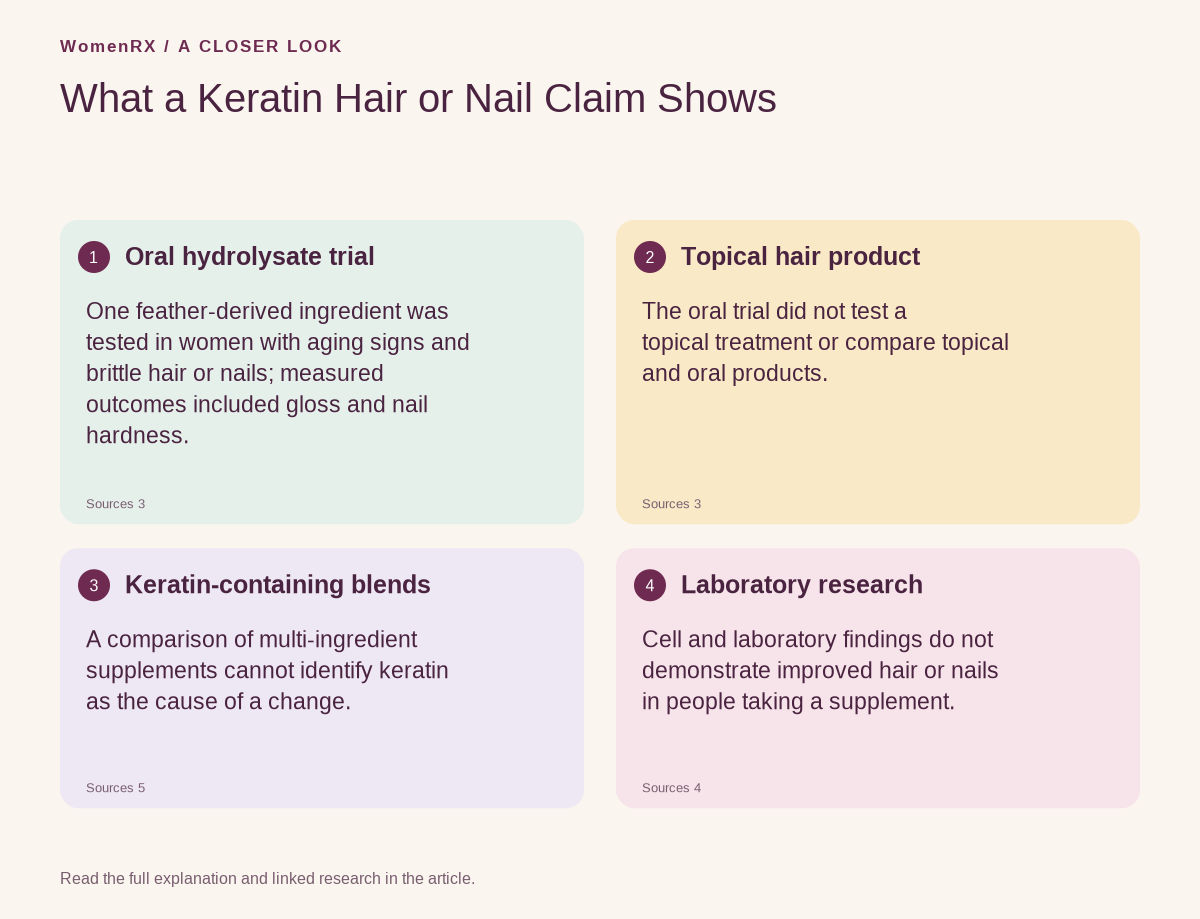
What a Keratin Hair or Nail Claim Shows
Oral hydrolysate trial: One feather-derived ingredient was tested in women with aging signs and brittle hair or nails; measured outcomes included gloss and nail hardness.3
Topical hair product: The oral trial did not test a topical treatment or compare topical and oral products.3
Keratin-containing blends: A comparison of multi-ingredient supplements cannot identify keratin as the cause of a change.5
Laboratory research: Cell and laboratory findings do not demonstrate improved hair or nails in people taking a supplement.4
Read the figure as text
Separate product type and study design from the outcomes the findings can support.- Oral hydrolysate trial: One feather-derived ingredient was tested in women with aging signs and brittle hair or nails; measured outcomes included gloss and nail hardness.3
- Topical hair product: The oral trial did not test a topical treatment or compare topical and oral products.3
- Keratin-containing blends: A comparison of multi-ingredient supplements cannot identify keratin as the cause of a change.5
- Laboratory research: Cell and laboratory findings do not demonstrate improved hair or nails in people taking a supplement.4
More questions, answered
How long did the keratin supplement study last?
The trial of a specific oral feather-derived keratin hydrolysate lasted 90 days. That describes the study period, not a proven schedule for every keratin product or a timeframe for hair regrowth. 3
Does a study of a keratin blend prove keratin works?
No. A study of formulas with several ingredients can’t identify which ingredient accounts for a result. One trial in women with telogen effluvium compared a product containing keratin with another containing amino acids associated with keratin and collagen. It did not isolate keratin’s effect. 5
Sources you can check
- Hair loss in new moms: Dermatologist tipsAccessed 2026-09-25Return to first citation
- Hair Loss | Alopecia | Alopecia Areata | MedlinePlusAccessed 2026-09-25Return to first citation
- The Effects of an Oral Supplementation of a Natural Keratin Hydrolysate on Skin Aging: A Randomized, Double-Blind, Placebo-Controlled Clinical Study in Healthy Women.Tursi F, Nobile V, Cestone E, De Ponti I, Lepoudere A, Sergheraert R, Soulard JP. · Journal of cosmetic dermatology · 2025Return to first citation
- Human hair proteins as natural reactive oxygen species scavengers for in vitro applications.Lai HY, Setyawati MI, Duarte CV, Chua HM, Low CT, Ng KW. · Journal of biomedical materials research. Part B, Applied biomaterials · 2023Return to first citation
- Comparative evaluation between two nutritional supplements in the improvement of telogen effluvium.Sant'Anna Addor FA, Donato LC, Melo CSA. · Clinical, cosmetic and investigational dermatology · 2018Return to first citation
- Hair loss: Who gets and causesAccessed 2026-09-25Return to first citation
- Hair loss: Diagnosis and treatmentAccessed 2026-09-25Return to first citation
- Melanonychia striata: clarifying behind the Black Curtain. A review on clinical evaluation and management of the 21st century.Leung AKC, Lam JM, Leong KF, Sergi CM. · International journal of dermatology · 2019Return to first citation
- Dermoscopic Evaluation of Inflammatory Nail Disorders and Their Mimics.Lim SS, Chamberlain A, Hur K, Ohn J, Han B, Mar V, Mun JH. · Acta dermato-venereologica · 2021Return to first citation