Do Keratin Supplements Help Hair and Nails?
Two small trials reported improvements, but they tested different keratin products and cannot tell you why your hair or nails have changed.
There is some evidence for specific oral keratin products, not for keratin supplements as a category. One small trial tested a keratin-and-nutrient formula; another tested a particular feather-derived keratin hydrolysate. Both reported improvements in hair or nail appearance measures, but neither establishes that a supplement treats the cause of hair loss or unexplained nail changes. 45
What did the keratin trials actually test?
The distinction that matters most on a supplement label is keratin alone versus a formula containing keratin. In a randomized trial of 50 women ages 40 to 71 with damaged hair and nails, one group took Cynatine HNS, a product containing wool-derived keratin peptides plus vitamins and minerals; the other took a placebo. After 90 days, the researchers reported statistically significant improvements in hair and nail measures in the product group compared with placebo. Because the ingredients were given together, the trial cannot tell you how much of any improvement came from keratin itself. Statistical significance also doesn't tell you, on its own, how noticeable a change would be in your mirror. 5
A different randomized trial enrolled 99 healthy women ages 35 to 65 who had signs of skin aging, damaged or brittle hair, and brittle nails. It tested a specific feather-derived keratin hydrolysate against placebo for 90 days. The researchers measured several skin outcomes along with hair and nail gloss and nail hardness, and reported improvements in those hair and nail appearance measures. This hydrolysate was described as a distinctive mixture rich in free amino acids, not an interchangeable version of every product labeled “hydrolyzed keratin.” 4
So the honest answer is narrower than “keratin works.” These studies offer preliminary, product-specific evidence for some cosmetic hair and nail measures. They do not show that an arbitrary keratin capsule will reverse hair loss, or that a change in nail hardness identifies what made your nails brittle. 45
Match the claim to what was measured
If a package promises thicker-looking, glossier hair or stronger-looking nails, check whether its ingredients resemble those used in a study and whether that study measured the outcome you care about. The feather-derived hydrolysate trial assessed gloss and nail hardness; it wasn't a trial of treatment for a diagnosed hair-loss condition. The Cynatine HNS trial included hair-loss and hair-growth measures, but tested a multi-ingredient product in women selected for damaged hair and nails. Neither result transfers automatically to a different formula or to every reason hair can thin. 45
That matters because “my hair is changing” can describe different problems. Hair loss may be associated with family history and aging, but illness, thyroid problems, some medicines, stress, and poor nutrition are also among the possible causes. Treatment depends on the cause. A supplement trial in people with damaged hair cannot sort those possibilities out for you. 2
When the timing tells you more than the bottle
For example, if you notice a lot of shedding a few months after giving birth, that timing may fit postpartum telogen effluvium. The drop in estrogen after delivery can trigger temporary shedding, which usually peaks around four months after birth. Most women regain their usual fullness by their baby's first birthday. The keratin trials did not establish that their products shorten this process: the feather-hydrolysate trial excluded pregnant and lactating women, and the multi-ingredient trial excluded pregnant and breastfeeding women. If your usual fullness hasn't returned by a year, the American Academy of Dermatology recommends assessment for another cause. 145
If thinning becomes noticeable around menopause or later, age alone still doesn't establish the cause. Female pattern hair loss can run in families, while medical conditions, medicines, and nutrition can also affect hair. Rather than choosing a capsule on the assumption that this is a keratin shortage, getting the pattern and cause of the change assessed gives you a better basis for deciding what to do. The keratin trials did not test treatment specifically for menopausal hair changes. 2345
What if nails are your main concern?
The nail evidence is about brittle or damaged nails and measured appearance or hardness, not about diagnosing nail changes. That gives you a useful dividing line. If you're weighing a product for cosmetic brittleness similar to what the trial participants had, the findings may be relevant, though they remain small and specific to the tested products. If a nail has changed in a way you can't explain, neither trial identifies its cause or establishes whether a supplement would help that change. 45
When comparing labels, look for the exact form of keratin and the rest of the ingredient list. Wool-derived keratin peptides in a vitamin-and-mineral formula are not the same intervention as the feather-derived hydrolysate tested on its own. If your product differs, neither trial verifies its results or safety. And if you're pregnant or breastfeeding, these trials offer no direct evidence for use in that period because those participants were excluded. 45
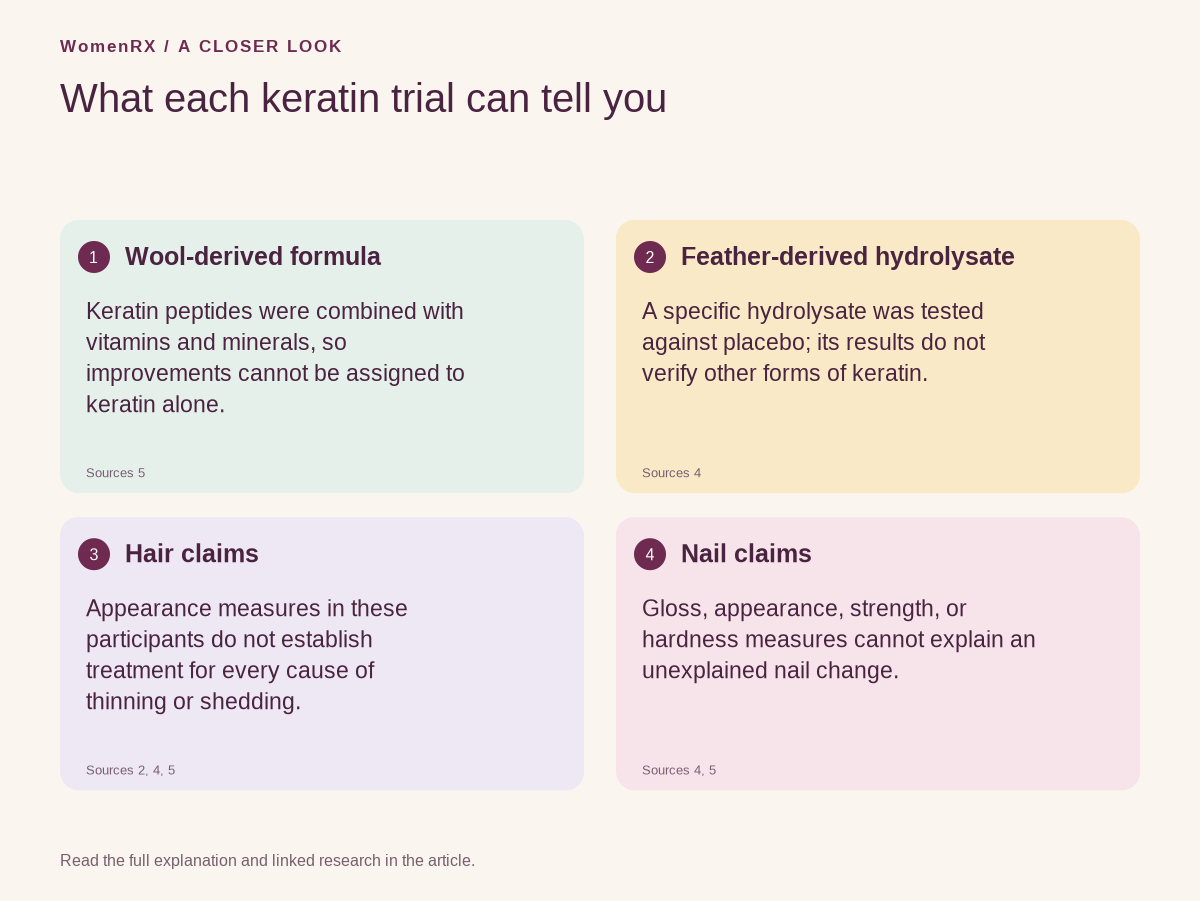
What each keratin trial can tell you
Wool-derived formula: Keratin peptides were combined with vitamins and minerals, so improvements cannot be assigned to keratin alone.5
Feather-derived hydrolysate: A specific hydrolysate was tested against placebo; its results do not verify other forms of keratin.4
Hair claims: Appearance measures in these participants do not establish treatment for every cause of thinning or shedding.245
Nail claims: Gloss, appearance, strength, or hardness measures cannot explain an unexplained nail change.45
Read the figure as text
The tested ingredient and the measured outcome both matter when comparing a study with a supplement label.- Wool-derived formula: Keratin peptides were combined with vitamins and minerals, so improvements cannot be assigned to keratin alone.5
- Feather-derived hydrolysate: A specific hydrolysate was tested against placebo; its results do not verify other forms of keratin.4
- Hair claims: Appearance measures in these participants do not establish treatment for every cause of thinning or shedding.245
- Nail claims: Gloss, appearance, strength, or hardness measures cannot explain an unexplained nail change.45
Sources you can check
- Hair loss in new moms: Dermatologist tipsAccessed 2026-09-25Return to first citation
- Hair Loss | Alopecia | Alopecia Areata | MedlinePlusAccessed 2026-09-25Return to first citation
- Hair loss - NHSAccessed 2026-09-25Return to first citation
- The Effects of an Oral Supplementation of a Natural Keratin Hydrolysate on Skin Aging: A Randomized, Double-Blind, Placebo-Controlled Clinical Study in Healthy Women.Tursi F, Nobile V, Cestone E, De Ponti I, Lepoudere A, Sergheraert R, Soulard JP. · Journal of cosmetic dermatology · 2025Return to first citation
- A clinical trial to investigate the effect of Cynatine HNS on hair and nail parameters.Beer C, Wood S, Veghte RH. · TheScientificWorldJournal · 2014Return to first citation