What Do We Know About Keratin Supplement Safety?
A six-month study in women offers a limited look at two oral blends, but it cannot answer whether keratin alone is safe to take long term.
The most directly relevant human study compared two multi-ingredient oral supplements in women with diffuse hair loss for six months. It found no significant difference in reported adverse events between the blends. Because neither formula tested keratin alone, the findings cannot establish the long-term safety of keratin, hydrolyzed keratin, or the particular product in your cabinet. 2
What the six-month study can tell you
If you’re thinking about continuing a keratin supplement, the key question is whether the research tested your ingredient in a comparable product for a comparable length of time. In one randomized, blinded study, 120 women with telogen effluvium, a type of diffuse hair loss, were assigned to one of two oral supplements for 180 days. One blend contained keratin, cystine, medicinal yeast and other ingredients. The other contained vitamins, minerals, and what the researchers called “amino acids of keratin and collagen.” The report describes those as essential and nonessential amino acids that make up keratin, including cystine. It does not establish that the blend contains keratin protein or specify the source of those amino acids. Neither blend was keratin alone. 2
The researchers found no significant difference between the blends in probable or proven adverse events, or in total adverse events. One participant in the blend containing vitamins, minerals, and amino acids of keratin and collagen reported mild nausea. Two participants in the blend containing keratin, cystine, and medicinal yeast reported mild digestive symptoms. None stopped treatment because of those symptoms. These findings describe what was reported during this comparison; they do not prove that either blend is free of risks or show which ingredient caused a symptom. 2
Six months is also the limit of the study period. It cannot tell you what happens with longer use. The participants had a specific hair-loss condition, and pregnancy risk and lactation were among the study’s noninclusion criteria. Its findings therefore do not answer questions about use while pregnant or breastfeeding. 2
Match the label to the evidence
Look past the word keratin on the front of the bottle and read the full ingredient list. Does it say keratin, hydrolyzed keratin, or amino acids of keratin? What other ingredients are included? The study identified keratin in one multi-ingredient formula and used the phrase “amino acids of keratin and collagen” for the other. It did not report a separate test of hydrolyzed keratin. A similar-sounding ingredient name is not enough to treat a different product as one of the studied blends. 2
This distinction matters if you’re weighing a claim about stronger nails, too. A 2025 review discusses several nail supplements, including solubilized keratin, but its abstract does not provide a long-term safety estimate for an oral keratin product. It urges that recommendations reflect the strength of the evidence for the ingredients involved. 1
Hair products applied on the outside answer a different question
A keratin treatment applied to hair is not an oral supplement. The six-month study tested swallowed blends, not products applied to hair or the scalp. Its results cannot establish topical safety, and a topical product claim cannot establish what happens when you swallow keratin. 2
For a decision about continuing your supplement, compare its whole formula with what was studied, then consider how long you intend to use it. If its label says hydrolyzed keratin, contains a different combination of ingredients, or you plan to take it beyond six months, this study does not settle its safety. And a hair or nail concern by itself does not show that keratin supplementation is needed: the hair study enrolled women with an assessed form of diffuse hair loss, not women with every kind of hair concern. 2
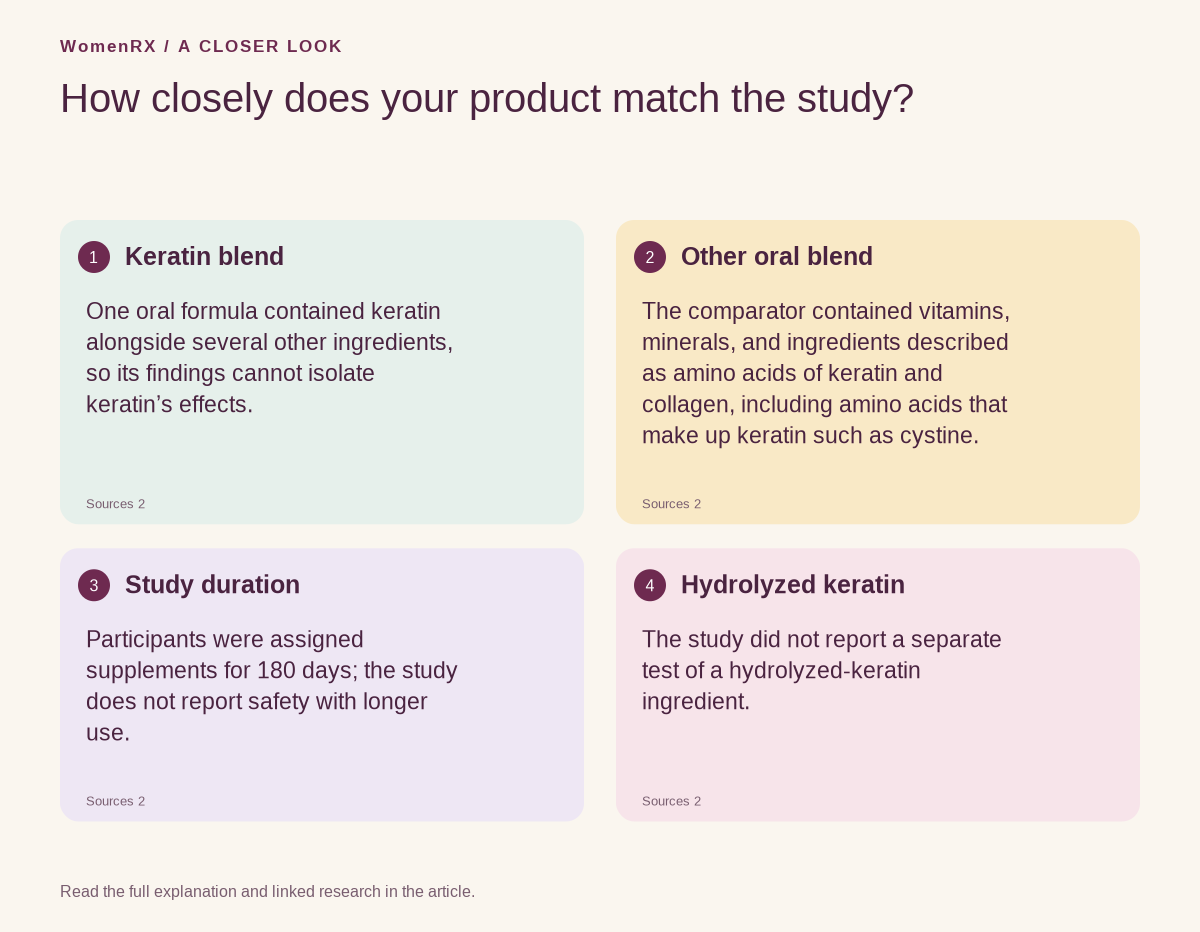
How closely does your product match the study?
Keratin blend: One oral formula contained keratin alongside several other ingredients, so its findings cannot isolate keratin’s effects.2
Other oral blend: The comparator contained vitamins, minerals, and ingredients described as amino acids of keratin and collagen, including amino acids that make up keratin such as cystine.2
Study duration: Participants were assigned supplements for 180 days; the study does not report safety with longer use.2
Hydrolyzed keratin: The study did not report a separate test of a hydrolyzed-keratin ingredient.2
Read the figure as text
The oral study’s ingredients and duration set the boundaries for what its safety observations can address.- Keratin blend: One oral formula contained keratin alongside several other ingredients, so its findings cannot isolate keratin’s effects.2
- Other oral blend: The comparator contained vitamins, minerals, and ingredients described as amino acids of keratin and collagen, including amino acids that make up keratin such as cystine.2
- Study duration: Participants were assigned supplements for 180 days; the study does not report safety with longer use.2
- Hydrolyzed keratin: The study did not report a separate test of a hydrolyzed-keratin ingredient.2
More questions, answered
Does the study show keratin is safe for six months?
It provides six months of adverse-event reporting for two specific multi-ingredient blends. Because keratin was not tested alone, it cannot establish the safety of keratin by itself or of every keratin supplement. 2
Sources you can check
- Nail Supplements: When, How, and Why?Zaraa I, Richert B. · Skin appendage disorders · 2025Return to first citation
- Comparative evaluation between two nutritional supplements in the improvement of telogen effluvium.Sant'Anna Addor FA, Donato LC, Melo CSA. · Clinical, cosmetic and investigational dermatology · 2018Return to first citation