Keratin Supplements: Read the Ingredients, Not the Promise
A product marketed for hair may contain keratin, biotin, or a blend, and those ingredients don’t have the same evidence or cautions.
Check the Supplement Facts panel to see whether keratin is actually listed, and note every other active ingredient and its amount. A trial in women with hair shedding tested two multi-ingredient formulas, so it couldn’t show whether keratin itself helped. Biotin has limited evidence for hair benefits in otherwise healthy people, and higher supplemental amounts can interfere with some lab tests. 1 2
Start with what’s actually in the bottle
“Hair supplement” describes a product’s marketing, not a single ingredient. Read the Supplement Facts panel and look for the ingredient names and amounts per serving. A formula might list keratin, amino acids, biotin (vitamin B7), or several nutrients together. These aren’t interchangeable, and evidence for one ingredient doesn’t establish that the others work.
That distinction matters because a clinical study in adult women with chronic telogen effluvium, a type of diffuse shedding, compared two different blends. One included biotin, minerals, vitamins, and amino acids of keratin and collagen; the other included keratin and several other ingredients. Participants were assigned to one blend or the other, not to keratin alone or a placebo. Hair measures improved over the study, but the design can’t tell whether keratin caused the changes, whether another ingredient mattered, or how much change would have happened without either product. 2
So a product listing keratin isn’t automatically backed by evidence that keratin treats hair loss. The trial also doesn’t establish that a different product with a different blend will have the same effects.
Biotin is a separate ingredient, with a separate caution
Biotin is often included in products promoted for hair, skin, and nails. Biotin deficiency can involve hair loss, but deficiency is rare. Evidence that biotin supplements improve hair in people without a deficiency is very limited: the hair reports described by the NIH Office of Dietary Supplements involved children with a rare hair-shaft condition, not adult women with common shedding or thinning. 1
The most useful biotin safety point is about testing, not a proven toxic effect. High supplemental amounts can distort some lab results, including certain thyroid tests; the result may appear falsely high or low depending on the test. A study in six healthy adults found interference in several assays after taking 10 mg of biotin daily for a week. The NIH fact sheet also describes interference with thyroid tests after a single 10 mg dose when testing occurred within 24 hours. 1
If you take a hair supplement, tell the person ordering or interpreting your blood test and share the label. Don’t assume a product is biotin-free just because its front label emphasizes keratin, and don’t stop or change a prescribed supplement on your own.
Match the claim to the formula
A useful label check is to compare the product’s promise with its actual ingredients. If the product claims a keratin benefit but lists biotin and other nutrients, the claim may not reflect evidence for keratin itself. If it lists several active ingredients, any result from a study of another blend may not apply. In the women’s trial, both products contained multiple ingredients and differed from each other, which makes it impossible to identify one ingredient as the reason for improvement. 2
Also check the serving size and amounts, then compare them with any multivitamin or other hair, skin, and nail product you already use. That helps you notice duplicated ingredients, especially biotin, and gives you a complete list to share before lab testing. This is a label-reading step, not proof that a particular combination is effective or safe for you.
Hair changes after pregnancy or around menopause don’t, by themselves, show that you need keratin or biotin. Biotin deficiency is rare, and the available hair-benefit reports don’t establish that biotin helps common hair changes in adult women. The women’s supplement trial studied chronic telogen effluvium, not hair changes specifically after pregnancy or during menopause. 1 2 If shedding or thinning is concerning, the pattern and timing are useful information to discuss when looking for a cause rather than treating a supplement label as a diagnosis.
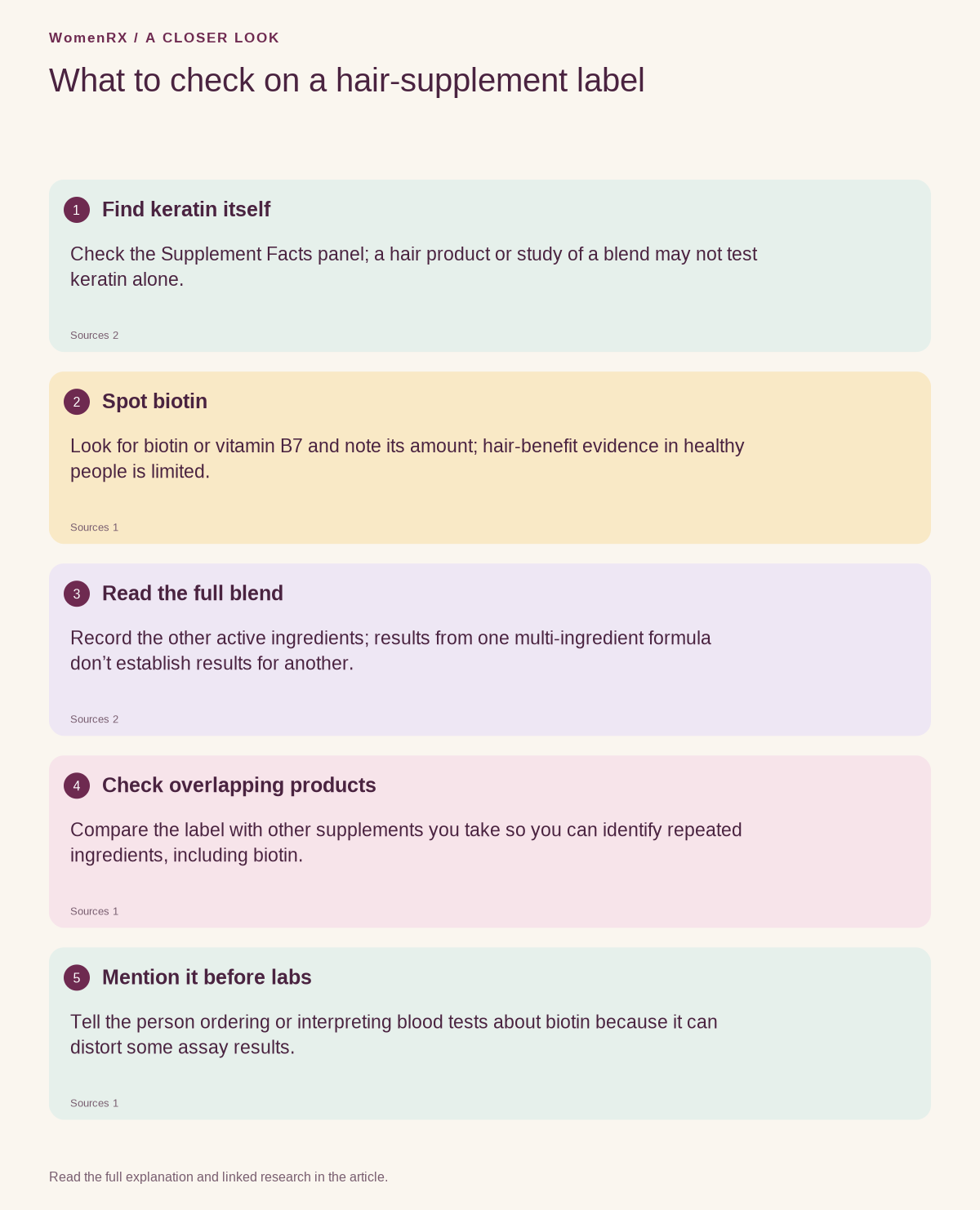
What to check on a hair-supplement label
Find keratin itself: Check the Supplement Facts panel; a hair product or study of a blend may not test keratin alone.2
Spot biotin: Look for biotin or vitamin B7 and note its amount; hair-benefit evidence in healthy people is limited.1
Read the full blend: Record the other active ingredients; results from one multi-ingredient formula don’t establish results for another.2
Check overlapping products: Compare the label with other supplements you take so you can identify repeated ingredients, including biotin.1
Mention it before labs: Tell the person ordering or interpreting blood tests about biotin because it can distort some assay results.1
Read the figure as text
Separate the ingredient named in the product promise from the ingredients with their own evidence and cautions.- Find keratin itself: Check the Supplement Facts panel; a hair product or study of a blend may not test keratin alone.2
- Spot biotin: Look for biotin or vitamin B7 and note its amount; hair-benefit evidence in healthy people is limited.1
- Read the full blend: Record the other active ingredients; results from one multi-ingredient formula don’t establish results for another.2
- Check overlapping products: Compare the label with other supplements you take so you can identify repeated ingredients, including biotin.1
- Mention it before labs: Tell the person ordering or interpreting blood tests about biotin because it can distort some assay results.1
More questions, answered
Does a keratin supplement contain keratin?
Not necessarily. Check the Supplement Facts panel for keratin itself; a hair product may instead contain biotin, amino acids, or a mixture. A study of a blend that includes keratin can’t show that keratin alone produced the reported changes. 2
Can biotin affect blood tests?
Yes. Supplemental biotin can interfere with some lab assays, including certain thyroid tests, and make results falsely high or low. Share the product label with the person ordering or interpreting your test. 1
Sources you can check
- Biotin - Health Professional Fact SheetAccessed 2026-09-25Return to first citation
- Comparative evaluation between two nutritional supplements in the improvement of telogen effluvium.Sant'Anna Addor FA, Donato LC, Melo CSA. · Clinical, cosmetic and investigational dermatology · 2018Return to first citation