Vitamin K2: Is There a Daily Dose for Women?
There’s a daily target for vitamin K overall, but no established K2 supplement dose for women.
For women age 19 and older, the adequate intake is 90 micrograms of vitamin K per day from all sources. That figure covers vitamin K overall, not a recommended K2 supplement dose. Research hasn’t established a universal K2 dose for bone health, including after menopause. If you take a vitamin K antagonist, ask the clinician managing it about the specific product’s form and amount; the reported interaction finding is for MK-7. 123
The daily number is for vitamin K overall
The U.S. adequate intake for vitamin K is 90 micrograms a day for adult women, including during pregnancy and lactation. It’s a general nutrition reference, not a target for a K2 pill. Vitamin K includes phylloquinone (K1) and menaquinones (K2), and the available guidance doesn’t set a separate daily K2 requirement for women. 1
An adequate intake is used when there isn’t enough evidence to establish a recommended dietary allowance. It’s a guide to total intake, not a prescription to take that amount as a supplement. Vitamin K comes from food as well as supplements; leafy greens are common sources of K1, while menaquinones occur in some fermented foods and animal products. 1
Does K2 help protect bone after menopause?
Vitamin K helps activate proteins involved in bone, which gives K2 a plausible role in bone health. But a plausible mechanism and a change in a bone marker don’t establish that a supplement prevents osteoporosis or fractures. The NIH review describes mixed results: some trials reported improvements, while others found no significant difference in bone mineral density. 1
Much of the bone-trial evidence discussed in that review came from postmenopausal women, but the results don’t establish a reliable K2 dose or prove that being postmenopausal, by itself, makes supplementation beneficial. For example, one trial using MK-7 for three years reported improvements in bone-strength measures, while another trial in postmenopausal women found no significant bone-density difference with vitamin K treatments compared with placebo. The forms, amounts, study designs, and outcomes varied. 1
That variation matters: MK-4 and MK-7 are different forms of K2, and a dose studied in one trial shouldn’t be treated as a general recommendation. Some older trials used 45 milligrams of MK-4, while a separate MK-7 trial used 180 micrograms per day. Those research regimens are not interchangeable and don’t establish a daily dose for women to follow. 1
Check medicines before choosing a supplement
Vitamin K intake can matter if you take a blood thinner, so check with the clinician managing your medicine before changing your intake. A review specifically reports clinically relevant interference between MK-7 and vitamin K antagonist therapy; that finding shouldn’t be generalized to every form of K2. Ask about the particular product’s form and amount before adding or changing it. 23
It’s also worth checking every label in your routine. Vitamin K may be included in a multivitamin or a combination supplement, so a new K2 product could add to what you already take. The NIH notes that supplement products vary widely in their vitamin K amounts. 1
Separate total vitamin K needs from a K2 capsule dose
If your goal is general nutrition, use 90 micrograms as a reference for total vitamin K intake, not as a K2 capsule dose. If your goal is bone health, don’t assume a K2 supplement has a proven preventive benefit or that menopause alone makes it necessary. If you take a vitamin K antagonist, check the product’s form and amount with the clinician managing that medicine before making a change. These distinctions can help you assess a product claim without confusing a nutrient target, a research dose, and a proven treatment.
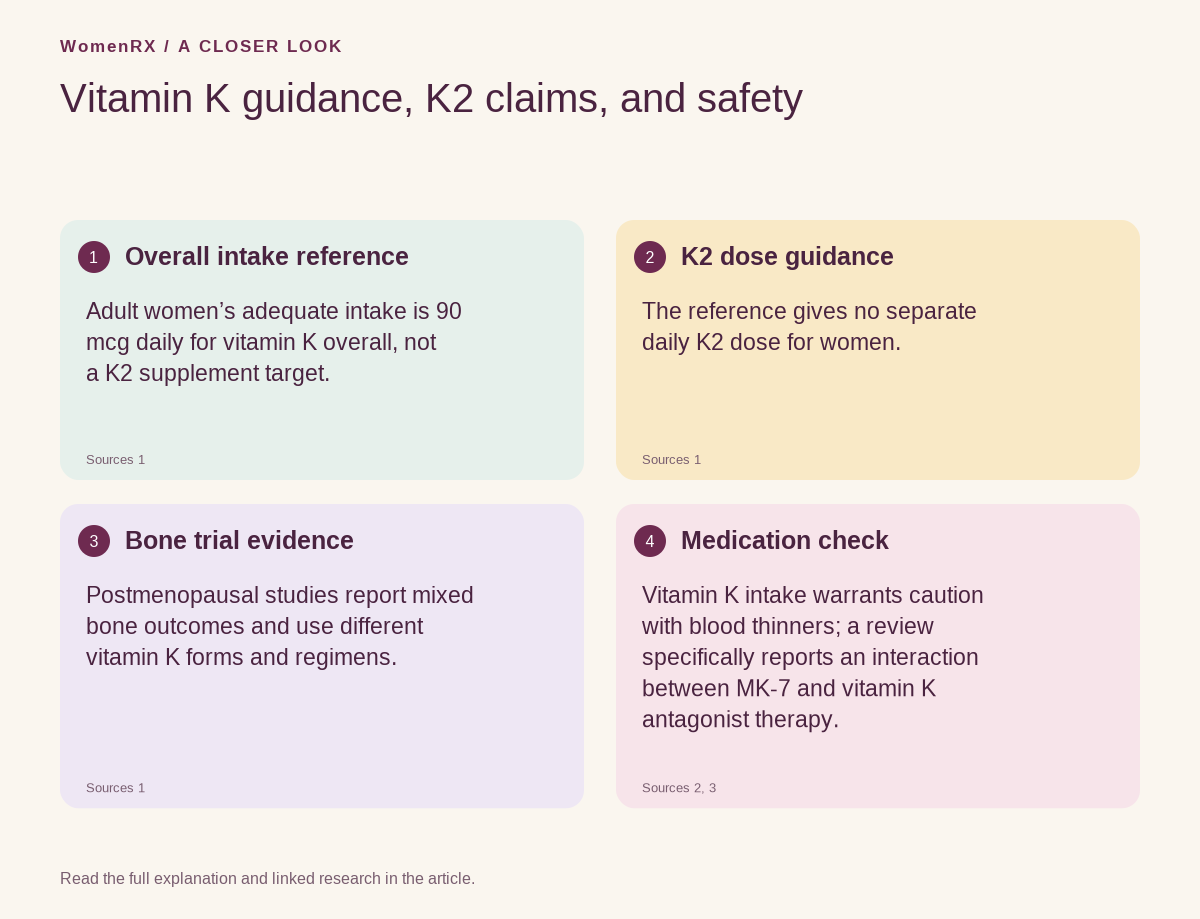
Vitamin K guidance, K2 claims, and safety
Overall intake reference: Adult women’s adequate intake is 90 mcg daily for vitamin K overall, not a K2 supplement target.1
K2 dose guidance: The reference gives no separate daily K2 dose for women.1
Bone trial evidence: Postmenopausal studies report mixed bone outcomes and use different vitamin K forms and regimens.1
Medication check: Vitamin K intake warrants caution with blood thinners; a review specifically reports an interaction between MK-7 and vitamin K antagonist therapy.23
Read the figure as text
These distinctions show why an overall nutrient reference, a supplement trial, and a medication-safety question are not the same thing.- Overall intake reference: Adult women’s adequate intake is 90 mcg daily for vitamin K overall, not a K2 supplement target.1
- K2 dose guidance: The reference gives no separate daily K2 dose for women.1
- Bone trial evidence: Postmenopausal studies report mixed bone outcomes and use different vitamin K forms and regimens.1
- Medication check: Vitamin K intake warrants caution with blood thinners; a review specifically reports an interaction between MK-7 and vitamin K antagonist therapy.23
More questions, answered
Is the 90-microgram target only for K2?
No. It’s the adequate intake for vitamin K overall for adult women, not a K2-only target or a supplement dose. 1
Is there a tolerable upper limit for vitamin K?
The NIH’s reference says the Food and Nutrition Board did not establish an upper limit for vitamin K. That does not create a recommended K2 dose or remove the need to check vitamin K intake with the clinician managing a vitamin K antagonist. 12
Sources you can check
- Vitamin K - Health Professional Fact SheetAccessed 2026-09-25Return to first citation
- Vitamin K: MedlinePlusAccessed 2026-09-25Return to first citation
- Beyond Bone Health: Exploring the "Heart-Brain-Bone" Axis Modulated by Lipid-Soluble Nutrients (Omega-3, Vitamin D3, and Vitamin K2).Fang SC, Huang MK, Shen HE, Zhang BB, Chao TC, Wu CC. · Nutrients · 2026Return to first citation