Vitamin D3 and K2 Together: Is There an Added Benefit?
Both nutrients have roles in bone health, but their roles alone don’t show that taking them together offers extra protection.
Vitamin D3 helps your body absorb calcium, while vitamin K2 is a form of a vitamin needed to make bone-related and blood-clotting proteins. Those roles make the combination worth studying, but they don’t establish that a D3-and-K2 supplement protects bones better than meeting your vitamin D needs without added K2. 1 2 4
Why these vitamins are paired
Vitamin D helps your body absorb calcium, one of bone’s main building blocks. Vitamin K helps your body make proteins involved in healthy bones and tissues, as well as blood clotting. D3 is also called cholecalciferol; K2 refers to menaquinones, including the MK-7 form discussed in some studies. 1 2 4
That gives the pairing a reasonable biological story. It does not mean K2 directs calcium from your arteries into your bones or makes vitamin D supplementation safer. A proposed mechanism and a demonstrated benefit from a combined product are different things. A review describes the proposed D3-and-K2 mechanisms as plausible, but insufficiently confirmed in humans. 4
What the combination research actually measures
If your goal is stronger bones, look for outcomes such as bone loss or fractures, and check whether a study compares the combination with D3 alone. A trial comparing D3 plus K2 with a placebo, for example, could test whether the pair has an effect. It could not tell you whether the K2 adds anything beyond D3.
The distinction matters in the findings reported so far. A review reports that combined MK-7 and D3 did not slow aortic valve or coronary artery calcification in one trial. Those are cardiovascular imaging outcomes, not measures of bone strength or fractures. The same review reports that MK-7 did not reduce bone loss in early menopausal women, but that finding concerns K2 rather than the combination. Neither result demonstrates an extra bone benefit from adding K2 to D3. 4
There has also been a randomized D3-and-K2 trial in adults with long COVID, most of whom were women. It examined symptoms and biomarkers, not bone health, and excluded pregnant and lactating women. Its results can’t answer whether a combined product helps bones or has a pregnancy-specific benefit. 3
The useful conclusion is narrower than either “the combination works” or “it can never help”: the separate roles of these nutrients don’t establish a reason to choose a combined product for extra bone protection.
Use the label to answer your own question
First, ask what prompted you to shop for a supplement. If it’s a concern about vitamin D intake or status, assess the vitamin D part of the label on its own. Vitamin D can come from foods, fortified foods, sunlight, and supplements. Both D2 and D3 can raise blood vitamin D, though D3 may raise it higher and for longer. 1
Next, check the form and amount of each nutrient on the Supplement Facts panel. Compare them with what’s in any multivitamin or other supplement you already use. A combined bottle may be convenient if you have a reason to take both nutrients, but the presence of K2 doesn’t establish that the product adds bone protection or offsets risks from vitamin D. 4
One medication question deserves attention before adding K2: if you take a vitamin K antagonist, discuss the supplement or a change in vitamin K intake with the clinician managing that treatment. Vitamin K can interfere with vitamin K antagonist therapy. 2 4
Pregnancy and menopause call for different evidence
During pregnancy and breastfeeding, meeting vitamin D needs is a separate question from whether K2 adds a benefit. MedlinePlus lists 600 IU as the recommended daily amount of vitamin D for pregnancy or breastfeeding. That recommendation does not establish a need for a D3-and-K2 product. The combination trial described above excluded pregnant and lactating women. 1 3
If you’re thinking about bone health around menopause, don’t mistake a study of K2 alone for proof about a combined supplement. The early-menopause bone-loss finding reported in the review was for MK-7, while the combined-product trial it discusses measured cardiovascular calcification. Neither directly shows that adding K2 to D3 prevents fractures after menopause. 4
A sensible choice starts with the nutrient you have a reason to consider, then checks whether the other ingredient serves a supported purpose for you. Two familiar vitamins on one label aren’t, by themselves, evidence of a better bone-health plan.
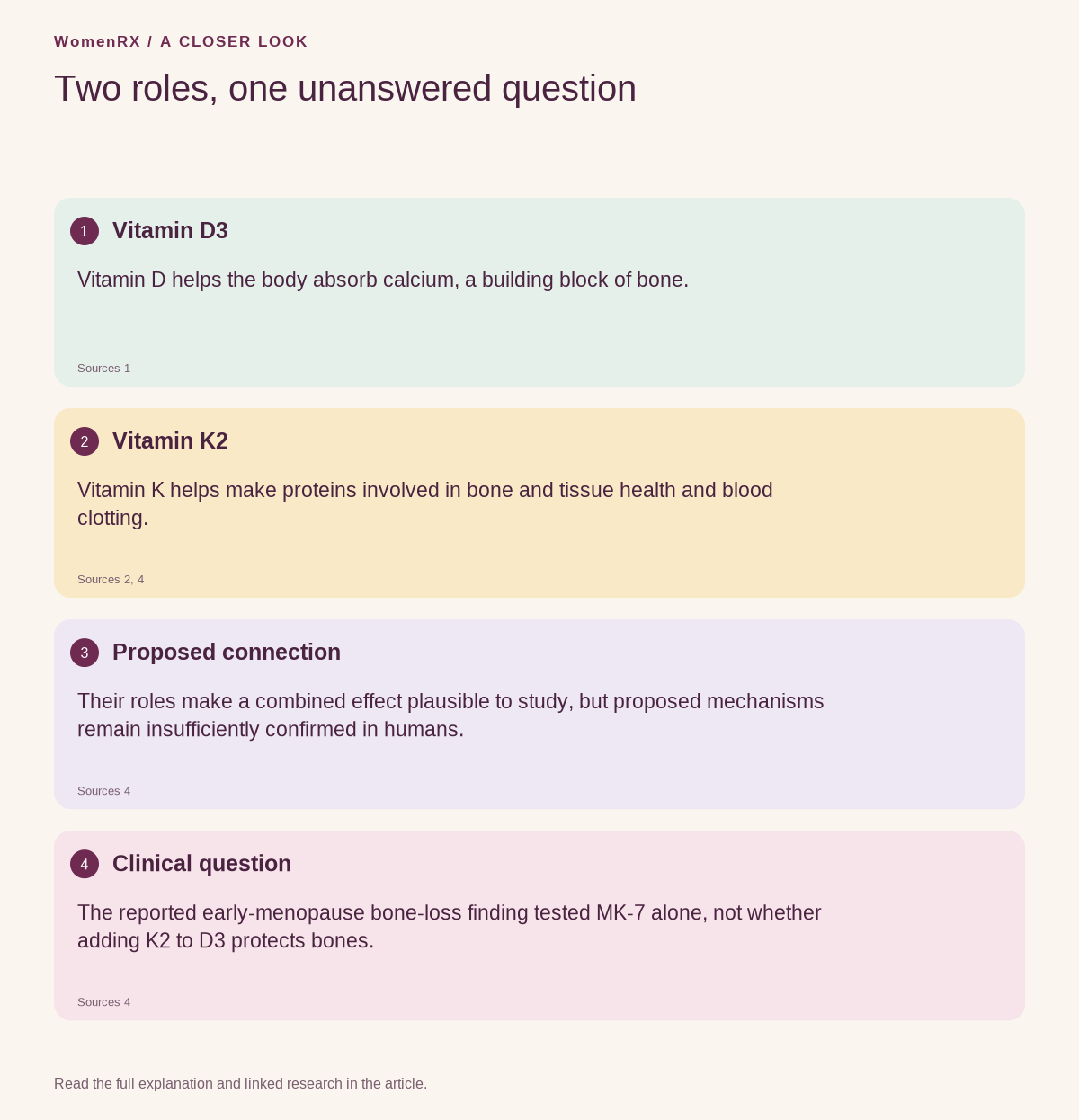
Two roles, one unanswered question
Vitamin D3: Vitamin D helps the body absorb calcium, a building block of bone.1
Vitamin K2: Vitamin K helps make proteins involved in bone and tissue health and blood clotting.24
Proposed connection: Their roles make a combined effect plausible to study, but proposed mechanisms remain insufficiently confirmed in humans.4
Clinical question: The reported early-menopause bone-loss finding tested MK-7 alone, not whether adding K2 to D3 protects bones.4
Read the figure as text
Follow the separate nutrient roles, then see where a claim about the combined product needs clinical evidence.- Vitamin D3: Vitamin D helps the body absorb calcium, a building block of bone.1
- Vitamin K2: Vitamin K helps make proteins involved in bone and tissue health and blood clotting.24
- Proposed connection: Their roles make a combined effect plausible to study, but proposed mechanisms remain insufficiently confirmed in humans.4
- Clinical question: The reported early-menopause bone-loss finding tested MK-7 alone, not whether adding K2 to D3 protects bones.4
More questions, answered
Does K2 make vitamin D3 safer?
That hasn’t been established by the nutrients’ separate roles. The proposed combined mechanisms remain insufficiently confirmed in humans, so K2 on the label isn’t a reason to assume it offsets risks from vitamin D. 4
Sources you can check
- Vitamin D: MedlinePlusAccessed 2026-09-25Return to first citation
- Vitamin K: MedlinePlusAccessed 2026-09-25Return to first citation
- Vitamins K2 and D3 Improve Long COVID, Fungal Translocation, and Inflammation: Randomized Controlled Trial.Atieh O, Daher J, Durieux JC, Abboud M, Labbato D, Baissary J, Koberssy Z, Ailstock K, Cummings M, Funderburg NT, McComsey GA. · Nutrients · 2025Return to first citation
- Beyond Bone Health: Exploring the "Heart-Brain-Bone" Axis Modulated by Lipid-Soluble Nutrients (Omega-3, Vitamin D3, and Vitamin K2).Fang SC, Huang MK, Shen HE, Zhang BB, Chao TC, Wu CC. · Nutrients · 2026Return to first citation