Vitamin D3 and K2 Together: What Dose Guidance Says
Vitamin D has age-based intake guidance; adding K2 isn’t a standard requirement or a proven way to make D3 work better.
For healthy adults, vitamin D guidance is 600-800 IU (15-20 mcg) daily, depending on age. Vitamin K guidance is separate: women 19 and older, including during pregnancy and lactation, have an adequate intake of 90 mcg daily from all sources. These values don’t set a D3-to-K2 ratio or show that a combined product is better. Check all supplement labels for overlapping amounts. 1 3
Start with the amount of D3, not the combination claim
Vitamin D helps your body absorb calcium, and U.S. intake guidance sets an age-based daily amount for healthy people: 600-800 IU (15-20 mcg) for adults, depending on age. That’s a target for total intake, not a dose recommendation for a particular supplement. D3 is one form of vitamin D; both D2 and D3 can raise blood vitamin D, though D3 tends to raise it more and keep it higher for longer. 3 4
Vitamin K has a different job: it helps make proteins involved in blood clotting and bone. But a role in bone biology doesn’t by itself show that taking extra K2 improves bone outcomes or makes D3 safer. The NIH’s vitamin K guidance describes mixed findings on supplementation and bone health, and says it remains unclear whether vitamin K supplements reduce osteoporosis risk. 1 2
What the numbers mean for women
For women age 19 and older, the adequate intake (AI) for vitamin K is 90 mcg a day. The AI is 90 mcg during pregnancy and lactation as well. It covers vitamin K from all sources and applies to vitamin K overall, not specifically to a K2 supplement. The NIH notes that evidence wasn’t sufficient to set an RDA for vitamin K, so the AI is an estimate of intake assumed to be adequate, not a treatment dose or a reason every woman needs a K2 pill. 1
The vitamin D recommendation is also a population guideline, not an individualized prescription. A clinician may recommend a different plan for a particular health situation. Pregnancy and breastfeeding don’t make a D3-and-K2 combination automatically necessary: check a product’s label against your prenatal or other supplements and your personal care plan before adding it. The guidance provided here does not establish a special combination dose for pregnancy or lactation. 1 3
What a combined product can, and can’t, tell you
A supplement that contains both nutrients may be convenient if you have a reason to take both. But the label alone can’t show that the combination offers extra protection for your bones. Vitamin K studies have tested different forms and doses, with both positive and null results; one trial in postmenopausal women found no difference in bone mineral density with vitamin K supplementation compared with placebo, even though participants in every group also received calcium and D3. These findings don’t establish that adding K2 to D3 is better than taking D3 alone. 1
There’s also no established D3-to-K2 ratio in the intake guidance. Treat each amount separately: compare the D3 on the label with your overall vitamin D plan, and the K amount with your total vitamin K intake. K2 supplements may list a form such as MK-4 or MK-7; the NIH notes that data comparing the bioavailability of different supplement forms are limited. 1 3
A quick label check before you buy
Look at the Supplement Facts panel and record the amount per serving, not just the amount per capsule. Check every product you already use, including a multivitamin, prenatal vitamin, calcium or bone-health formula, and standalone D3. Add the D3 amounts from those products so you can spot overlap. Then check whether the K entry names K2, and whether it specifies MK-4 or MK-7. This helps you see what the product actually provides without assuming that a higher amount or a particular ratio is better.
One interaction deserves special attention: vitamin K can affect blood thinners. If you take one, ask your prescriber or pharmacist before starting, stopping, or changing a K2 supplement. 2
The practical takeaway is simple: choose D3 based on your vitamin D needs, not on a promise that K2 must accompany it. A combined product is a choice, not a universal bone-health requirement, and its label should fit your overall supplement plan.
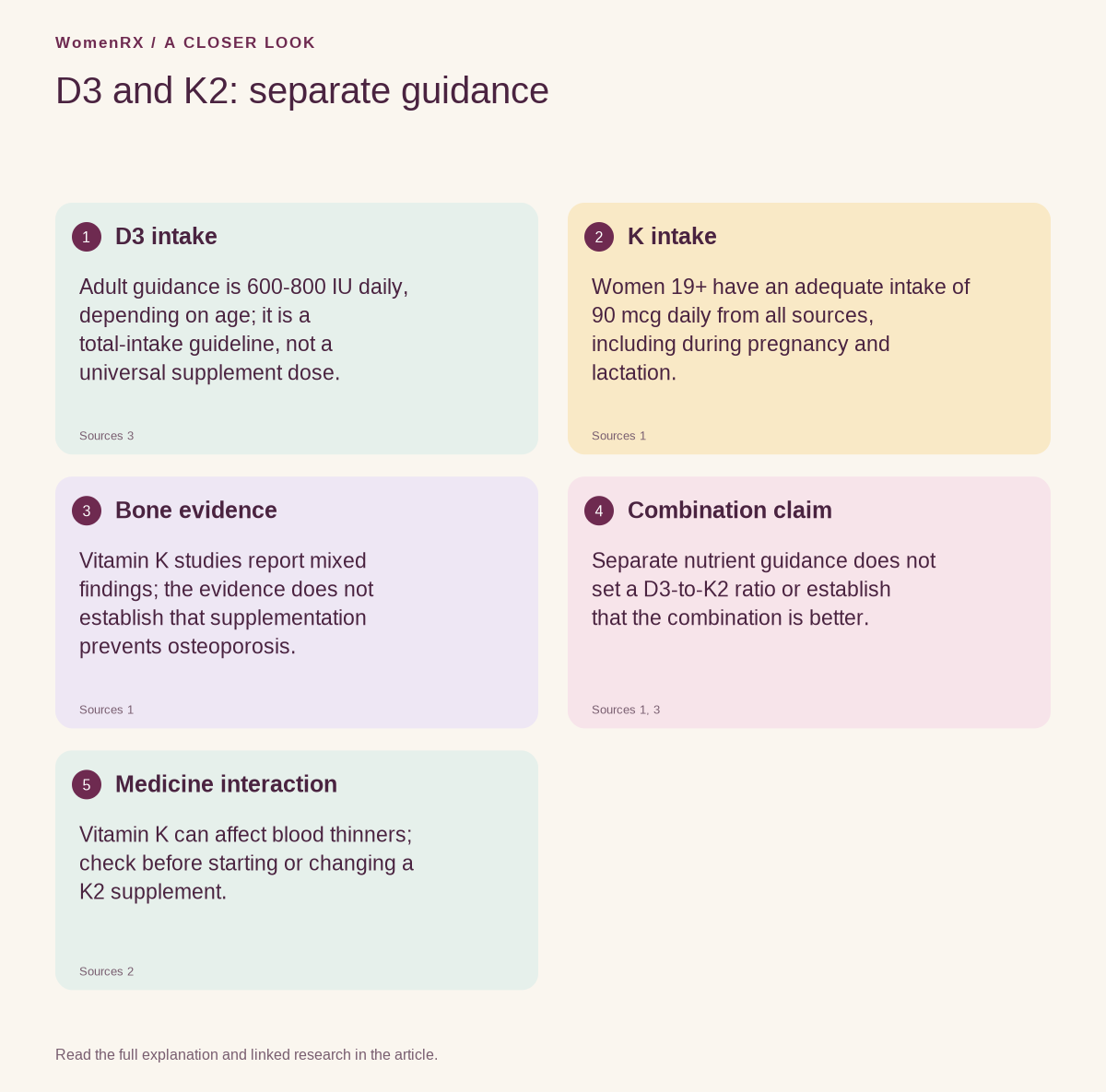
D3 and K2: separate guidance
D3 intake: Adult guidance is 600-800 IU daily, depending on age; it is a total-intake guideline, not a universal supplement dose.3
K intake: Women 19+ have an adequate intake of 90 mcg daily from all sources, including during pregnancy and lactation.1
Bone evidence: Vitamin K studies report mixed findings; the evidence does not establish that supplementation prevents osteoporosis.1
Combination claim: Separate nutrient guidance does not set a D3-to-K2 ratio or establish that the combination is better.13
Medicine interaction: Vitamin K can affect blood thinners; check before starting or changing a K2 supplement.2
Read the figure as text
Compare what intake guidance says about each vitamin with what it does not establish about combination products.- D3 intake: Adult guidance is 600-800 IU daily, depending on age; it is a total-intake guideline, not a universal supplement dose.3
- K intake: Women 19+ have an adequate intake of 90 mcg daily from all sources, including during pregnancy and lactation.1
- Bone evidence: Vitamin K studies report mixed findings; the evidence does not establish that supplementation prevents osteoporosis.1
- Combination claim: Separate nutrient guidance does not set a D3-to-K2 ratio or establish that the combination is better.13
- Medicine interaction: Vitamin K can affect blood thinners; check before starting or changing a K2 supplement.2
More questions, answered
Does K2 prevent harm from taking vitamin D?
K2's role in bone and clotting biology doesn’t show that taking it prevents vitamin D-related harm. Vitamin K supplementation’s effect on osteoporosis risk remains unclear. 1 2
Should I take K2 if I use a blood thinner?
Check with your prescriber or pharmacist before changing vitamin K intake or starting K2. Vitamin K can affect blood thinners, so a new supplement may matter to your treatment plan. 2
Sources you can check
- Vitamin K - Health Professional Fact SheetAccessed 2026-09-25Return to first citation
- Vitamin K: MedlinePlusAccessed 2026-09-25Return to first citation
- Vitamin D - Health Professional Fact SheetAccessed 2026-09-25Return to first citation
- Vitamin D: MedlinePlusAccessed 2026-09-25Return to first citation