Resveratrol Supplements: Which Health Claims Have Human Evidence?
The clearest women-specific trial evidence is for changes in hormone measurements in PCOS, not proof that a supplement resolves symptoms or improves fertility.
For PCOS, a meta-analysis of four randomized trials involving 218 women found lower testosterone and DHEAS measurements with resveratrol than with placebo, but hormone changes don’t establish better symptoms or fertility outcomes. 7 In postmenopausal women, pooled results showed no significant difference in four lipid measures; the total-cholesterol evidence was rated low quality. 5 Medicine interactions and safety in pregnancy or breastfeeding need particular caution.
What the PCOS trials actually measured
The most specific women-focused clinical evidence is in polycystic ovary syndrome (PCOS). A meta-analysis pooled four randomized trials involving 218 women and found lower testosterone and DHEAS measurements in the resveratrol groups than in the placebo groups. These are hormone findings, not proof that resveratrol improves every feature of PCOS. The pooled review does not establish that it reliably restores ovulation, improves acne or unwanted hair, or leads to pregnancy. 7
The studies were limited in size and duration: the trials summarized in the review lasted 40 days to three months. The participants were reproductive-age women with PCOS, and trial designs varied. For example, one trial enrolled women aged 18 to 40 who were being treated for infertility, while other trials assessed different PCOS groups. That variation makes it hard to turn a pooled hormone change into a clear prediction for one person. 7
That distinction matters because PCOS can involve irregular or absent ovulation, higher androgen levels, and other symptoms, and care is chosen around the problem a person wants to address. A change in a blood test alone doesn’t show that those symptoms or reproductive outcomes improved. 17
Menopause claims are a different question
PCOS findings shouldn’t be carried over to menopause. A systematic review and meta-analysis of randomized trials in postmenopausal women found no significant difference between resveratrol and control groups in total cholesterol, HDL, LDL, or triglycerides. Each pooled lipid result included only two studies; the review explicitly rated the total-cholesterol evidence low quality. 5
A separate review describes possible cardiometabolic effects, including vascular and glucose-related changes, but its abstract does not identify the study populations behind those reported effects. They therefore can’t be treated as results specifically demonstrated in postmenopausal women. The review also notes inconsistent findings for weight and lipid measures and does not establish relief of menopause symptoms such as hot flashes. 3
Other human results don’t make a general-purpose case
A randomized, placebo-controlled study of 99 men and women with overweight or obesity tested resveratrol for 12 weeks. It found no significant differences between groups in markers of adiposity, inflammation, oxidation, or gut microbiome measures. Because this was a mixed-sex group and the reported results don’t give a women-specific analysis, they can’t establish a benefit for women in particular. 2
More broadly, a systematic review of clinical trials across many conditions concluded that there was no conclusive clinical evidence to recommend resveratrol in a healthcare setting and no agreed treatment regimen for a particular condition or outcome. Laboratory explanations, such as antioxidant or estrogen-related mechanisms, can help researchers form questions, but they don’t by themselves demonstrate a benefit in people. 46
Medicines and life-stage questions
There is a specific drug-interaction concern worth separating from proven human interactions. In laboratory experiments and rats, resveratrol inhibited the metabolism of vorolanib, increasing drug exposure in the animals. That is a preclinical finding, not proof of the same effect in people, but it is a reason for someone taking vorolanib to discuss resveratrol with the clinician managing that medication before using it. This study did not test anticoagulants and cannot answer whether resveratrol interacts with them. 8
PCOS trials in reproductive-age women don’t answer whether resveratrol is safe during pregnancy or breastfeeding. Nor do findings in postmenopausal women answer questions about cycling years or perimenopause. If you’re considering a supplement while taking a prescription medicine, trying to conceive, pregnant, or breastfeeding, get advice about your specific circumstances rather than assuming a “natural” product is compatible. 75
A useful way to judge a label
Start with the outcome you care about, then ask whether a human study measured that outcome in people like you. For PCOS, the evidence is more specific to hormone measurements than to symptom relief or fertility. For postmenopause, the cited randomized-trial synthesis found no significant pooled changes in common lipid measures; it rated the total-cholesterol evidence low quality. For other broad claims, a mechanism or a result in animals is not the same as a demonstrated human benefit. No single supplement choice follows from these findings; the practical question is whether the evidence matches your goal and whether it fits safely with your medicines and life stage. 4578
What resveratrol studies measured
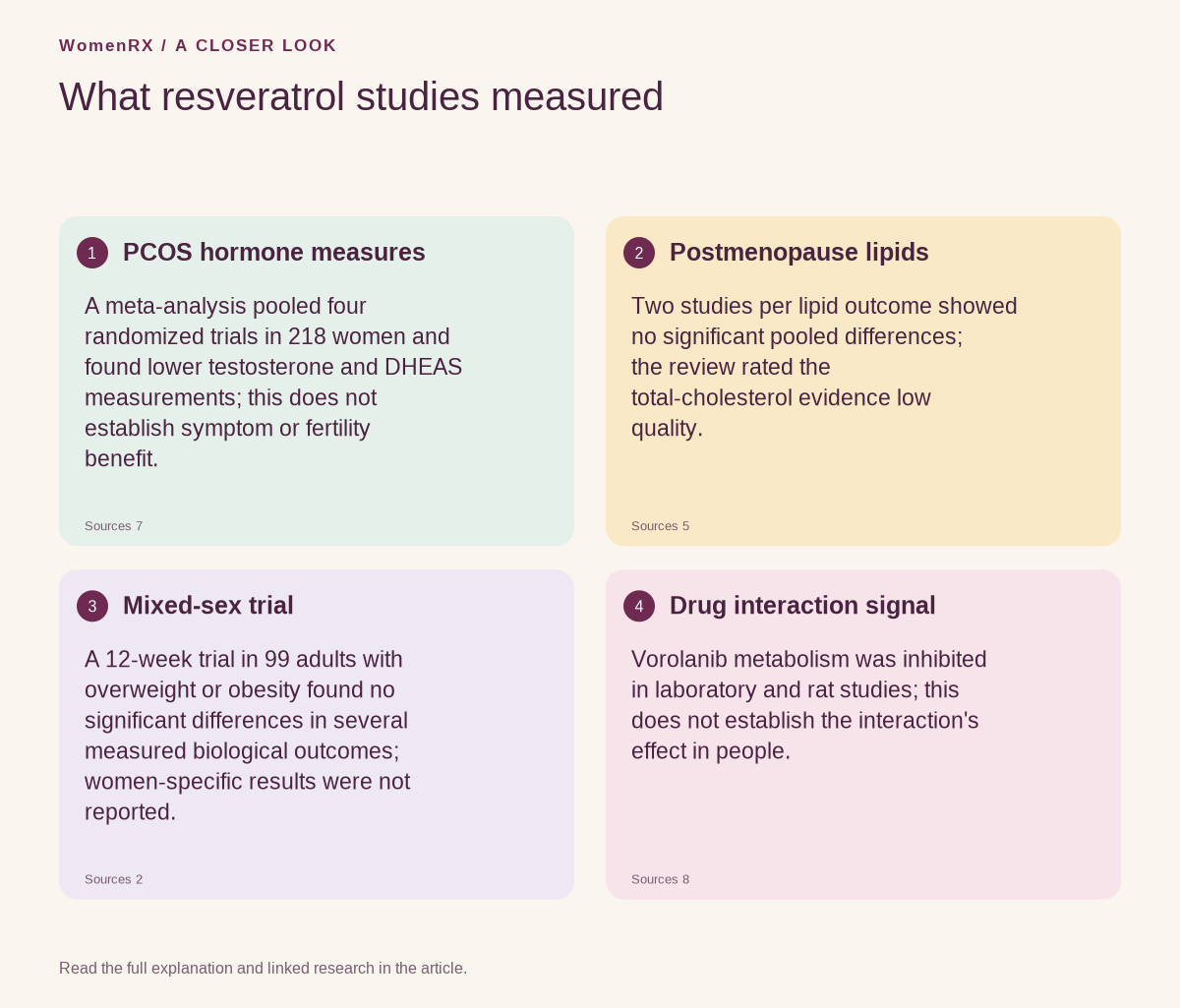
PCOS hormone measures: A meta-analysis pooled four randomized trials in 218 women and found lower testosterone and DHEAS measurements; this does not establish symptom or fertility benefit.7
Postmenopause lipids: Two studies per lipid outcome showed no significant pooled differences; the review rated the total-cholesterol evidence low quality.5
Mixed-sex trial: A 12-week trial in 99 adults with overweight or obesity found no significant differences in several measured biological outcomes; women-specific results were not reported.2
Drug interaction signal: Vorolanib metabolism was inhibited in laboratory and rat studies; this does not establish the interaction's effect in people.8
Read the figure as text
These study groups and outcomes show why hormone or laboratory changes should not be treated as proof of symptom relief or safety across life stages.- PCOS hormone measures: A meta-analysis pooled four randomized trials in 218 women and found lower testosterone and DHEAS measurements; this does not establish symptom or fertility benefit.7
- Postmenopause lipids: Two studies per lipid outcome showed no significant pooled differences; the review rated the total-cholesterol evidence low quality.5
- Mixed-sex trial: A 12-week trial in 99 adults with overweight or obesity found no significant differences in several measured biological outcomes; women-specific results were not reported.2
- Drug interaction signal: Vorolanib metabolism was inhibited in laboratory and rat studies; this does not establish the interaction's effect in people.8
More questions, answered
Do the PCOS hormone findings mean resveratrol improves fertility?
Not by themselves. The meta-analysis reports pooled changes in hormone measurements, but those findings don’t establish better conception or live-birth outcomes. A trial’s inclusion of women being treated for infertility is not, on its own, evidence that the supplement improved fertility. 7
Can I assume resveratrol is safe with my medication?
No. A laboratory and animal study found that resveratrol inhibited vorolanib metabolism in those settings, but it does not establish the size of an interaction in people. That study did not test anticoagulants, so it cannot answer whether resveratrol interacts with them. Check your exact medication with the clinician or pharmacist who manages it. 8
Sources you can check
- PCOS | Polycystic Ovary Syndrome | MedlinePlusAccessed 2026-09-25Return to first citation
- The effects of 12-weeks resveratrol supplementation on cognition, gastrointestinal microbiota, and systemic inflammation, in an overweight and obese human population: a randomized, double-blind, placebo controlled, parallel groups trial.Wightman E, Lodge J, Kennedy D, Bowerbank S, Cheung W, Cuthbertson L, Nelson A, Smith D. · Frontiers in nutrition · 2026Return to first citation
- The Effects of Resveratrol on Menopausal Cardio-metabolic Changes: A Systematic Review.Amini A, Heidari-Soureshjani S, Sherwin CM, Ghahfarrokhi SH. · Cardiovascular & hematological disorders drug targets · 2026Return to first citation
- Resveratrol for the Management of Human Health: How Far Have We Come? A Systematic Review of Resveratrol Clinical Trials to Highlight Gaps and Opportunities.Brown K, Theofanous D, Britton RG, Aburido G, Pepper C, Sri Undru S, Howells L. · International journal of molecular sciences · 2024Return to first citation
- Effects of resveratrol on the lipid profile of post-menopause women: Systematic review and meta-analysis.Rodrigues Uggioni ML, Ronsani L, Motta S, Denoni Júnior JC, Marçal F, Dagostin Ferraz S, Rosa MI, Colonetti T. · Nutrition, metabolism, and cardiovascular diseases : NMCD · 2025Return to first citation
- New Perspectives on the Use of Resveratrol in the Treatment of Metabolic and Estrogen-Dependent Conditions Through Hormonal Modulation and Anti-Inflammatory Effects.Renke G, Fuschini AC, Clivati B, Teixeira LM, Cuyabano ML, Erel CT, Rosado EL. · Current issues in molecular biology · 2025Return to first citation
- Efficacy of resveratrol in women with polycystic ovary syndrome: a systematic review and meta-analysis of randomized clinical trials.Ali Fadlalmola H, Elhusein AM, Al-Sayaghi KM, Albadrani MS, Swamy DV, Mamanao DM, El-Amin EI, Ibrahim SE, Abbas SM. · The Pan African medical journal · 2023Return to first citation
- Combining in vivo and in vitro studies to elucidate the inhibitory effect of resveratrol on vorolanib metabolism.Chen D, Xia H, Cao L, Fu H, Chen Y, Jiang S, Zhan R. · Frontiers in pharmacology · 2026Return to first citation