Quercetin Research in Women: What Have Trials Tested?
A few small trials enrolled women, but their findings range from condition-specific signals to results that cannot be attributed to quercetin alone.
Yes, quercetin has been tested in women, especially in small PCOS trials and one rheumatoid arthritis trial. Those studies measured specific hormone, metabolic, inflammatory, or symptom outcomes, not general health benefits. A premenopausal study tested a blend containing quercetin and caffeine, while a postmenopausal bone trial tested quercetin only as part of a drug combination. Neither shows what quercetin alone does for women. 1 2 3 4 6
“Included women” isn’t the same as “answered a women’s health question”
Quercetin has been studied in women, but the results don’t add up to a broad claim that it improves women’s health. The clearest women-specific trials focused on particular conditions: polycystic ovary syndrome (PCOS) and rheumatoid arthritis (RA). They were relatively small and measured different outcomes, so a finding in one condition cannot be assumed to apply to another. 1 2 3
It also matters whether a study tested quercetin by itself. One trial in premenopausal women used a blend of flavonoids and caffeine, and a postmenopausal bone trial used quercetin with dasatinib. Those studies can’t tell us what quercetin alone would do. 4 6
PCOS: hormone and metabolic measures, not a settled treatment claim
Two randomized trials studied women with PCOS. One enrolled 84 women and measured metabolic markers and hormones, including insulin resistance, adiponectin, testosterone, and luteinizing hormone. It reported differences between the quercetin and placebo groups in some of those measures after the study period. A separate report with the same sample size and a matching PCOS intervention examined related cellular markers. These reports appear to come from the same trial, so they should not be counted as two independent confirmations. 3 5
A different trial enrolled 72 women with PCOS and assessed inflammatory and hormonal markers as well as IVF-related outcomes, including oocyte and embryo grades and pregnancy rate. Its abstract says the researchers found improvements in oocyte and embryo grade and pregnancy rate, but does not give the size of those differences or enough detail to judge how clinically meaningful they were. It is a reason to study those outcomes further, not a basis for promising a fertility benefit. 1
These are findings in women with PCOS, not proof that quercetin improves fertility or metabolic health for women generally. The trials also do not establish whether results differ by menstrual-cycle stage, age, or other reproductive life stages.
Rheumatoid arthritis: symptoms were measured in women
A randomized, double-blind trial assigned 50 women with RA to quercetin or placebo and followed them for eight weeks. The researchers assessed pain, morning stiffness, disease activity, physical function, and inflammatory measures. The abstract reports improvements in some symptoms and disease-activity measures in the quercetin group, along with a reduction in one inflammation marker compared with placebo. It did not find significant between-group differences in tender or swollen joint counts. 2
That is direct evidence in women with RA, but it is still a small, short trial. It does not establish quercetin as a replacement for RA treatment or show that the same findings apply to women without RA.
Two studies that sound relevant but answer a different question
A crossover study in 19 premenopausal women measured short-term energy use after a supplement containing quercetin, other flavonoids, and caffeine. Because the ingredients were combined, the measured difference in energy expenditure cannot be credited to quercetin. The study also measured an acute response in a controlled setting, not lasting weight loss or a health benefit in daily life. 4
In postmenopausal women, a phase 2 trial tested dasatinib plus quercetin as an intermittent senolytic combination, not quercetin alone. Its main bone-resorption outcome did not differ between groups at 20 weeks. Some secondary and exploratory findings appeared in particular measures or subgroups, but they do not establish a bone benefit from quercetin by itself. 6
What the evidence can support
The most accurate takeaway is narrow: researchers have tested quercetin in women with PCOS and RA, and have tested quercetin-containing combinations in premenopausal and postmenopausal women. Some condition-specific trial outcomes were encouraging, but the small studies, varied measures, and combination products leave important questions unanswered. These studies don’t support a general-purpose quercetin health claim for women, or a claim specific to pregnancy, perimenopause, or menopause.
If you see a claimed benefit, check three things: who was studied, what outcome was actually measured, and whether the product contained quercetin alone. Those distinctions often change what a trial result means in real life.
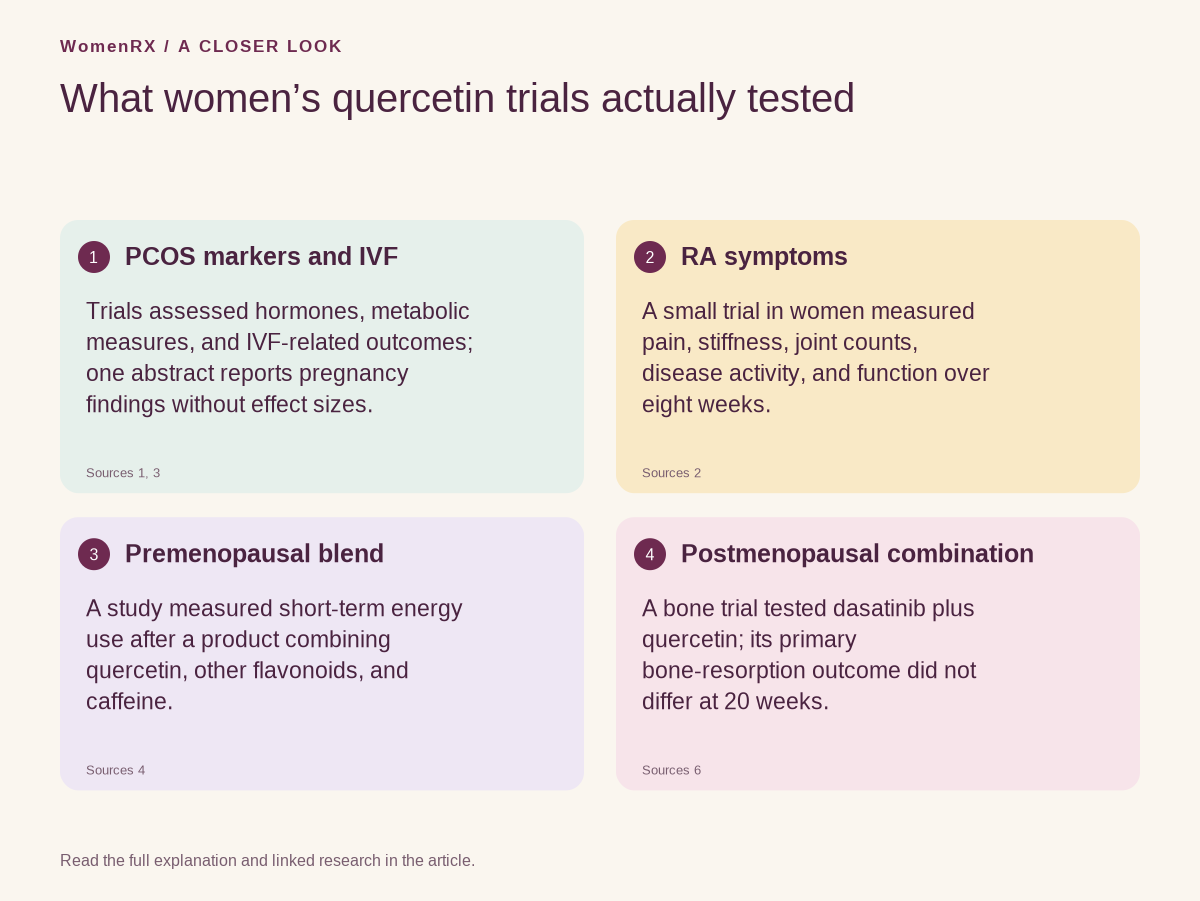
What women’s quercetin trials actually tested
PCOS markers and IVF: Trials assessed hormones, metabolic measures, and IVF-related outcomes; one abstract reports pregnancy findings without effect sizes.13
RA symptoms: A small trial in women measured pain, stiffness, joint counts, disease activity, and function over eight weeks.2
Premenopausal blend: A study measured short-term energy use after a product combining quercetin, other flavonoids, and caffeine.4
Postmenopausal combination: A bone trial tested dasatinib plus quercetin; its primary bone-resorption outcome did not differ at 20 weeks.6
Read the figure as text
The study population and product matter: some trials tested quercetin in a specific condition, while others tested blends or combinations.- PCOS markers and IVF: Trials assessed hormones, metabolic measures, and IVF-related outcomes; one abstract reports pregnancy findings without effect sizes.13
- RA symptoms: A small trial in women measured pain, stiffness, joint counts, disease activity, and function over eight weeks.2
- Premenopausal blend: A study measured short-term energy use after a product combining quercetin, other flavonoids, and caffeine.4
- Postmenopausal combination: A bone trial tested dasatinib plus quercetin; its primary bone-resorption outcome did not differ at 20 weeks.6
More questions, answered
Have quercetin trials studied fertility or pregnancy outcomes?
One randomized trial in women with PCOS assessed IVF-related outcomes, including embryo and oocyte grades and pregnancy rate. Its abstract reports improvement but does not provide the effect size or enough detail to judge how meaningful the result was. That single report does not establish quercetin as a fertility treatment. 1
Does the postmenopausal bone study show that quercetin protects bones?
No. The trial tested quercetin with dasatinib, not quercetin alone, and its primary bone-resorption outcome did not differ between groups at 20 weeks. Exploratory findings in a subgroup need further testing and cannot be treated as proof of a quercetin effect. 6
Sources you can check
- Quercetin and polycystic ovary syndrome; inflammation, hormonal parameters and pregnancy outcome: A randomized clinical trial.Vaez S, Parivr K, Amidi F, Rudbari NH, Moini A, Amini N. · American journal of reproductive immunology (New York, N.Y. : 1989) · 2023Return to first citation
- The Effect of Quercetin on Inflammatory Factors and Clinical Symptoms in Women with Rheumatoid Arthritis: A Double-Blind, Randomized Controlled Trial.Javadi F, Ahmadzadeh A, Eghtesadi S, Aryaeian N, Zabihiyeganeh M, Rahimi Foroushani A, Jazayeri S. · Journal of the American College of Nutrition · 2017Return to first citation
- Effects of Quercetin on Adiponectin-Mediated Insulin Sensitivity in Polycystic Ovary Syndrome: A Randomized Placebo-Controlled Double-Blind Clinical Trial.Rezvan N, Moini A, Janani L, Mohammad K, Saedisomeolia A, Nourbakhsh M, Gorgani-Firuzjaee S, Mazaherioun M, Hosseinzadeh-Attar MJ. · Hormone and metabolic research = Hormon- und Stoffwechselforschung = Hormones et metabolisme · 2017Return to first citation
- Acute Ingestion of a Mixed Flavonoid and Caffeine Supplement Increases Energy Expenditure and Fat Oxidation in Adult Women: A Randomized, Crossover Clinical Trial.Nieman DC, Simonson A, Sakaguchi CA, Sha W, Blevins T, Hattabaugh J, Kohlmeier M. · Nutrients · 2019Return to first citation
- Oral Quercetin Supplementation Enhances Adiponectin Receptor Transcript Expression in Polycystic Ovary Syndrome Patients: A Randomized Placebo-Controlled Double-Blind Clinical Trial.Rezvan N, Moini A, Gorgani-Firuzjaee S, Hosseinzadeh-Attar MJ. · Cell journal · 2018Return to first citation
- Effects of intermittent senolytic therapy on bone metabolism in postmenopausal women: a phase 2 randomized controlled trial.Farr JN, Atkinson EJ, Achenbach SJ, Volkman TL, Tweed AJ, Vos SJ, Ruan M, Sfeir J, Drake MT, Saul D, Doolittle ML, Bancos I, Yu K, Tchkonia T, LeBrasseur NK, Kirkland JL, Monroe DG... · Nature medicine · 2024Return to first citation