Quercetin and weight: a small human signal, not proof
One small trial found a modest weight decrease in people with fatty liver disease, but that doesn’t show quercetin is a reliable weight-loss supplement.
Quercetin has not been shown to cause meaningful, dependable weight loss. In one small trial of people with fatty liver disease, researchers reported a modest weight decrease during quercetin treatment. A separate 15-day trial in healthy men found no significant between-group differences in body weight or body-composition measures. The evidence doesn’t establish a weight effect for women specifically, or for people pursuing weight loss outside those study groups. 2 3
What the human studies actually measured
The clearest weight-related signal comes from a randomized, double-blind crossover trial in 41 people with nonalcoholic fatty liver disease. Participants took quercetin or placebo for 12 weeks, switched to the other intervention after a four-week washout, and 36 completed the trial. In the researchers’ analysis, body weight fell by an average of 1.5 kg during the quercetin intervention, compared with 0.2 kg during the placebo intervention. BMI also fell slightly during quercetin treatment. 2
That’s a result worth noticing, but it’s not a settled answer. It comes from a small study lasting weeks, in people who had fatty liver disease, not from a large, long-term weight-loss trial in a broad population. The figures describe changes during each intervention; they shouldn’t be treated as a guaranteed result or as proof that quercetin works for weight loss generally. 2
The trial’s main outcome was liver fat, measured by MRI, not body fat. Liver fat decreased during quercetin treatment, while the study also found the modest weight change. Those are related but different measurements: a change in liver fat doesn’t tell you how much body fat changed. 2 Body weight itself includes more than fat, so the scale can’t explain what tissue changed. 1
A separate randomized trial studied 110 healthy men taking quercetin or placebo during a 15-day high-altitude trip. It found no significant differences between groups in body weight, fat mass, body-fat percentage, or total body water. The study was short and involved only men in a specific setting, so it doesn’t answer what might happen with longer use or in women. 3
What the findings mean for women
Women were represented in the fatty-liver trial: its authors reported a female subgroup analysis. The reported subgroup result concerned liver fat, not a women-specific weight-loss effect. Liver-fat reduction was numerically larger in women than men, but the difference wasn’t statistically significant. That result doesn’t establish that women respond differently, and it doesn’t show a special effect during perimenopause or menopause. 2
The practical takeaway is that the human evidence is too limited to count on quercetin for a personal weight goal. A modest change in one small study is not the same as a demonstrated, lasting effect across different people and circumstances. If your goal is to understand changes in health, weight is only one measure; waist circumference and other health factors can provide context too. 1
Keep the measurements separate
The two trials don’t provide a simple yes-or-no answer for everyone: one reported a modest weight decrease in people with fatty liver disease, while a short trial in healthy men found no significant between-group differences in weight or body composition. The fatty-liver study’s primary result was about liver fat, which is not the same as whole-body fat. Together, these findings offer a preliminary signal in one specific group, not a reliable prediction for a personal weight goal. 2 3
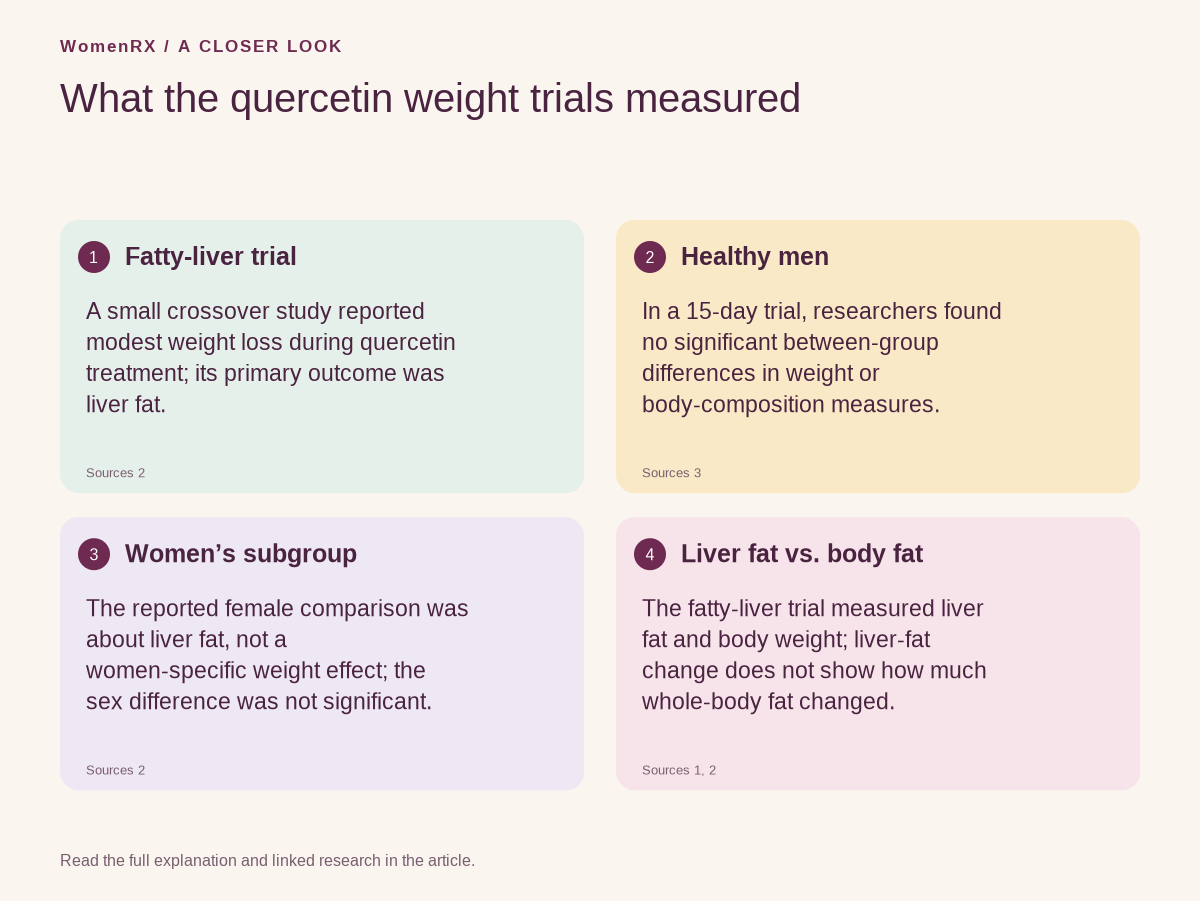
What the quercetin weight trials measured
Fatty-liver trial: A small crossover study reported modest weight loss during quercetin treatment; its primary outcome was liver fat.2
Healthy men: In a 15-day trial, researchers found no significant between-group differences in weight or body-composition measures.3
Women’s subgroup: The reported female comparison was about liver fat, not a women-specific weight effect; the sex difference was not significant.2
Liver fat vs. body fat: The fatty-liver trial measured liver fat and body weight; liver-fat change does not show how much whole-body fat changed.12
Read the figure as text
The two human trials involved different groups and outcomes. Keeping the measurements distinct helps show what their results can and can’t tell you.- Fatty-liver trial: A small crossover study reported modest weight loss during quercetin treatment; its primary outcome was liver fat.2
- Healthy men: In a 15-day trial, researchers found no significant between-group differences in weight or body-composition measures.3
- Women’s subgroup: The reported female comparison was about liver fat, not a women-specific weight effect; the sex difference was not significant.2
- Liver fat vs. body fat: The fatty-liver trial measured liver fat and body weight; liver-fat change does not show how much whole-body fat changed.12
More questions, answered
Does the fatty-liver study show quercetin reduces body fat?
No. The study measured liver fat by MRI and also recorded body weight and BMI. A change in liver fat is not the same as a measured reduction in body fat throughout the body. 2 1
Is there evidence that quercetin helps with menopause-related weight changes?
The reported human studies don’t establish a menopause-specific effect. The fatty-liver trial included a female subgroup analysis, but it reported liver-fat results, not a weight effect specific to menopausal stage. 2
Sources you can check
- Body Weight: MedlinePlusAccessed 2026-09-25Return to first citation
- Quercetin intervention reduced hepatic fat deposition in patients with nonalcoholic fatty liver disease: a randomized, double-blind, placebo-controlled crossover clinical trial.Li N, Cui C, Xu J, Mi M, Wang J, Qin Y. · The American journal of clinical nutrition · 2024Return to first citation
- Quercetin prophylaxis in prevention of acute mountain sickness (AMS): a randomized, double blind, placebo controlled phase-II clinical trials.Sagi SSK, Kirar V, Prasad J, Singh S, Rathi V, Sultana K, Singh VK, Verma SK, Kumar D, Kumar V, Saxena S, Mishra R, Singh VV, Chopra S, Varshney R. · European journal of nutrition · 2026Return to first citation