How to Check a Vitamin D3 and K2 Supplement
Read the amounts, forms, duplicate products, and medicine cautions before deciding whether a D3-and-K2 combination fits your needs.
There isn’t one established D3-to-K2 ratio or combination dose that suits everyone. Compare the vitamin D amount with your needs and other sources, check whether the label names a K2 form such as MK-4 or MK-7, and add up nutrients in your other supplements. If you take a blood thinner, check before starting or changing a vitamin K supplement. 1 3 4
Start with the amounts, not the ratio
A D3-and-K2 label can make the pair look like it comes with a standard balance. It doesn’t. The available guidance gives vitamin D intake recommendations, but it doesn’t establish a universal D3-to-K2 ratio or a single combination dose for women. Research on vitamin K supplements and bone outcomes has not produced a consistent basis for choosing one K2 amount to pair with D3. 1 3
For vitamin D, the recommended dietary allowance for adults is 15-20 micrograms (600-800 IU) a day, depending on age. That’s a daily intake reference for healthy people, not a dose that everyone needs to take as a supplement. Your intake can also come from food and other supplements, and individual needs may differ. 1
Check the label for the amount per serving, then note how many servings you’d take. Vitamin D is listed in micrograms (mcg) or International Units (IU); 1 mcg equals 40 IU. The ingredient name cholecalciferol means vitamin D3. 1
Identify which K2 is in the bottle
Vitamin K2 is a family of compounds called menaquinones. Labels may name a form such as MK-4 or MK-7. Record the amount and form rather than treating all products labeled “K2” as identical. The vitamin K guidance describes several menaquinones, but it does not give a universal K2 supplement dose for pairing with vitamin D. 3
That distinction helps you assess what you’re actually buying. It doesn’t show that one K2 form or a particular D3-and-K2 balance is necessary for you.
Do a quick duplicate-product audit
Look beyond the combination bottle. Vitamin D is included in some multivitamins, and vitamin K is present in most multivitamin/mineral supplements. Read the Supplement Facts panels on your multivitamin, bone-health product, and any other supplements, then note how much D and K each provides. This can reveal that you’re already taking one or both ingredients. 2 3
A simple label note can help: write down each product, its serving size, and its D and K amounts. Add the daily amounts from products you actually use. Keep dietary vitamin D in mind too, since fortified foods contribute to intake in the United States. 1
Make the medicine check before adding K2
Vitamin K is involved in blood clotting. If you take a blood thinner, ask the clinician or pharmacist managing that medicine before adding, stopping, or changing a vitamin K supplement. The concern is the vitamin K intake and the medicine together, so mention the K2 product and its labeled amount rather than asking only whether “vitamins” are okay. 3 4
This caution is about the medicine, not about being a woman. Don’t assume that a D3-and-K2 combination is automatically suitable just because both ingredients are nutrients.
Pregnancy and breastfeeding call for individual guidance
If you’re pregnant or breastfeeding, include the combination product in a review of your full supplement routine. The listed vitamin D intake recommendation for pregnancy and breastfeeding is 600 IU a day, but that figure is not a recommended dose for a D3-and-K2 supplement and does not establish a K2 amount. Check how the product fits with your individual guidance and other supplements. 2
A label audit you can use
Before buying or continuing the product, make sure you can answer four questions: How much D3 is in one serving? Which K2 form and amount does it contain? Are D or K already in other products you use? Do you take a blood thinner, or are you pregnant or breastfeeding and need your routine reviewed? If any answer is unclear, bring the label itself to a pharmacist or clinician who knows your medicines and circumstances.
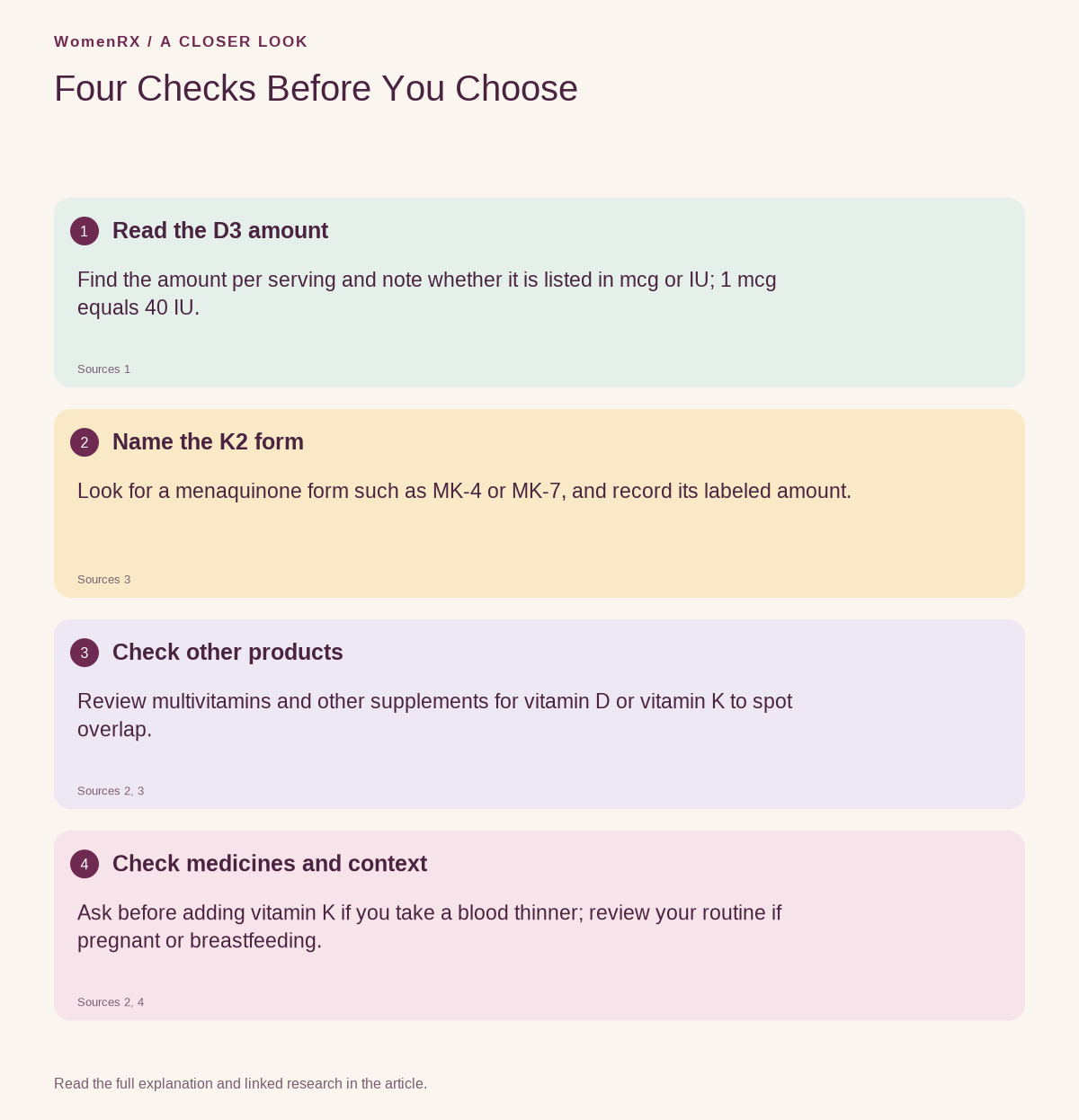
Four Checks Before You Choose
Read the D3 amount: Find the amount per serving and note whether it is listed in mcg or IU; 1 mcg equals 40 IU.1
Name the K2 form: Look for a menaquinone form such as MK-4 or MK-7, and record its labeled amount.3
Check other products: Review multivitamins and other supplements for vitamin D or vitamin K to spot overlap.23
Check medicines and context: Ask before adding vitamin K if you take a blood thinner; review your routine if pregnant or breastfeeding.24
Read the figure as text
Use the label and your own supplement and medicine list to see what the product contains and which circumstances call for individual guidance.- Read the D3 amount: Find the amount per serving and note whether it is listed in mcg or IU; 1 mcg equals 40 IU.1
- Name the K2 form: Look for a menaquinone form such as MK-4 or MK-7, and record its labeled amount.3
- Check other products: Review multivitamins and other supplements for vitamin D or vitamin K to spot overlap.23
- Check medicines and context: Ask before adding vitamin K if you take a blood thinner; review your routine if pregnant or breastfeeding.24
More questions, answered
Does taking K2 make a higher vitamin D3 amount safe?
The cited guidance does not establish that adding K2 makes a particular D3 amount safe or necessary. Assess the vitamin D amount on its own, including what you get from other products, and don’t use a supposed D3-to-K2 ratio as a substitute for individualized guidance. 1 3
What does MK-7 mean on a K2 label?
MK-7 is one type of menaquinone, the family of compounds known as vitamin K2. The label name identifies the form; it does not by itself show that the product is the right choice or dose for you. 3
Sources you can check
- Vitamin D - Health Professional Fact SheetAccessed 2026-09-25Return to first citation
- Vitamin D: MedlinePlusAccessed 2026-09-25Return to first citation
- Vitamin K - Health Professional Fact SheetAccessed 2026-09-25Return to first citation
- Vitamin K: MedlinePlusAccessed 2026-09-25Return to first citation