Taking Vitamin K2 Long Term? Check These Details First
Before you continue or change a K2 supplement, check its form, your reason for taking it, and whether you use warfarin.
Vitamin K2 supplements commonly contain MK-4 or MK-7, and evidence comparing forms is limited. The clearest medication concern is warfarin: K2 may compromise its anticoagulant effect, so speak with the clinician or team managing your treatment before starting, stopping, or changing a K2 product. For other reasons to take K2, long-term benefit and safety for every product and life stage aren’t established. 1 3
If you take warfarin, start with that conversation
Vitamin K2 may compromise warfarin’s anticoagulant effect. If you take warfarin, check with the clinician or anticoagulation team managing it before starting, stopping, or changing a K2 supplement. Don’t adjust your prescribed warfarin on your own. Include multivitamins and combination products in the conversation, since they may also contain vitamin K. 1 3
MedlinePlus also advises people taking blood thinners to be careful about vitamin K and ask their care team for recommendations. The clearest K2-specific warning in the evidence is about warfarin; if you take a different blood thinner, ask the person managing your medication whether K2 is relevant to your treatment rather than assuming the same interaction applies. 2 3
Check which K2 you actually have
“K2” can refer to different menaquinones. The NIH Office of Dietary Supplements identifies MK-4 and MK-7 among the forms used in supplements, and notes that data comparing the relative bioavailability of vitamin K supplement forms are limited. So a finding about one form shouldn’t automatically be treated as evidence about another. 1
Read the full ingredient panel for the form, amount, and any other ingredients. Check whether vitamin K is also included in a multivitamin or blend. Keeping the label or a photo of it makes it easier to discuss the exact product. The label can clarify what you’re taking; it can’t show by itself whether you need it or whether long-term use is right for you.
“No upper limit” doesn’t answer every long-term question
The Food and Nutrition Board did not establish a tolerable upper intake level for vitamin K, citing its low potential for toxicity. The NIH fact sheet also reports no adverse effects associated with vitamin K from food or supplements. Those are reassuring general points, but they don’t establish long-term safety for every K2 form, amount, combination product, or health situation. 1
The reason for taking K2 matters too. Vitamin K has a role in bone biology, but it remains unclear whether supplementing with any form reduces osteoporosis risk. The role of different forms in artery calcification and coronary heart disease is also unclear. These uncertainties don’t mean K2 has no effects; they do mean that bone or heart protection shouldn’t be assumed as a general reason to take it indefinitely. 1
If you’re taking it for bone or heart health, make the review specific: What outcome are you hoping to affect, and what supports using this product for that purpose? Age or being a woman alone doesn’t establish a routine need for K2.
Pregnancy and breastfeeding need a product-specific review
Vitamin K intake guidance includes pregnancy and lactation, but that is not the same as a recommendation to take a separate K2 supplement. The guidance does not establish the safety or need of every K2 form and product during pregnancy or breastfeeding. If either applies to you, review the exact product with your prenatal or postpartum care team rather than assuming general vitamin K guidance answers the K2 question. 1
A useful long-term check is therefore concrete: identify the form and amount, note other sources in your supplements, clarify the reason you’re taking it, and check for warfarin. The medication issue deserves priority because it can affect treatment; for other uses, weigh the specific reason against what is and isn’t established about benefit and long-term use.
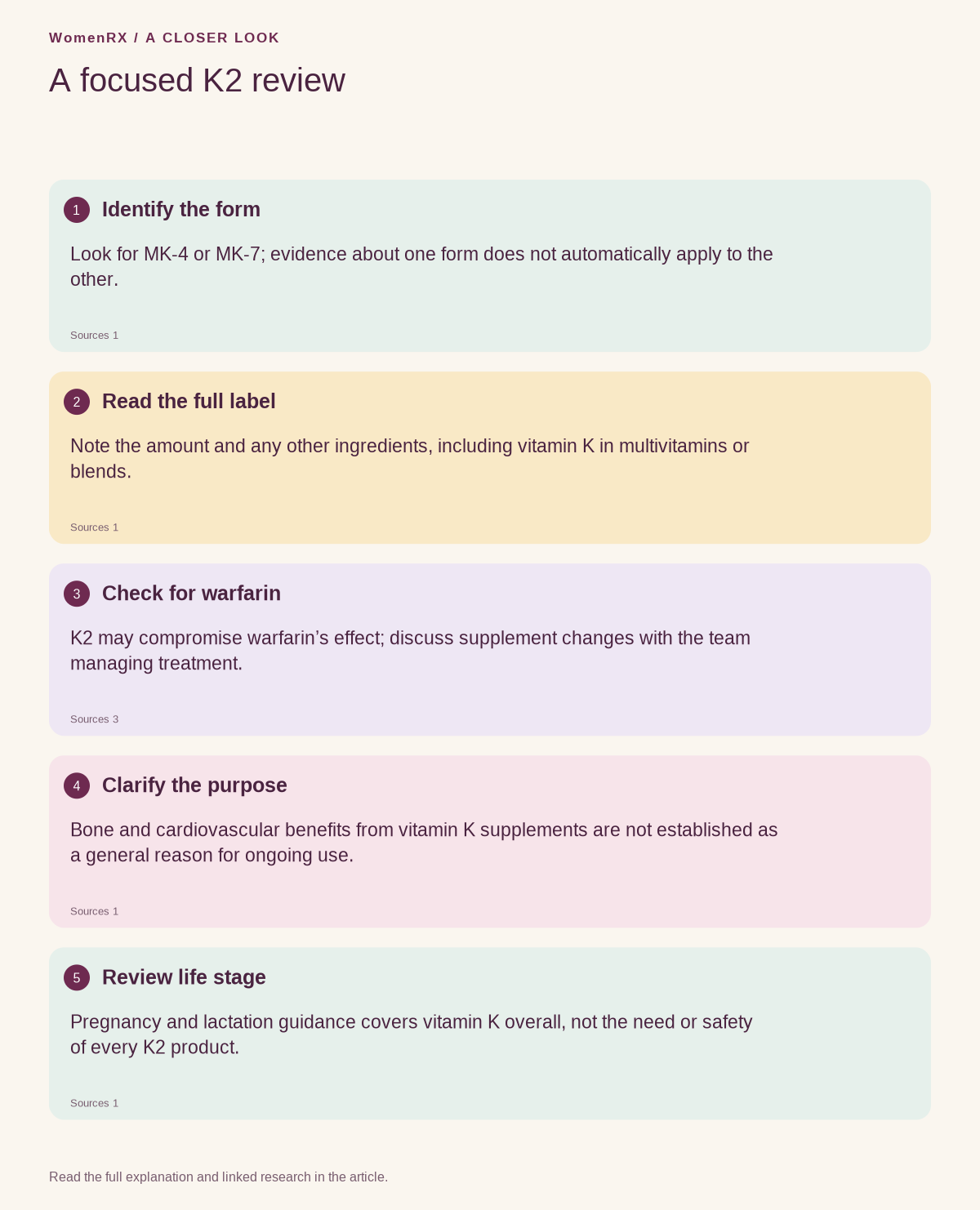
A focused K2 review
Identify the form: Look for MK-4 or MK-7; evidence about one form does not automatically apply to the other.1
Read the full label: Note the amount and any other ingredients, including vitamin K in multivitamins or blends.1
Check for warfarin: K2 may compromise warfarin’s effect; discuss supplement changes with the team managing treatment.3
Clarify the purpose: Bone and cardiovascular benefits from vitamin K supplements are not established as a general reason for ongoing use.1
Review life stage: Pregnancy and lactation guidance covers vitamin K overall, not the need or safety of every K2 product.1
Read the figure as text
Use these checks to make a long-term review specific to the product, its purpose, and the clearest medication concern.- Identify the form: Look for MK-4 or MK-7; evidence about one form does not automatically apply to the other.1
- Read the full label: Note the amount and any other ingredients, including vitamin K in multivitamins or blends.1
- Check for warfarin: K2 may compromise warfarin’s effect; discuss supplement changes with the team managing treatment.3
- Clarify the purpose: Bone and cardiovascular benefits from vitamin K supplements are not established as a general reason for ongoing use.1
- Review life stage: Pregnancy and lactation guidance covers vitamin K overall, not the need or safety of every K2 product.1
More questions, answered
Does MK-7 stay in the body longer than MK-4?
The NIH fact sheet describes one study in which MK-7 had a longer half-life than vitamin K1. That does not establish a direct half-life comparison between MK-7 and MK-4. 1
Does pregnancy intake guidance mean I should take K2?
No. The listed guidance is for vitamin K overall. It doesn’t establish a need for a separate K2 supplement or answer the safety question for every K2 product during pregnancy or breastfeeding. 1
Sources you can check
- Vitamin K - Health Professional Fact SheetAccessed 2026-09-25Return to first citation
- Vitamin K: MedlinePlusAccessed 2026-09-25Return to first citation
- Vitamin K2 in Managing Nocturnal Leg Cramps: A Randomized Clinical Trial.Tan J, Zhu R, Li Y, Wang L, Liao S, Cheng L, Mao L, Jing D. · JAMA internal medicine · 2024Return to first citation