What to Check Before Taking Vitamin E Long Term
Before continuing a vitamin E supplement, check its dose, your other sources, and whether a medicine or medical reason changes the picture.
Start with the amount of alpha-tocopherol you take from every supplement, not just the vitamin E bottle. Food sources such as nuts, seeds, and vegetable oils are different from concentrated supplements. Review the total dose and your reason for taking it, especially if you use a blood thinner or aspirin, are pregnant or breastfeeding, or have a condition that affects fat absorption. 1 2
First, separate food from a supplement
Vitamin E in food and vitamin E in a high-dose supplement aren’t interchangeable for safety review. Nuts, seeds, vegetable oils, and leafy greens provide vitamin E, and the NIH Office of Dietary Supplements reports no adverse effects from consuming it in food. Supplements, by contrast, often provide far more than the amount needed for daily nutrition. 1
For adults, including during pregnancy, the recommended dietary allowance is 15 mg of alpha-tocopherol a day. During breastfeeding, it’s 19 mg a day. These are intake targets, not supplement prescriptions: food contributes too, and many vitamin-E-only supplements contain amounts substantially above the recommended allowance. 1
Add up the amount from every product
Check the Supplement Facts label on your vitamin E, multivitamin, and any other combination product. Add their listed vitamin E amounts so you can review the overall intake, rather than judging one bottle in isolation. Labels may describe vitamin E as alpha-tocopherol; the form may also be identified as natural (d-alpha or RRR-alpha-tocopherol) or synthetic (dl-alpha or all-rac-alpha-tocopherol). The same weight in milligrams doesn’t represent the same activity for those two forms, so don’t assume that matching numbers on different products make them equivalent. 1
The adult tolerable upper intake level is 1,000 mg per day from supplemental alpha-tocopherol. That’s a ceiling established around potential harmful effects, not a suggested dose or proof that taking a large amount long term is risk-free. The evidence on high-dose safety is limited, and the NIH fact sheet notes that long-term intake above the upper limit increases the risk of adverse effects. 1
The key safety question: could bleeding risk matter?
High-dose alpha-tocopherol can affect blood clotting. The NIH fact sheet describes increased hemorrhagic-stroke risk in two trials: one involving Finnish male smokers taking 50 mg daily for an average of six years, and another involving male physicians taking 400 IU of synthetic vitamin E every other day for eight years. Many participants in the physicians’ trial also took aspirin, so the findings don’t establish exactly how vitamin E and aspirin interacted. Still, they make it sensible to review a supplement with the prescriber if you take aspirin or a blood thinner. 1
MedlinePlus also cautions that vitamin E supplements may be harmful for people taking blood thinners and other medicines. Bring the product label and your full supplement list to that conversation; a clinician or pharmacist can check your specific medicines and dose. 2
Check why you’re taking it, not just how much
If you started vitamin E for general prevention, reconsider whether the expected benefit justifies continuing a concentrated supplement. Trials have not established routine vitamin E supplements as a way to prevent cardiovascular disease. For example, a large trial in healthy women aged 45 and older found no significant difference in overall cardiovascular events or all-cause mortality between those assigned vitamin E and those assigned placebo over an average of 10 years. That result doesn’t answer every possible reason for supplementation, but it doesn’t support taking high-dose vitamin E routinely for heart protection. 1
Some people with conditions that impair fat absorption, including Crohn’s disease or cystic fibrosis, may need extra vitamin E. In that situation, supplementation can be part of care for a specific nutritional problem, so don’t treat it like an optional general-wellness supplement or change a prescribed plan without reviewing the reason and dose with the treating clinician. 1 2
Pregnancy and breastfeeding call for a separate review
Pregnancy and breastfeeding have different recommended intakes: 15 mg daily during pregnancy and 19 mg daily during lactation. The adult upper intake level listed by the NIH is 1,000 mg daily for both. Those reference values do not establish that a high-dose supplement is needed or that long-term high-dose use has been well studied in pregnancy or breastfeeding. If you’re taking more than a standard prenatal or multivitamin provides, review the actual label and reason for use with your pregnancy or postpartum care team. 1
A practical label-and-reason check
Before continuing, write down the milligrams of vitamin E in each product, the form listed on each label, and why you began taking it. Note whether you also use aspirin or a blood thinner, and whether pregnancy, breastfeeding, or a fat-absorption condition applies. That gives your clinician or pharmacist the details needed to assess the particular combination, rather than relying on the front of the bottle or a general dose limit.
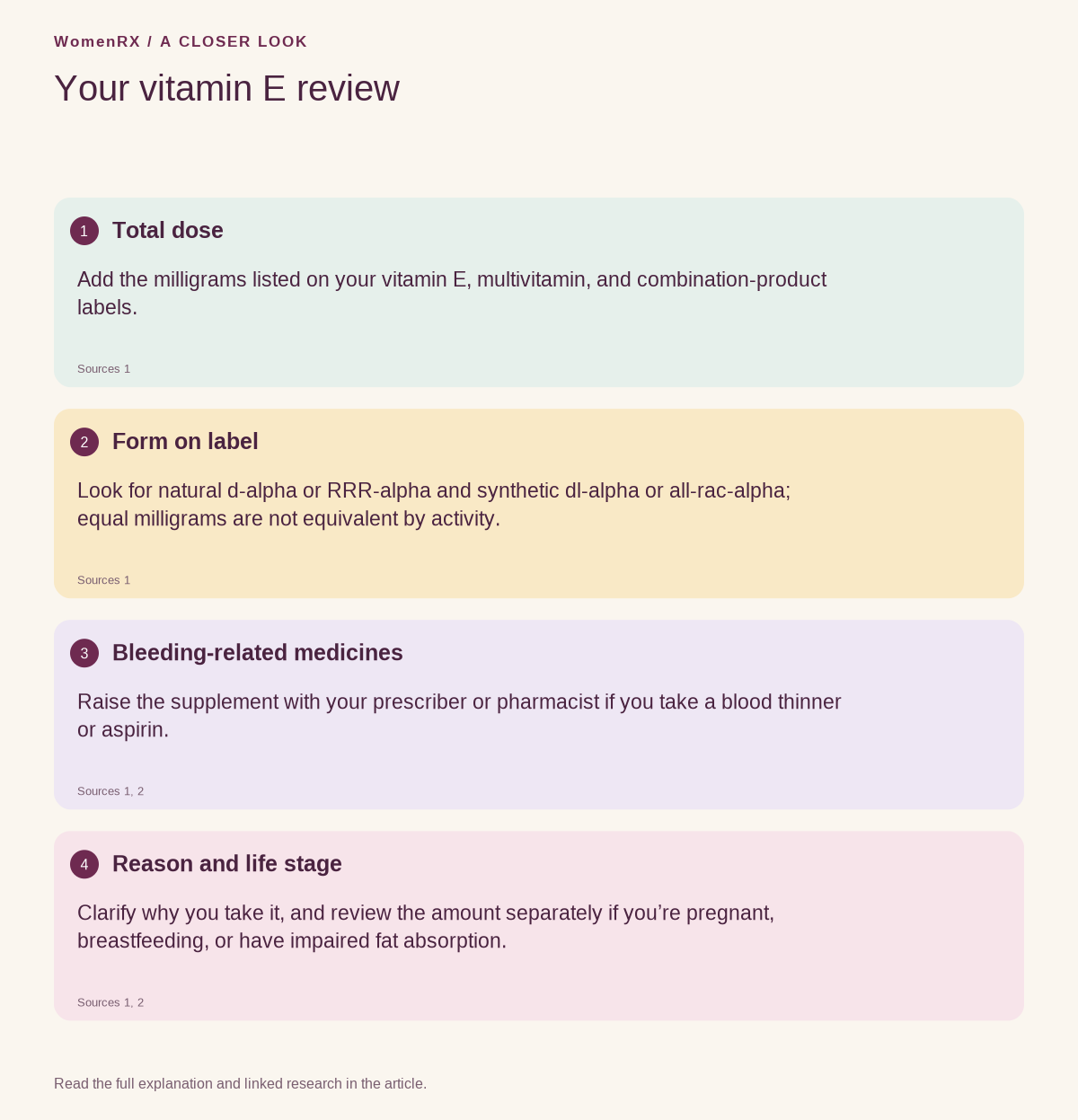
Your vitamin E review
Total dose: Add the milligrams listed on your vitamin E, multivitamin, and combination-product labels.1
Form on label: Look for natural d-alpha or RRR-alpha and synthetic dl-alpha or all-rac-alpha; equal milligrams are not equivalent by activity.1
Bleeding-related medicines: Raise the supplement with your prescriber or pharmacist if you take a blood thinner or aspirin.12
Reason and life stage: Clarify why you take it, and review the amount separately if you’re pregnant, breastfeeding, or have impaired fat absorption.12
Read the figure as text
Use these four checks to make a continued-use review specific to your dose, reason, and circumstances.- Total dose: Add the milligrams listed on your vitamin E, multivitamin, and combination-product labels.1
- Form on label: Look for natural d-alpha or RRR-alpha and synthetic dl-alpha or all-rac-alpha; equal milligrams are not equivalent by activity.1
- Bleeding-related medicines: Raise the supplement with your prescriber or pharmacist if you take a blood thinner or aspirin.12
- Reason and life stage: Clarify why you take it, and review the amount separately if you’re pregnant, breastfeeding, or have impaired fat absorption.12
More questions, answered
Is vitamin E from food a concern if I take a supplement?
Food sources and concentrated supplements have different safety profiles. The NIH Office of Dietary Supplements reports no adverse effects from vitamin E in food, but says high-dose alpha-tocopherol supplements can affect clotting. Include your supplement dose in a medication review rather than avoiding foods such as nuts, seeds, or vegetable oils. 1
Does being below the upper limit mean a long-term dose is safe?
Not necessarily. The upper limit is a reference ceiling, not a recommended intake, and evidence about high-dose use over long periods is limited. A dose below it can still deserve review if you take a blood thinner or aspirin or if you’re using the supplement without a specific medical reason. 1 2
Sources you can check
- Vitamin E - Health Professional Fact SheetAccessed 2026-09-25Return to first citation
- Vitamin E: MedlinePlusAccessed 2026-09-25Return to first citation