How to Read a Vitamin E Supplement Label
Check the form and amount first: natural and synthetic vitamin E use different conversions, and many vitamin-E-only supplements provide much more than the adult Daily Value.
Compare the form, amount per serving, and full ingredient list, not just the front label. Natural alpha-tocopherol is usually labeled d-alpha; synthetic is dl-alpha, and the same amount in milligrams of the synthetic form has about half the activity. Many vitamin-E-only products contain substantially more than the adult Daily Value, so check with a pharmacist if you take a blood thinner or other medicine. 12
Start with the amount per serving
Turn the bottle to Supplement Facts and find vitamin E’s amount per serving. Check how many capsules, softgels, or other units make up that serving; the front label may emphasize a number that doesn’t match one unit. The adult Daily Value is 15 mg, a reference for comparing nutrient amounts on labels. It isn’t a measure of what you personally need. 1
That comparison matters because most vitamin-E-only supplements provide at least 67 mg, substantially more than the recommended dietary allowance, according to the NIH Office of Dietary Supplements. A high percentage of Daily Value doesn’t mean a product is more useful. 1
Read the form before comparing numbers
Alpha-tocopherol is the form of vitamin E recognized to meet human requirements. On labels, naturally sourced alpha-tocopherol is commonly called d-alpha-tocopherol (RRR-alpha-tocopherol); the synthetic form is commonly called dl-alpha-tocopherol (all-rac-alpha-tocopherol). 1
If two products list amounts in milligrams, check whether the form is natural or synthetic before treating those amounts as equivalent: the same weight of synthetic alpha-tocopherol has about half the activity of natural alpha-tocopherol. If the amount is listed in IU, conversion also depends on the form: 1 IU of natural vitamin E equals 0.67 mg, while 1 IU of synthetic vitamin E equals 0.45 mg. When possible, compare both the form and the milligram amount rather than comparing IU figures alone. 1
A product may also list mixed tocopherols or tocotrienols. These are other members of the vitamin E family, but alpha-tocopherol is the form recognized to meet human requirements; the other forms have received less research. The word “mixed” by itself doesn’t show that a supplement better matches your needs. 1
Check everything else in the serving
Read the full Supplement Facts panel, not only the vitamin E line. Note other listed nutrients and ingredients, and whether any amounts come from a proprietary blend rather than being shown individually. That gives you a clearer picture of what you’d be taking alongside vitamin E. A label-reading screen used in a study of selected weight-loss supplements treated proprietary blends as a caution flag; that study did not test vitamin E products, so it cannot tell you how common blends are in this category. 3
Then look at the separate “other ingredients” list for the product’s non-nutrient ingredients. If you have a known allergy or need to avoid a particular ingredient, the product name and marketing claims aren’t a substitute for checking that list.
Treat quality claims as clues, not proof
A phrase such as “quality tested” on its own doesn’t tell you who did the testing or what was checked. If a product displays a third-party certification, identify the certifier and what its verification covers. A study of selected weight-loss supplements used named third-party certification seals as one label-screening item and described vague, self-applied quality claims separately. It did not examine vitamin E products, so this is a reason to scrutinize the claim, not evidence that any particular vitamin E brand has passed or failed testing. 3
No label or seal establishes that a supplement will improve skin, fertility, or heart health. Those are benefit claims, not proof of product quality, and this label comparison doesn’t establish those outcomes.
Make the medicine check part of the comparison
Vitamin E supplements may be harmful for people taking blood thinners or other medicines, and the NIH sets upper intake limits for supplemental alpha-tocopherol based on the potential for hemorrhagic effects. These cautions make the amount per serving especially relevant if you use a medicine that affects bleeding. Before starting a vitamin E supplement in that situation, check the product and its amount with a pharmacist or prescriber. 12
Food is another part of the comparison: vegetable oils and leafy greens are among the sources of vitamin E, and the nutrient is added to some foods. A supplement label shows what’s in that product, not your total intake from food and other supplements. 2
A “women’s” label doesn’t establish that a product is a better fit. The amount and form are the useful starting points; pregnancy-specific needs can’t be determined from a supplement label alone, so don’t assume a general product comparison establishes what’s appropriate during pregnancy. 1
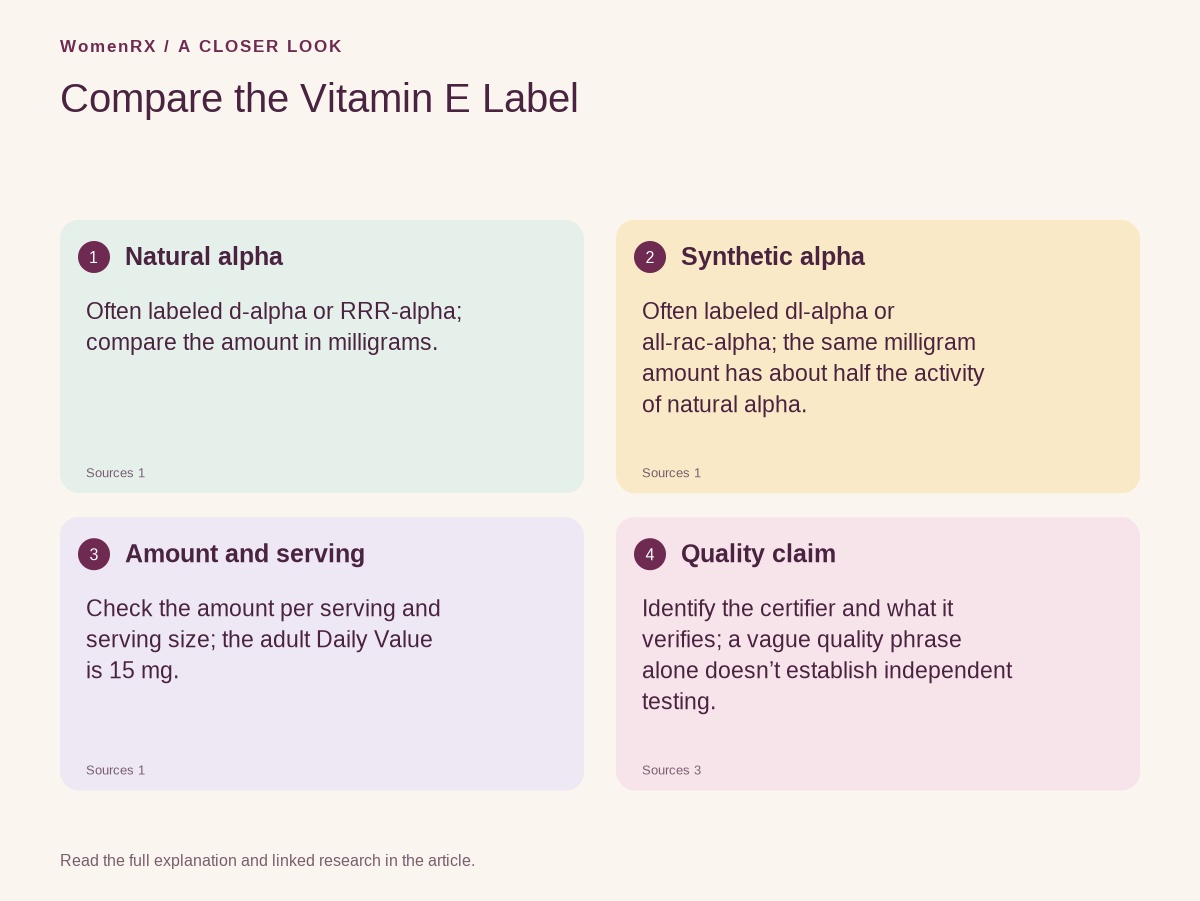
Compare the Vitamin E Label
Natural alpha: Often labeled d-alpha or RRR-alpha; compare the amount in milligrams.1
Synthetic alpha: Often labeled dl-alpha or all-rac-alpha; the same milligram amount has about half the activity of natural alpha.1
Amount and serving: Check the amount per serving and serving size; the adult Daily Value is 15 mg.1
Quality claim: Identify the certifier and what it verifies; a vague quality phrase alone doesn’t establish independent testing.3
Read the figure as text
Check these label details side by side before comparing products. The form affects how to interpret the amount, while a certification claim is not the same as evidence of a health benefit.- Natural alpha: Often labeled d-alpha or RRR-alpha; compare the amount in milligrams.1
- Synthetic alpha: Often labeled dl-alpha or all-rac-alpha; the same milligram amount has about half the activity of natural alpha.1
- Amount and serving: Check the amount per serving and serving size; the adult Daily Value is 15 mg.1
- Quality claim: Identify the certifier and what it verifies; a vague quality phrase alone doesn’t establish independent testing.3
Sources you can check
- Vitamin E - Health Professional Fact SheetAccessed 2026-09-25Return to first citation
- Vitamin E: MedlinePlusAccessed 2026-09-25Return to first citation
- Label Accuracy and Quality of Select Weight-Loss Dietary Supplements Sold on or near US Military Bases.Crawford C, Lindsey AT, Avula B, Katragunta K, Khan IA, Deuster PA. · Nutrients · 2024Return to first citation