Vitamin E Supplements: Which Benefits Hold Up?
Vitamin E’s antioxidant role is real, but it doesn’t show that a supplement prevents disease or reliably treats it.
For most people, vitamin E supplements aren’t a proven way to prevent disease or improve health simply because vitamin E acts as an antioxidant. In people with mild cognitive impairment, one trial found no reduction in progression to Alzheimer’s dementia over three years. Evidence for other outcomes is limited or mixed, and results from food studies aren’t interchangeable with supplement trials. 4 7
Vitamin E plays a role in immune and metabolic processes, and foods such as vegetable oils and leafy greens provide it. Most people get enough from food. But a nutrient’s role in the body, or its antioxidant activity, doesn’t by itself show that taking extra vitamin E will prevent an illness or treat one. 1 7
Prevention and treatment answer different questions
A prevention study asks whether a supplement lowers the chance of developing a condition. A treatment study asks whether it helps people who already have that condition. A finding in one group doesn’t automatically apply to the other.
For example, a Cochrane review considered people who already had mild cognitive impairment. In one trial of 516 people, vitamin E probably did not reduce progression to Alzheimer’s dementia over three years compared with placebo. The estimated hazard ratio was 1.02, with a 95% confidence interval from 0.74 to 1.41. This result speaks to progression among people with mild cognitive impairment, not dementia prevention for people who don’t have it. 4
A review of Alzheimer’s disease trials reported slower functional decline with high-dose vitamin E, but no improvement in cognition. The size of the reported functional benefit is unclear. This is a treatment signal in people with Alzheimer’s disease, not evidence that vitamin E prevents Alzheimer’s or improves memory. 6
What the evidence says about other health claims
Heart disease and cancer prevention: A randomized-trial report notes that alpha-tocopherol supplements have not reduced cardiovascular disease or cancer risk in most large-scale clinical trials. A broader review also concludes that randomized human trials of antioxidant supplementation have not demonstrated clinical benefit overall. These findings don’t answer every possible health question, but they don’t support taking vitamin E as a general disease-prevention strategy. 5 7
Periodontal disease: A 2024 review combined eight human studies, totaling 12,832 participants. The studies included both observational research and randomized trials, and considered dietary intake as well as supplements. Their results varied substantially. That mix of evidence doesn’t establish that taking a vitamin E supplement treats gum disease. 3
Antioxidant claims: Antioxidant activity describes what a substance can do in biological processes. It isn’t proof that a supplement improves a health outcome. The outcome needs to be tested directly in people. 7
Food findings aren’t supplement findings
Eating foods that contain vitamin E helps provide a nutrient your body uses. It doesn’t prove that a concentrated supplement produces the same health effects. In a randomized trial of 184 adult nonsmokers, alpha-tocopherol supplementation lowered blood levels of gamma-tocopherol compared with placebo over two months. That was a change in a blood marker, not evidence by itself of a health benefit or harm. 1 5
The findings discussed here don’t establish a vitamin E benefit specific to women, pregnancy, or reproductive health. A general antioxidant claim shouldn’t be treated as a women-specific result.
A practical way to assess a vitamin E claim
Ask what outcome was actually studied: preventing a disease, treating an existing condition, changing a lab marker, or measuring vitamin E in food. Then check whether the study tested a supplement in people with the condition or situation you care about. A food association, biological explanation, or change in a blood marker is not a substitute for evidence that a supplement improves health.
There’s also a practical safety consideration. MedlinePlus cautions that vitamin E supplements may be harmful for people taking blood thinners. Its vitamin K guidance says vitamin E can interfere with how vitamin K works in the body. If either applies to you, check before adding a vitamin E supplement. 1 2
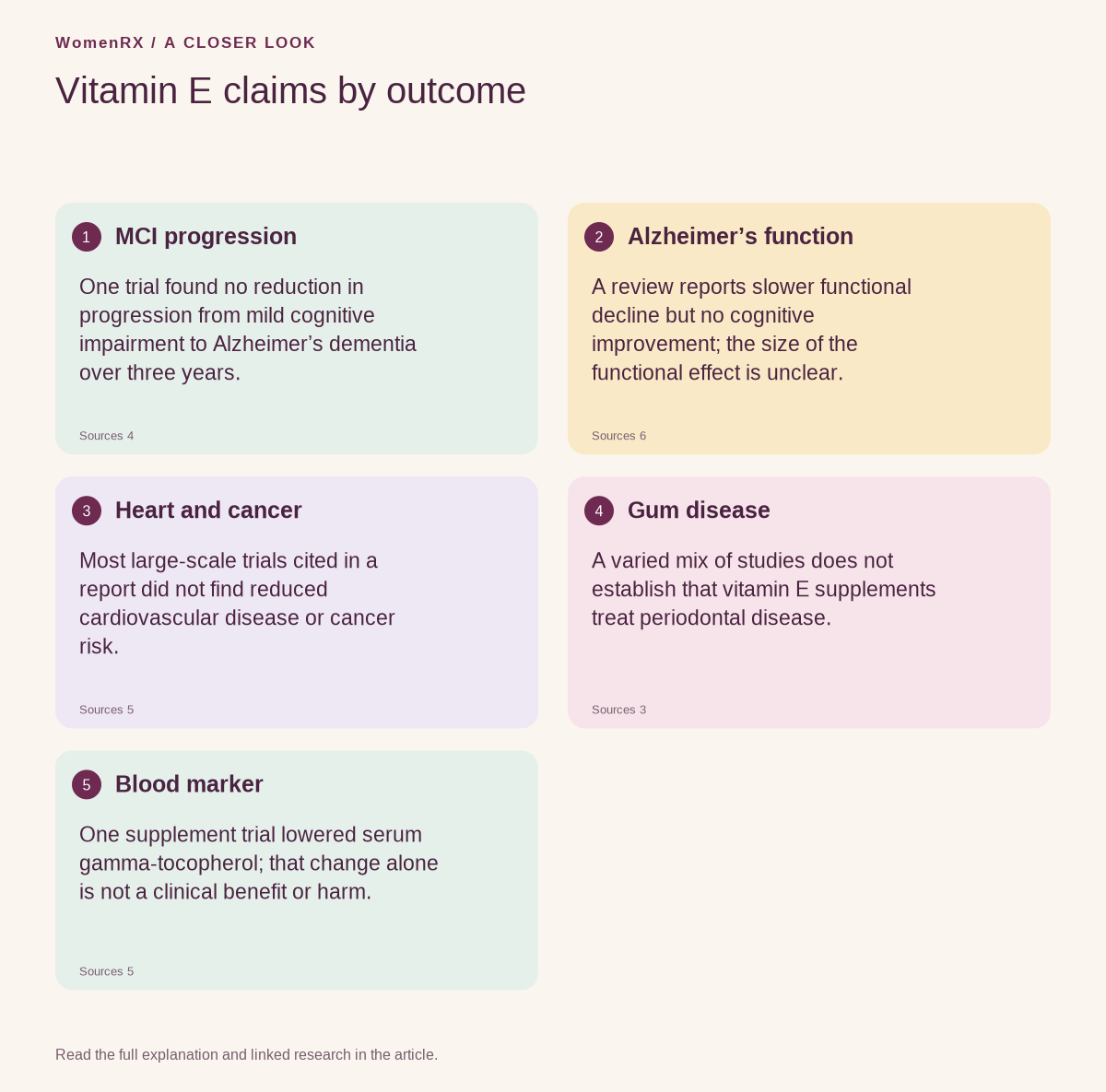
Vitamin E claims by outcome
MCI progression: One trial found no reduction in progression from mild cognitive impairment to Alzheimer’s dementia over three years.4
Alzheimer’s function: A review reports slower functional decline but no cognitive improvement; the size of the functional effect is unclear.6
Heart and cancer: Most large-scale trials cited in a report did not find reduced cardiovascular disease or cancer risk.5
Gum disease: A varied mix of studies does not establish that vitamin E supplements treat periodontal disease.3
Blood marker: One supplement trial lowered serum gamma-tocopherol; that change alone is not a clinical benefit or harm.5
Read the figure as text
Compare what different kinds of human evidence say, and keep prevention, treatment, and lab-marker findings separate.- MCI progression: One trial found no reduction in progression from mild cognitive impairment to Alzheimer’s dementia over three years.4
- Alzheimer’s function: A review reports slower functional decline but no cognitive improvement; the size of the functional effect is unclear.6
- Heart and cancer: Most large-scale trials cited in a report did not find reduced cardiovascular disease or cancer risk.5
- Gum disease: A varied mix of studies does not establish that vitamin E supplements treat periodontal disease.3
- Blood marker: One supplement trial lowered serum gamma-tocopherol; that change alone is not a clinical benefit or harm.5
Sources you can check
- Vitamin E: MedlinePlusAccessed 2026-09-25Return to first citation
- Vitamin K: MedlinePlusAccessed 2026-09-25Return to first citation
- Impact of Tocopherol Supplementation on Clinical Parameters of Periodontal Disease: A Systematic Review and Meta-Analysis.Bumbu BA, Luca MM, Buzatu R. · Journal of personalized medicine · 2024Return to first citation
- Vitamin and mineral supplementation for preventing dementia or delaying cognitive decline in people with mild cognitive impairment.McCleery J, Abraham RP, Denton DA, Rutjes AW, Chong LY, Al-Assaf AS, Griffith DJ, Rafeeq S, Yaman H, Malik MA, Di Nisio M, Martínez G, Vernooij RW, Tabet N. · The Cochrane database of systematic reviews · 2018Return to first citation
- Supplementation of diets with alpha-tocopherol reduces serum concentrations of gamma- and delta-tocopherol in humans.Huang HY, Appel LJ. · The Journal of nutrition · 2003Return to first citation
- Dietary Bioactives in Alzheimer's Disease: A Critical Appraisal of Clinical Trials and Future Nutritional Strategies.Kumari A, Zeng XA. · Nutrients · 2026Return to first citation
- Antioxidant Supplementation in Oxidative Stress-Related Diseases: What Have We Learned from Studies on Alpha-Tocopherol?Meulmeester FL, Luo J, Martens LG, Mills K, van Heemst D, Noordam R. · Antioxidants (Basel, Switzerland) · 2022Return to first citation