Vitamin K2 Foods and How They Differ From K1
Leafy greens are rich in K1, while natto is a standout K2 source, but food tables and bone-health claims don’t always tell the whole story.
Vitamin K1 (phylloquinone) comes mainly from leafy greens and some oils. Vitamin K2 (menaquinones) occurs in natto, some cheeses, and certain animal foods. Natto is a particularly rich source, but K2 amounts in foods vary and are not as well documented as K1. If you take warfarin, keep your vitamin K intake steady rather than making sudden diet or supplement changes. 1
K1 and K2 come from different food patterns
Vitamin K is a family of related compounds. K1, or phylloquinone, is found mainly in plants. Spinach, kale, collard greens, turnip greens, and broccoli are examples of K1-rich foods; soybean and canola oils also contain K1. K2 refers to menaquinones, a group that includes forms such as MK-4 and MK-7. 1
Natto, fermented soybeans, is a standout source of MK-7. Some cheeses and animal foods, including eggs and meat, contain menaquinones too. These are general patterns, not a strict divide: foods can contain different forms, and the amounts in fermented foods can depend on the bacteria and fermentation conditions. 1
A dietary study of participants in Poland found vegetables were the main K1 contributors, while K2 in the diets studied came largely from processed meats and cheeses. That describes one population’s eating patterns, not a universal ranking of foods. 3
Why a vitamin K number may not mean K2
Food comparisons can be tricky because most vitamin K food-composition figures describe K1. In the NIH’s selected-food table, natto is listed for MK-7 and some animal foods are listed for MK-4, but data on menaquinones in foods are limited. So a general vitamin K figure for a food may not tell you how much K2 it provides. 1
For example, choosing spinach or broccoli means choosing foods known for K1. Natto is a more specific K2 source. Cheese, eggs, or meat may contribute K2, but amounts and forms vary. These distinctions help describe what’s on your plate; they don’t show that one form is better for your bones or arteries.
What the bone evidence says for women
Vitamin K helps activate proteins involved in bone, which is one reason researchers have studied it. But a role in a biological process, or a change in a bone-related marker, does not by itself show that K2-rich foods or supplements prevent fractures. 1
In a trial described in the NIH review, 381 postmenopausal women received K1, MK-4, or a placebo for 12 months. All participants also received calcium and vitamin D. Vitamin K changed a bone-related marker, but the groups did not differ significantly in bone mineral density at the measured sites. Other research has reported some favorable bone findings, while trials in older adults have also found no effect on bone mineral density. 1
A systematic review of randomized trials in women described K2 results as promising, but said study limitations meant the findings needed confirmation. Overall, the evidence does not establish that K2 prevents fractures or reliably improves bone outcomes after menopause. And evidence about supplements does not automatically tell us what K2-containing foods do. 1 4
Artery claims need similar care. Some observational studies have linked higher dietary menaquinone intake with less arterial calcification or lower heart-disease mortality, but those associations cannot show that K2 caused the difference. The NIH review says few trials have tested vitamin K supplements for artery calcification or heart-disease risk, and the role of different forms remains unclear. 1
Warfarin makes consistency the key point
Warfarin and similar vitamin K antagonist medicines work by opposing vitamin K’s role in blood clotting. A sudden increase or decrease in vitamin K intake can change the medicine’s anticoagulant effect. The practical point is not to avoid greens, natto, or other vitamin K foods; it’s to keep your usual intake consistent. 1 2
If you take warfarin, talk with the clinician managing it before making a substantial change to your diet or starting or stopping a vitamin K supplement. Don’t change your medicine or vitamin K intake on your own. 1
K1, K2, and warfarin
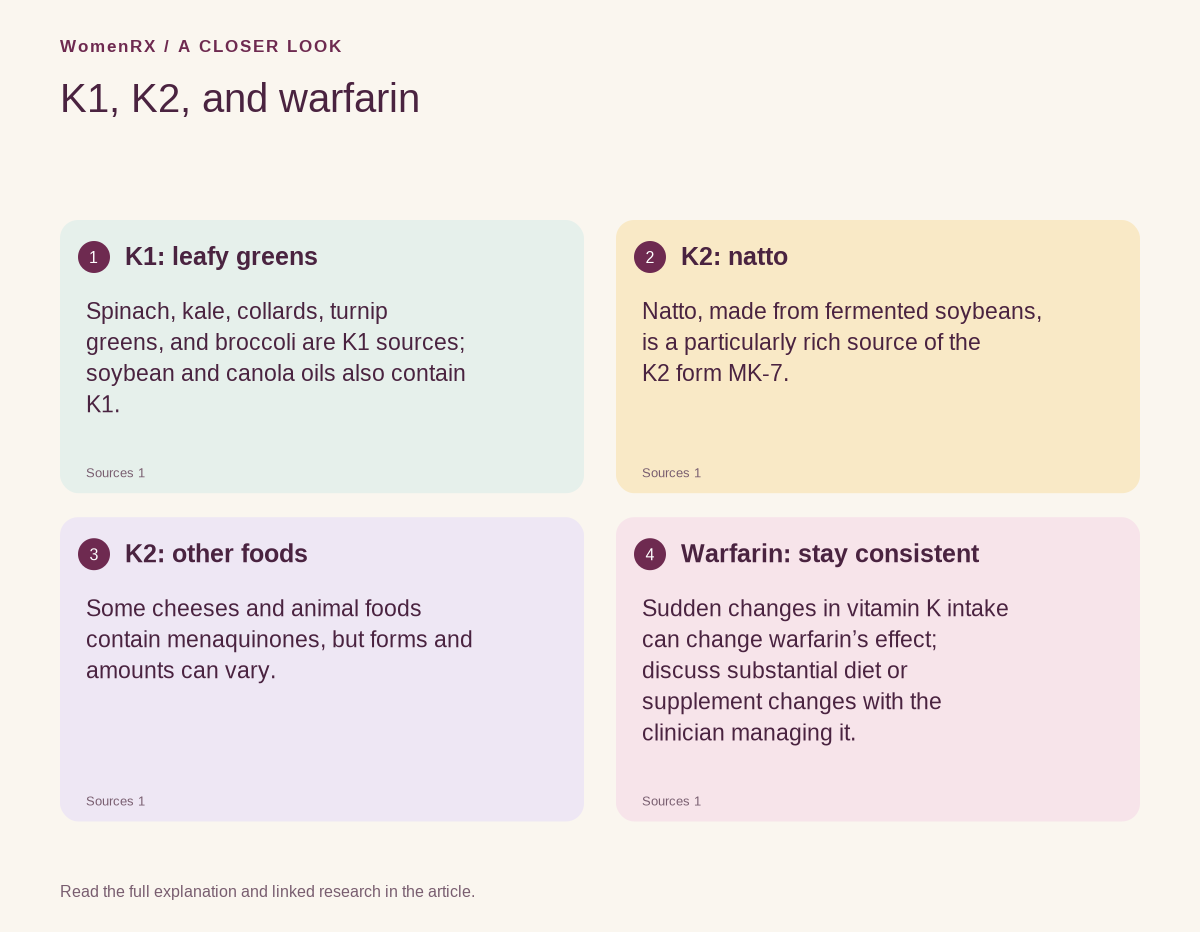
K1: leafy greens: Spinach, kale, collards, turnip greens, and broccoli are K1 sources; soybean and canola oils also contain K1.1
K2: natto: Natto, made from fermented soybeans, is a particularly rich source of the K2 form MK-7.1
K2: other foods: Some cheeses and animal foods contain menaquinones, but forms and amounts can vary.1
Warfarin: stay consistent: Sudden changes in vitamin K intake can change warfarin’s effect; discuss substantial diet or supplement changes with the clinician managing it.1
Read the figure as text
Compare common food sources of K1 and K2, then see why steady intake matters with warfarin.- K1: leafy greens: Spinach, kale, collards, turnip greens, and broccoli are K1 sources; soybean and canola oils also contain K1.1
- K2: natto: Natto, made from fermented soybeans, is a particularly rich source of the K2 form MK-7.1
- K2: other foods: Some cheeses and animal foods contain menaquinones, but forms and amounts can vary.1
- Warfarin: stay consistent: Sudden changes in vitamin K intake can change warfarin’s effect; discuss substantial diet or supplement changes with the clinician managing it.1
More questions, answered
Is natto the only food source of vitamin K2?
No. Natto is a particularly rich source of MK-7, and some cheeses and animal foods contain menaquinones such as MK-4. The forms and amounts vary, and food-composition data for K2 are limited. 1
Should women take K2 for bone health after menopause?
The available evidence does not establish that K2 supplements prevent fractures or reliably improve bone density in postmenopausal women. Research has found mixed results, so K2 is not a proven stand-alone answer for bone health. 1 4
Sources you can check
- Vitamin K - Health Professional Fact SheetAccessed 2026-09-25Return to first citation
- Vitamin K: MedlinePlusAccessed 2026-09-25Return to first citation
- Estimation of Vitamin K Content and Its Sources in the Diet of the Polish Participants of the PURE Study.Regulska-Ilow B, Różańska D, Zatońska K, Szuba A. · Nutrients · 2022Return to first citation
- Natural health products in the prevention and treatment of osteoporosis: systematic review of randomized controlled trials.Whelan AM, Jurgens TM, Bowles SK. · The Annals of pharmacotherapy · 2006Return to first citation