Vitamin K2 From Food: When Might a Supplement Make Sense?
Natto and some animal and fermented foods contain K2, but food intake and supplement research answer different questions.
Vitamin K2, or menaquinone, is one form of vitamin K. Natto is especially rich in it; some cheeses, meats, dairy foods, and eggs contain smaller amounts. There’s no separate K2 intake target in US recommendations, and research hasn’t established a routine reason for every woman to take a K2 supplement for bone health. Warfarin is a key exception: keep vitamin K intake consistent. 14
K2 is one form of vitamin K
Vitamin K includes phylloquinone, known as K1, and menaquinones, known as K2. K1 is the main dietary form and is found mostly in green leafy vegetables and some oils. K2 includes several compounds, including MK-4 and MK-7. Natto, made from fermented soybeans, is high in menaquinones; some other fermented foods and animal foods contain more modest amounts. 1
US intake recommendations are for vitamin K overall, rather than a separate K2 target. That makes the everyday question less about reaching a special K2 number and more about whether you have a specific reason to consider a supplement. 1
Food sources vary, and labels may not fill in the gaps
Natto is a particularly rich food source, but you don’t need to eat it to get vitamin K. Cheese, meat, dairy foods, and eggs can also contain menaquinones. The catch is that K2 amounts vary, and food-composition data for menaquinones are limited. In a study of selected Australian cheese, yoghurt, and meat products, researchers found different vitamin K forms and concentrations across samples, with variation by location. Those results aren’t a standard chart for foods sold in the United States. 12
It can also be hard to work out your intake from a package. US food labels aren’t required to list vitamin K unless it has been added to the food. And many food tables report K1 rather than K2, because data on menaquinones are limited. 1
For a practical approach, include foods you enjoy rather than treating one K2-rich food as a guarantee of adequacy. Greens contribute the main dietary form, K1, while some fermented and animal foods contribute menaquinones. Neither a particular food nor a supplement is established here as a way to guarantee a bone-health benefit. 14
A supplement study isn’t the same as a food recommendation
K2 supplements can provide specific menaquinones such as MK-4 or MK-7, forms that have been studied. But research on concentrated supplements doesn’t show that everyone needs them, or that taking one is equivalent to eating K2-containing foods. 14
The most directly relevant bone evidence in women comes from a 2025 systematic review and meta-analysis of nine randomized trials involving 2,570 postmenopausal women with osteoporosis. K2 supplementation changed several bone-turnover markers, including osteocalcin measures. These markers reflect bone activity; the review says findings for bone density and fractures are inconsistent and that longer studies are needed to establish clinical benefits. The results don’t show that women generally, or women without osteoporosis, should take K2 for bone health. 4
So if you’re considering a supplement because of osteoporosis or a fracture, the key distinction is between a change in a lab marker and a demonstrated improvement in bone density or fracture risk. The research doesn’t establish that a K2 supplement should replace or routinely be added to an individual treatment plan. 4
Warfarin changes the food-and-supplement calculation
If you take warfarin, sudden changes in vitamin K from food or supplements can change the medicine’s anticoagulant effect. Aim for a consistent pattern and speak with the clinician managing your warfarin before making a major dietary change or starting a K2 supplement. 1
Natto deserves particular attention because it can contain high levels of K2. A small trial of a specially developed, lower-K2 natto product in 10 people taking warfarin doesn’t establish that ordinary natto or a K2 supplement is safe to add without guidance. 13
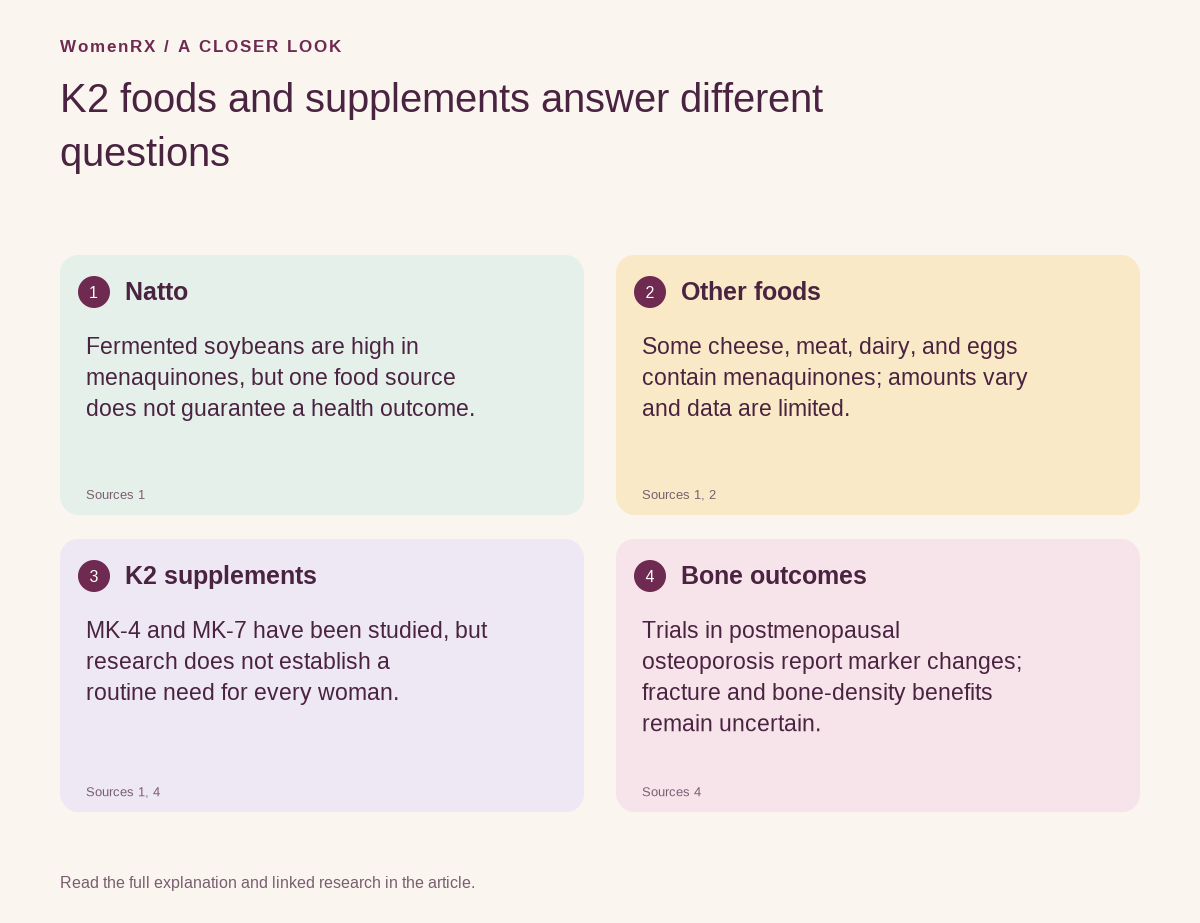
K2 foods and supplements answer different questions
Natto: Fermented soybeans are high in menaquinones, but one food source does not guarantee a health outcome.1
Other foods: Some cheese, meat, dairy, and eggs contain menaquinones; amounts vary and data are limited.12
K2 supplements: MK-4 and MK-7 have been studied, but research does not establish a routine need for every woman.14
Bone outcomes: Trials in postmenopausal osteoporosis report marker changes; fracture and bone-density benefits remain uncertain.4
Read the figure as text
Compare where menaquinones occur in food with what supplement studies can and cannot show about bone health.- Natto: Fermented soybeans are high in menaquinones, but one food source does not guarantee a health outcome.1
- Other foods: Some cheese, meat, dairy, and eggs contain menaquinones; amounts vary and data are limited.12
- K2 supplements: MK-4 and MK-7 have been studied, but research does not establish a routine need for every woman.14
- Bone outcomes: Trials in postmenopausal osteoporosis report marker changes; fracture and bone-density benefits remain uncertain.4
More questions, answered
Does eating greens provide K2?
Greens are mainly a source of vitamin K1, not K2. They still contribute to overall vitamin K intake, while natto and some animal and fermented foods provide menaquinones. 1
Is natto the only food source of K2?
No. Natto is especially rich in menaquinones, while some cheeses and other animal foods contain them in more modest amounts. The amount can vary, and food-composition data are limited. 12
Sources you can check
- Vitamin K - Health Professional Fact SheetAccessed 2026-09-25Return to first citation
- Vitamin K content of cheese, yoghurt and meat products in Australia.Dunlop E, Jakobsen J, Jensen MB, Arcot J, Qiao L, Cunningham J, Black LJ. · Food chemistry · 2022Return to first citation
- First Clinical Trial of a Newly Developed, Low Menaquinone-7, Fermented Soybean Natto in Warfarin-Dependent Patients.Nakajima T, Taya Y, Nishikawa T, Kitamura Y, Kato H, Mathis BJ, Hiramatsu Y. · Journal of medicinal food · 2021Return to first citation
- The effect of vitamin K2 supplementation on bone turnover biochemical markers in postmenopausal osteoporosis patients: a systematic review and meta-analysis.Zhang Z, Li Y, Li J, Yuan Y, Liu K, Shi X. · Frontiers in endocrinology · 2025Return to first citation