Fermented Foods and Menopause: What Studies Actually Measure
Research on mood, hot flashes, gut microbes, and fractures asks different questions, so one food’s findings can’t stand in for all fermented foods.
There’s no basis in these findings for treating fermented foods as a proven remedy for menopause symptoms. A review of mood research in middle-aged and older women describes possible benefits but says the studies are few; menopause guidance does not recommend soy foods for hot flashes. Other research examined gut microbes in a lab or fracture risk, not symptom relief from eating fermented foods. 1 2 3 5
The food and the outcome both matter
“Fermented foods” covers many different products, ingredients, and microbes. A study of one food or a selected bacterial strain can’t establish that yogurt, kimchi, kefir, miso, and fermented soy all have the same effects. Just as important, a change in gut microbes or a link with bone health isn’t proof that a food eases hot flashes, sleep problems, anxiety, or other menopause symptoms.
When you see a menopause-related claim, look for three details: what exactly was consumed, who was studied, and what outcome was measured? Those details help separate a symptom trial in people from an early clue about a different question.
Mood research is promising, but hard to pin to a food
A 2024 narrative review considered psychobiotic supplements and fermented foods in middle-aged and older women. It described possible effects on mood, but said its conclusions rested on only a few studies and called for long-term, well-designed trials. The review’s summary doesn’t establish that a specific fermented food, microbe, or amount reliably improves mood during perimenopause or after menopause. 3
A separate review focused on anxiety during perimenopause and discussed fermented products alongside other approaches, including fiber-rich foods, dietary patterns, and probiotic or prebiotic formulations. Because it considers multiple interventions, it can’t isolate fermented foods as the cause of any potential effect. Its authors also describe trials specifically targeting perimenopausal people as limited. 4
These reviews make mood a reasonable area for further study, not a settled food recommendation. They also leave a practical gap: the summaries don’t let you compare a particular food, strain, or serving with a specific menopause-related mood outcome.
Hot flashes: guidance on soy is not a trial of every fermented food
The North American Menopause Society’s 2023 statement does not recommend soy foods or soy extracts for vasomotor symptoms, the term that includes hot flashes and night sweats. It also lists dietary modification as not recommended for those symptoms, based on Level III evidence. 1
That guidance is relevant when a product claim centers on soy, but it isn’t a direct test of every fermented soy food. And it says nothing specific about unrelated fermented foods. The careful takeaway is that soy foods are not an established hot-flash treatment in this guidance, not that a trial has disproved every possible product or outcome. 1
A gut-microbe result is not a menopause symptom result
One study tested soy beverages containing selected bacteria using a laboratory model made with fecal samples from postmenopausal women. The researchers measured changes in microbial composition and activity, and responses varied among donors. The study did not test whether women drank the beverages or experienced relief from menopause symptoms. 5
That makes the study useful as an early look at how particular products might interact with gut microbes, but it cannot establish a benefit for mood, hot flashes, or another symptom in daily life. A biological mechanism can help explain why researchers want to study a food; it doesn’t substitute for measuring the outcome people care about.
Bone findings answer a separate question
A systematic review of five prospective cohort studies reported suggestive associations between soy-food intake and lower fracture risk among women in Asian populations. Some analyses included fermented soy products. The studies examined fracture outcomes, not menopause symptoms, and observational associations can’t show that the food itself caused the difference. 2
So this finding may be relevant to research on soy and bone health, but it shouldn’t be presented as evidence that fermented foods relieve menopause symptoms. Keeping those outcomes separate is one of the simplest ways to assess a confident-sounding nutrition claim.
A quick way to check a claim
Before treating a headline or product claim as relevant to your symptoms, ask:
- Which food or microbe? A result for one product or selected strain may not apply to another.
- Who took part? Middle-aged or older participants aren’t necessarily all perimenopausal or postmenopausal.
- What did researchers measure? Mood, hot flashes, gut-microbe changes, and fractures are different outcomes.
- Was the outcome measured in people? A lab model or an observational link can suggest a research question, but doesn’t establish symptom relief.
If you enjoy fermented foods, you don’t need a menopause claim to decide whether they belong in your meals. The research described above doesn’t support treating them as a proven symptom therapy or assuming that results for one food apply to the whole category.
What each study can tell you
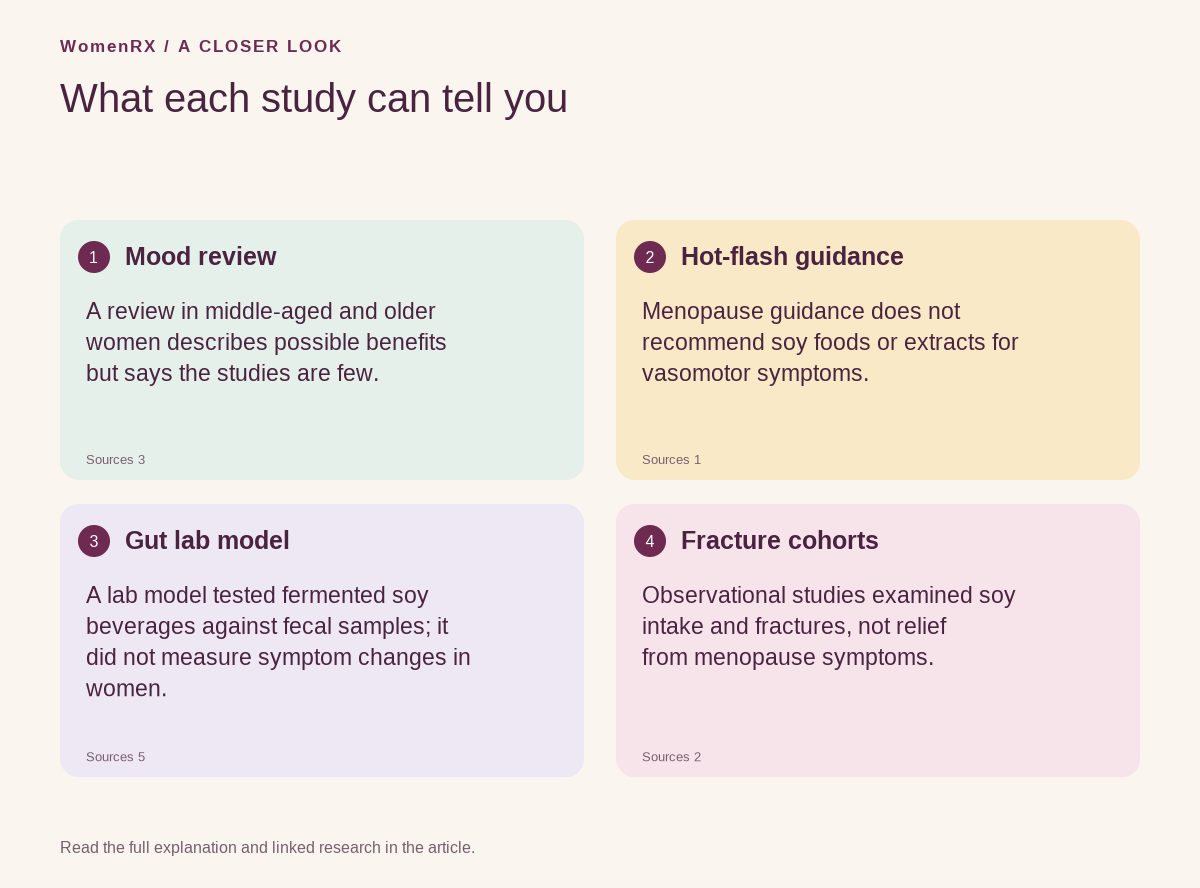
Mood review: A review in middle-aged and older women describes possible benefits but says the studies are few.3
Hot-flash guidance: Menopause guidance does not recommend soy foods or extracts for vasomotor symptoms.1
Gut lab model: A lab model tested fermented soy beverages against fecal samples; it did not measure symptom changes in women.5
Fracture cohorts: Observational studies examined soy intake and fractures, not relief from menopause symptoms.2
Read the figure as text
These findings concern different foods, populations, and outcomes. Compare what was actually measured before applying a result to menopause symptoms.- Mood review: A review in middle-aged and older women describes possible benefits but says the studies are few.3
- Hot-flash guidance: Menopause guidance does not recommend soy foods or extracts for vasomotor symptoms.1
- Gut lab model: A lab model tested fermented soy beverages against fecal samples; it did not measure symptom changes in women.5
- Fracture cohorts: Observational studies examined soy intake and fractures, not relief from menopause symptoms.2
Sources you can check
- The 2023 nonhormone therapy position statement of The North American Menopause Society.Menopause (New York, N.Y.) · 2023Return to first citation
- Soy Foods and the Risk of Fracture: A Systematic Review of Prospective Cohort Studies.Akhavan Zanjani M, Rahmani S, Mehranfar S, Zarrin M, Bazyar H, Moradi Poodeh B, Zare Javid A, Hosseini SA, Sadeghian M. · Complementary medicine research · 2022Return to first citation
- Could psychobiotics and fermented foods improve mood in middle-aged and older women?Zidan S, Hilary S, Al Dhaheri AS, Cheikh Ismail L, Ali HI, Apostolopoulos V, Stojanovska L. · Maturitas · 2024Return to first citation
- The Gut Microbiota in Perimenopausal Anxiety: A Novel Therapeutic Pathway Through Diet.Marano G, d'Abate C, Ianes I, Sorrenti G, Traversi G, Esposito R, Pavese F, D'Angelo T, Fuso P, Franceschini G, Paris I, Mazza M. · Nutrients · 2026Return to first citation
- Impact of Fermented Soy Beverages Containing Selected Vaginal Probiotics on the In Vitro Fecal Microbiota of Post-Menopausal Women.D'Alessandro M, Gottardi D, Arboleya S, Alvarado-Jasso GM, Parolin C, Vitali B, Lanciotti R, Gueimonde M, Patrignani F. · Foods (Basel, Switzerland) · 2025Return to first citation