B12 in Perimenopause and Menopause: When to Check
Fatigue, memory slips, or tingling can overlap with this life stage, but B12 is most worth checking when symptoms come with a dietary or absorption risk.
Perimenopause and menopause alone don’t establish that your B12 is low. B12 is more worth checking if fatigue, memory concerns, or tingling occur alongside a vegan or vegetarian diet, digestive disease or surgery, or long-term use of medicines such as metformin or proton pump inhibitors. Symptoms can’t diagnose deficiency; a blood test, and sometimes a follow-up test, can help clarify it. 1
The symptom is a clue, not an answer
Fatigue and memory concerns can have many causes. Fatigue may reflect sleep loss, stress, or a range of health conditions, while occasional forgetfulness can be ordinary. B12 deficiency can also cause fatigue and neurological changes, including numbness or tingling in the hands and feet. Those symptoms overlap, so noticing them during the menopause transition doesn’t tell you what’s causing them. 1 2 3
Tingling deserves particular attention when it persists or is new: B12-related neurological symptoms can occur even without anemia. That means a normal-looking blood count alone may not settle the question. 1
Look for a reason B12 might be low
Your menopause stage isn’t, by itself, evidence of B12 deficiency. More useful clues are whether you eat few or no animal-derived foods, have a digestive condition or history of gastrointestinal surgery, or use certain medicines for a prolonged time. The NIH Office of Dietary Supplements identifies vegetarian diets, absorption problems, pernicious anemia, gastrointestinal disorders or surgery, and prolonged metformin or proton pump inhibitor use among relevant risk factors. 1
There are different ways absorption can be affected. B12 in food is attached to protein; some people have difficulty absorbing it from food but absorb free B12 normally. Pernicious anemia can interfere with intrinsic factor, which is needed for B12 absorption, and can prevent absorption of both food-bound and free B12. So “I eat well” doesn’t rule out a problem if absorption is the issue. 1
What testing can clarify
A blood test measuring serum or plasma B12 is commonly used. The cutoff depends on the laboratory, though many labs consider results below 200 or 250 pg/mL subnormal. If a result falls between 150 and 399 pg/mL, a clinician may use methylmalonic acid (MMA) to help clarify whether deficiency is present. MMA isn’t perfect: kidney problems can raise it, and levels tend to be higher in older adults. 1
That’s why it helps to mention both your symptoms and your risk factors, rather than asking for a number to be interpreted on its own. If tingling or numbness is part of the picture, say so clearly; neurological effects can happen without anemia, and early recognition matters. 1
What a supplement can, and can’t, do
B12 supplements can provide the vitamin, but taking one doesn’t show that your symptoms were caused by low B12. If a problem with absorption is involved, the cause matters: some people absorb free B12 even when they have trouble absorbing the vitamin from food, while pernicious anemia can impair both routes. A clinician can interpret the test and the likely cause together. 1
There’s no basis here for treating B12 as a general remedy for menopause-related fatigue or memory concerns. In a study of 287 peri- and postmenopausal Polish women, 96% had normal B12 concentrations; the study was observational and doesn’t establish that B12 supplements improve memory or other menopause symptoms. 5 A separate review of supplement trials in women reported no anxiety reduction from B12 in older women, but that finding doesn’t answer every symptom or establish what happens in women with a confirmed deficiency. 4
If your fatigue has lasted for weeks, or memory changes are interfering with daily life, it’s reasonable to look beyond B12 as well. Fatigue has many possible causes, and a B12 result is only one piece of the picture. 2 3
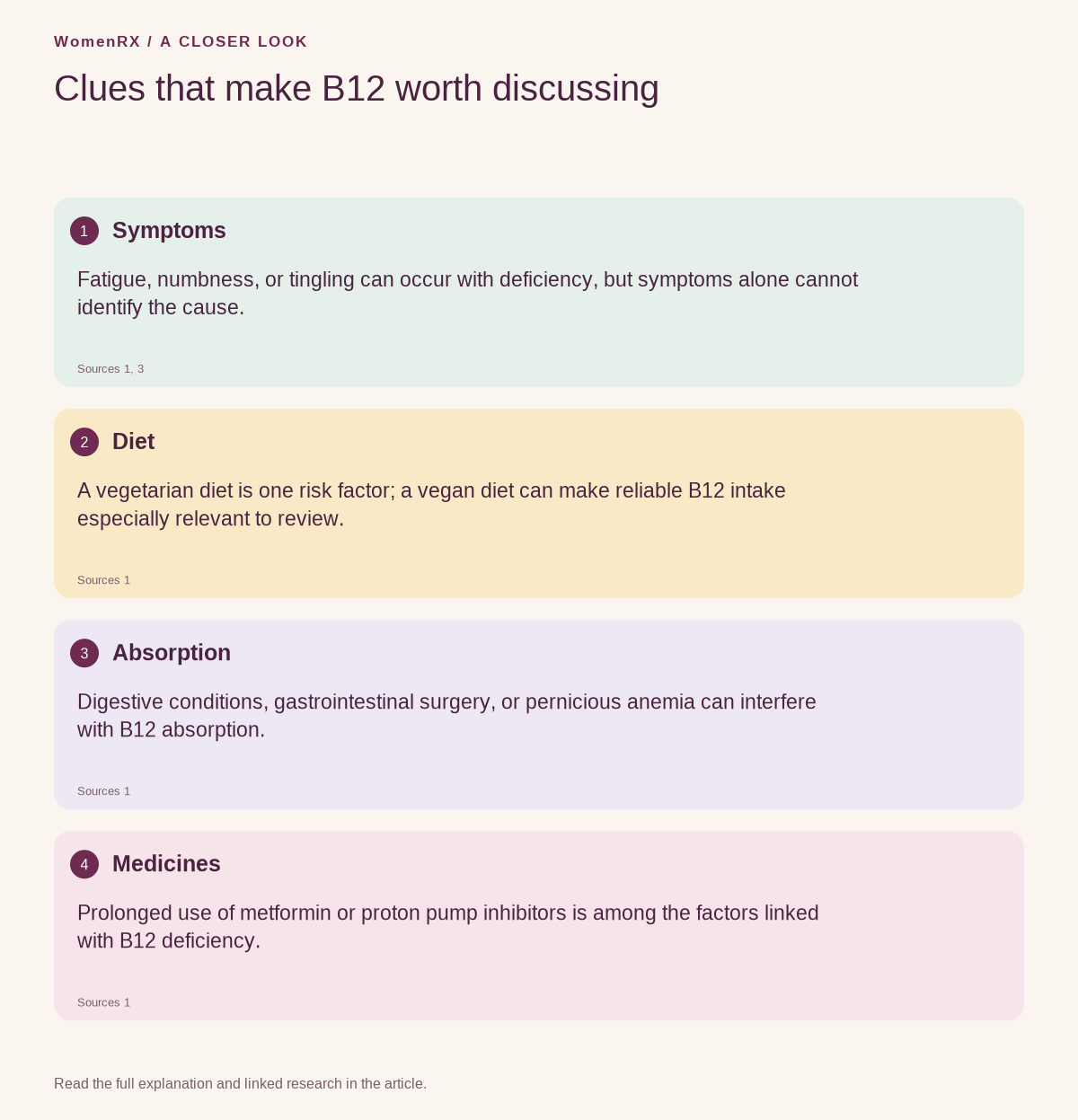
Clues that make B12 worth discussing
Symptoms: Fatigue, numbness, or tingling can occur with deficiency, but symptoms alone cannot identify the cause.13
Diet: A vegetarian diet is one risk factor; a vegan diet can make reliable B12 intake especially relevant to review.1
Absorption: Digestive conditions, gastrointestinal surgery, or pernicious anemia can interfere with B12 absorption.1
Medicines: Prolonged use of metformin or proton pump inhibitors is among the factors linked with B12 deficiency.1
Read the figure as text
These prompts organize a conversation about testing. They are not a diagnostic checklist, and no single item proves deficiency.- Symptoms: Fatigue, numbness, or tingling can occur with deficiency, but symptoms alone cannot identify the cause.13
- Diet: A vegetarian diet is one risk factor; a vegan diet can make reliable B12 intake especially relevant to review.1
- Absorption: Digestive conditions, gastrointestinal surgery, or pernicious anemia can interfere with B12 absorption.1
- Medicines: Prolonged use of metformin or proton pump inhibitors is among the factors linked with B12 deficiency.1
More questions, answered
Can B12 deficiency cause tingling even if I don’t have anemia?
Yes. B12-related numbness or tingling can occur without anemia, so the absence of anemia does not rule it out. 1
Does a borderline B12 result always mean deficiency?
Not necessarily. Lab cutoffs vary, and a clinician may use an MMA test to clarify a result in the 150-399 pg/mL range. Kidney function can affect MMA, so it needs context too. 1
Sources you can check
- Vitamin B12 - Health Professional Fact SheetAccessed 2026-09-25Return to first citation
- Memory | MedlinePlusAccessed 2026-09-25Return to first citation
- Fatigue: MedlinePlusAccessed 2026-09-25Return to first citation
- The impact of essential fatty acid, B vitamins, vitamin C, magnesium and zinc supplementation on stress levels in women: a systematic review.McCabe D, Lisy K, Lockwood C, Colbeck M. · JBI database of systematic reviews and implementation reports · 2017Return to first citation
- Impact of Serum Vitamin D, B6, and B12 and Cognitive Functions on Quality of Life in Peri- and Postmenopausal Polish Women.Raczkiewicz D, Gujski M, Sarecka-Hujar B, Suski K, Pedrycz-Wieczorska A, Wdowiak A, Bojar I. · Medical science monitor : international medical journal of experimental and clinical research · 2024Return to first citation