Digestive Enzymes: Which Products Have a Clear Use?
Lactase and pancreatic enzyme replacement address different digestive problems; a broad blend doesn’t tell you which one you have.
Start with what seems to need help being digested, not with a broad enzyme blend. Lactase is an option for lactose-related symptoms. Pancreatic enzyme replacement is a treatment for pancreatic exocrine insufficiency, which needs assessment in the context of symptoms and health history. Ongoing greasy stools, weight loss, or nutritional concerns are reasons to seek an evaluation rather than test supplements on yourself. 1 4
One label can hide very different jobs
Digestive enzymes aren’t interchangeable. Lactase is an option for lactose-related disorders. Pancreatic enzymes aid digestion. That’s why a product chosen for symptoms after milk isn’t a substitute for pancreatic enzyme replacement, and neither one explains every case of bloating or diarrhea. 1 4
The useful first question is whether your symptoms point to a particular digestive problem. Two situations have a clearer role for enzymes: symptoms linked to lactose and diagnosed pancreatic exocrine insufficiency (PEI). They call for different next steps.
Pregnancy, postpartum, or menopause doesn’t, by itself, identify which digestive problem you have. The clinical findings discussed here don’t establish a different enzyme choice for those life stages. A repeating symptom pattern and your health history are more useful starting points than a product marketed “for women.” 1 4
If symptoms follow dairy, think specifically about lactose
For example, bloating or diarrhea after milk may raise a question about lactose tolerance, though research in adults with IBS shows symptoms aren’t enough to confirm it. 3 A guideline on lactose-related disorders describes several individualized options, including reducing lactose selectively, using lactase, and choosing fermented dairy products. You don’t necessarily need to give up all dairy to address a lactose-related problem. 1
The pattern is a clue, not a diagnosis. In a systematic review of six studies involving 845 adults with irritable bowel syndrome (IBS), self-reported lactose intolerance had only moderate accuracy, and reported symptoms often didn’t match breath-test findings. The review did not support routinely recommending a lactose-free diet or breath testing to everyone with IBS without a clear indication. 3
There’s a nutritional tradeoff to broad dairy avoidance, too. A review of 13 observational studies in adults found that lactose intolerance was generally associated with lower calcium intake. Findings on bone outcomes were inconsistent, so the review does not establish that lactose intolerance itself causes poor bone health. If you’re cutting out dairy long term, pay attention to where your calcium will come from. 2
If stools are greasy or weight is falling, consider malabsorption
PEI means pancreatic enzymes aren’t available or active in sufficient amounts for normal digestion. It can cause greasy stools, bloating, abdominal discomfort, weight loss, and nutritional deficiencies. A history of chronic pancreatitis, cystic fibrosis, pancreatic surgery, or pancreatic cancer makes it more relevant to consider, but those symptoms alone cannot identify PEI. 4 5
This is a different decision from trying lactase. Pancreatic enzyme replacement therapy (PERT) is used to address pancreatic digestive insufficiency. Assessment considers symptoms, nutritional status, pancreatic function, and the broader clinical picture. 4 6
One commonly used initial test, fecal elastase-1, measures pancreatic enzyme secretion rather than showing directly how well you digest food. In a meta-analysis of 13 studies involving 888 patients, the test’s accuracy varied with the cutoff and clinical context. A result therefore needs interpretation alongside your history and symptoms, particularly when PEI was unlikely to begin with. 4
Choose the next question, not the biggest blend
If symptoms repeatedly follow lactose-containing foods, the focused question is whether lactose is responsible and which dietary or lactase option fits. If symptoms happen across many foods, don’t force them into a lactose explanation. If you have ongoing greasy stools, unexplained weight loss, or nutritional concerns, ask about an evaluation for malabsorption, especially if you have a pancreatic condition or relevant surgery in your history. 1 3 4
A broad over-the-counter blend doesn’t establish why you have symptoms or replace a condition-specific evaluation.
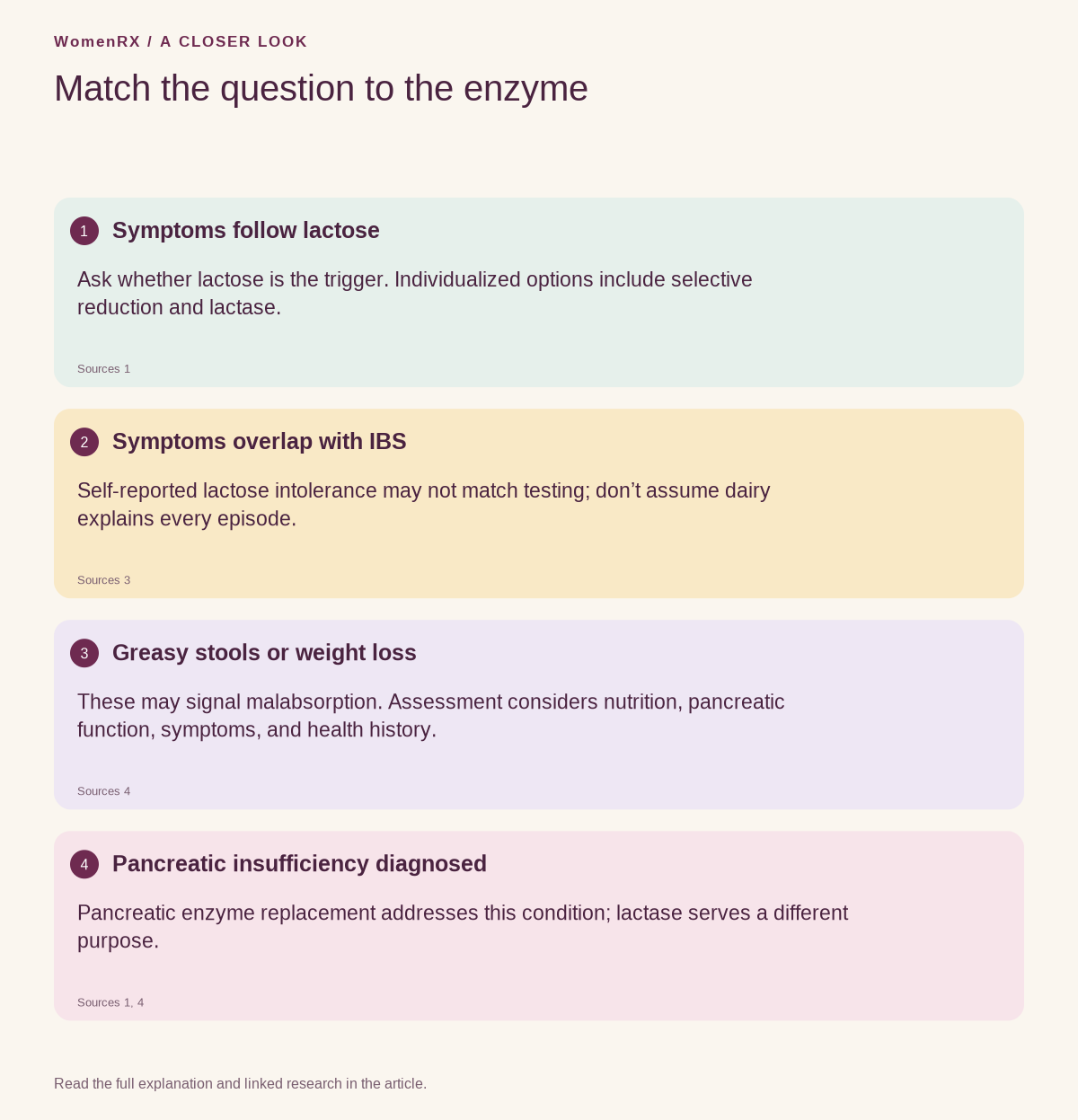
Match the question to the enzyme
Symptoms follow lactose: Ask whether lactose is the trigger. Individualized options include selective reduction and lactase.1
Symptoms overlap with IBS: Self-reported lactose intolerance may not match testing; don’t assume dairy explains every episode.3
Greasy stools or weight loss: These may signal malabsorption. Assessment considers nutrition, pancreatic function, symptoms, and health history.4
Pancreatic insufficiency diagnosed: Pancreatic enzyme replacement addresses this condition; lactase serves a different purpose.14
Read the figure as text
Use the symptom pattern and health history to decide what deserves a closer look, rather than treating every digestive symptom with the same product.- Symptoms follow lactose: Ask whether lactose is the trigger. Individualized options include selective reduction and lactase.1
- Symptoms overlap with IBS: Self-reported lactose intolerance may not match testing; don’t assume dairy explains every episode.3
- Greasy stools or weight loss: These may signal malabsorption. Assessment considers nutrition, pancreatic function, symptoms, and health history.4
- Pancreatic insufficiency diagnosed: Pancreatic enzyme replacement addresses this condition; lactase serves a different purpose.14
More questions, answered
Does bloating after eating mean I need an enzyme?
No. Bloating occurs in lactose-related disorders, IBS, and PEI, among other digestive problems. What you ate, whether the pattern repeats, and your health history are more informative than bloating alone. 3 4
Sources you can check
- Clinical guideline of the Asociación Mexicana de Gastroenterología for the diagnosis and treatment of lactose ingestion-related disorders.Remes-Troche JM, Amieva-Balmori M, Uscanga-Domínguez LF, Coss-Adame E, Bernal-Reyes R, Carmona-Sánchez R, Francisco MR, García-Zermeño KR, Gómez-Castaños PC, Gómez-Escudero O, Huer... · Revista de gastroenterologia de Mexico (English) · 2026Return to first citation
- Calcium, Vitamin D, and Phosphorus Levels and Bone Health in Adults with Lactose Intolerance: A Systematic Review.Almalki AH, Apekey T, Ranawana V. · Nutrition reviews · 2026Return to first citation
- Self-Perceived Lactose Intolerance Versus Confirmed Lactose Intolerance in Irritable Bowel Syndrome: A Systematic Review.Pop A, Popa SL, Pop DD, Ismaiel A, Nechita VI, Dumitrascu DL. · Journal of gastrointestinal and liver diseases : JGLD · 2024Return to first citation
- Diagnostic Accuracy of Fecal Elastase-1 Test for Pancreatic Exocrine Insufficiency: A Systematic Review and Meta-Analysis.de la Iglesia D, Agudo-Castillo B, Galego-Fernández M, Rama-Fernández A, Domínguez-Muñoz JE. · United European gastroenterology journal · 2025Return to first citation
- Unique causes of exocrine pancreatic insufficiency: When to consider pancreatic enzyme supplementation: A narrative review.Williams V, Funk S. · Nutrition in clinical practice : official publication of the American Society for Parenteral and Enteral Nutrition · 2026Return to first citation
- [Exocrine pancreas insufficiency: clinical significance and approaches to correction from evidence medicine].Maev IV, Kucheryavyy YA, Andreev DN. · Terapevticheskii arkhiv · 2021Return to first citation