Digestive Enzymes: Which Ones Match the Evidence?
Lactase and pancreatic enzyme replacement have specific uses; results for one enzyme don’t establish a benefit for every digestive symptom.
The clearest matches are lactase for lactose-related symptoms and pancreatic enzyme replacement for diagnosed exocrine pancreatic insufficiency (EPI). A placebo-controlled adult trial found that lactase improved symptoms, while clinical guidance recommends pancreatic enzymes for diagnosed EPI. An enzyme blend has shown encouraging results in people with IBS, but its uncontrolled study cannot show that the blend caused the improvement. None of these findings establishes a women-specific benefit. 2 3 4
Start with the digestive job
“Digestive enzymes” isn’t one treatment. Lactase breaks down lactose, the sugar in milk. Pancreatic enzyme replacement therapy supplies digestive enzymes when the pancreas doesn’t deliver enough to digest nutrients. A result with either one can’t be applied to every product labeled “digestive enzymes.” 2 3
When you’re weighing a product claim, ask three questions: Which enzyme is it? What problem is it meant to address? What outcome was actually studied? The answers are quite different for lactose intolerance, pancreatic insufficiency, and IBS.
Lactase: evidence for lactose-related symptoms
When lactase activity is low, lactose can pass undigested into the colon. Bacteria ferment it, contributing to gas, bloating, abdominal pain, and diarrhea after consuming dairy. Lactase has a specific job: helping break down that lactose. 2
In a randomized, double-blind crossover trial, 47 adults with confirmed lactose intolerance received lactase and placebo at separate visits. Symptom scores and hydrogen breath levels improved with lactase. Cumulative hydrogen breath levels over 180 minutes were 55% lower with lactase than with placebo. That breath-test result measures lactose digestion in this trial; it doesn’t mean every symptom fell by 55%. The study included 30 men and did not report a separate treatment effect for women. 2
The distinction matters if your bloating doesn’t consistently follow dairy. This trial supports lactase for the lactose intolerance it studied, not for unexplained bloating from any cause. 2
A separate randomized trial compared lactase with lactose-free formula in 50 children aged 6 to 24 months who had persistent diarrhea associated with secondary lactose intolerance. By day five, diarrhea episodes were less frequent in the lactase group; the other reported complaints were statistically similar between groups. It’s a result for young children with a particular illness, not evidence about routine adult digestive discomfort. 1
Pancreatic enzymes: replacement for diagnosed EPI
EPI means the pancreas isn’t delivering enough digestive enzymes to the intestine, which can lead to poor digestion and nutrient deficiencies. The American Gastroenterological Association (AGA) advises considering it in settings such as chronic pancreatitis, cystic fibrosis, previous pancreatic surgery, and pancreatic ductal adenocarcinoma. Possible features include greasy stools, diarrhea, weight loss, bloating, and nutritional deficiencies. Those symptoms can raise the question, but they don’t confirm the diagnosis. 3
The AGA update identifies fecal elastase testing on a semi-solid or solid stool sample as the most appropriate initial test. A result below 100 micrograms per gram provides good evidence of EPI; a result from 100 to 200 is indeterminate. It also cautions that feeling better during a trial of pancreatic enzymes is not a reliable way to diagnose EPI. 3
Once EPI is diagnosed, the AGA recommends pancreatic enzyme replacement. Success means more than less bloating: the update points to improvement in greasy stools and related symptoms, weight and muscle measures, and fat-soluble vitamin levels. That’s why pancreatic enzyme replacement is different from trying a general supplement for occasional discomfort. 3
Enzyme blends for IBS: an early signal
A study published in 2026 followed people with IBS who had bought an enzyme blend intended to break down FODMAPs, a group of fermentable carbohydrates. Participants completed symptom surveys before using the blend and after four weeks. They reported improvements in several symptoms, including bloating and flatulence. 4
But everyone in this open-label study used the blend. Without a placebo or other comparison group, the findings can’t separate the blend’s effect from expectations, changes over time, or other influences. They’re a reason to study this approach further, not proof that the blend treats IBS. Nor can a finding for one blend establish that another enzyme product will work. 4
Alpha-galactosidase is another name you might see on an enzyme label. An ingredient name alone doesn’t tell you whether the finished product has been shown to help your particular symptoms. Look for a study that matches both the enzyme and the condition, rather than relying on a broad “digestive support” claim.
Does the evidence say anything different for women?
The adult lactase trial included women but did not report whether lactase worked differently by sex. The pediatric trial included children of both genders, not adult women. The AGA’s EPI recommendations and the reported IBS blend results do not establish a women-specific treatment effect. These findings can help you match an enzyme to a digestive problem, but they don’t show a distinct benefit during pregnancy, postpartum, perimenopause, or after menopause. 1 2 3 4
If symptoms include greasy stools, unexplained weight loss, or signs of poor nutrition, the useful next question isn’t which blend to buy. It’s whether a condition such as EPI needs evaluation. If discomfort is tied specifically to lactose, lactase has more direct evidence for that match. 2 3
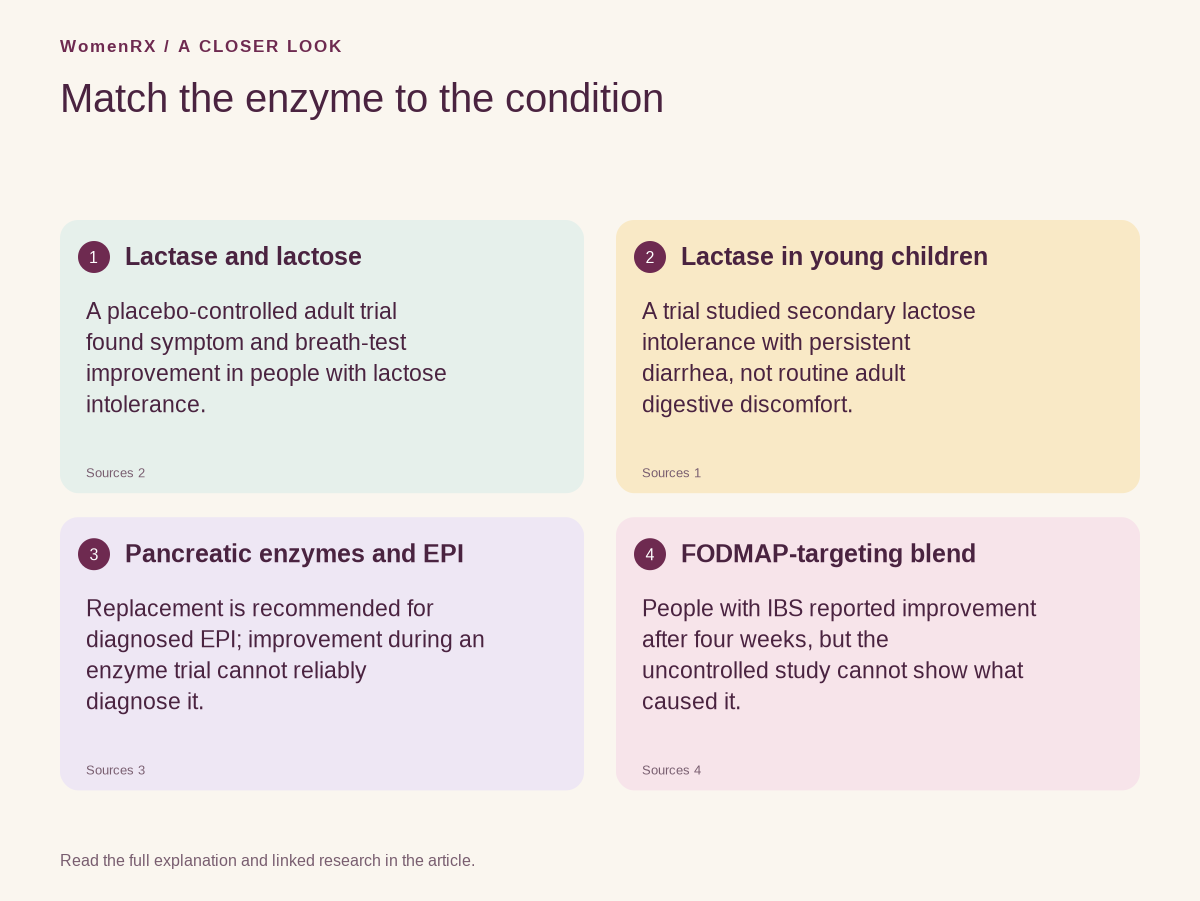
Match the enzyme to the condition
Lactase and lactose: A placebo-controlled adult trial found symptom and breath-test improvement in people with lactose intolerance.2
Lactase in young children: A trial studied secondary lactose intolerance with persistent diarrhea, not routine adult digestive discomfort.1
Pancreatic enzymes and EPI: Replacement is recommended for diagnosed EPI; improvement during an enzyme trial cannot reliably diagnose it.3
FODMAP-targeting blend: People with IBS reported improvement after four weeks, but the uncontrolled study cannot show what caused it.4
Read the figure as text
Each row pairs a digestive problem with the enzyme studied and what the evidence can tell you.- Lactase and lactose: A placebo-controlled adult trial found symptom and breath-test improvement in people with lactose intolerance.2
- Lactase in young children: A trial studied secondary lactose intolerance with persistent diarrhea, not routine adult digestive discomfort.1
- Pancreatic enzymes and EPI: Replacement is recommended for diagnosed EPI; improvement during an enzyme trial cannot reliably diagnose it.3
- FODMAP-targeting blend: People with IBS reported improvement after four weeks, but the uncontrolled study cannot show what caused it.4
Sources you can check
- Comparison of the effectiveness of oral lactase enzyme and lactose-free formula in the management of secondary lactose intolerance in persistent and severe persistent diarrhea.Siddiqi FG, Rais H, Anwar T, Khan AA. · Pakistan journal of medical sciences · 2026Return to first citation
- Effect of lactase on symptoms and hydrogen breath levels in lactose intolerance: A crossover placebo-controlled study.Baijal R, Tandon RK. · JGH open : an open access journal of gastroenterology and hepatology · 2021Return to first citation
- AGA Clinical Practice Update on the Epidemiology, Evaluation, and Management of Exocrine Pancreatic Insufficiency: Expert Review.Whitcomb DC, Buchner AM, Forsmark CE. · Gastroenterology · 2023Return to first citation
- FODMAP-Targeting Digestive Enzyme Blend for Management of Gastrointestinal Symptoms: A "Real-World" Pre-Post Intervention Cohort Study.Kaye AJ, Meyers SR, Hachuel D, Wells J, Wallach T, Thor S. · Gastro hep advances · 2026Return to first citation